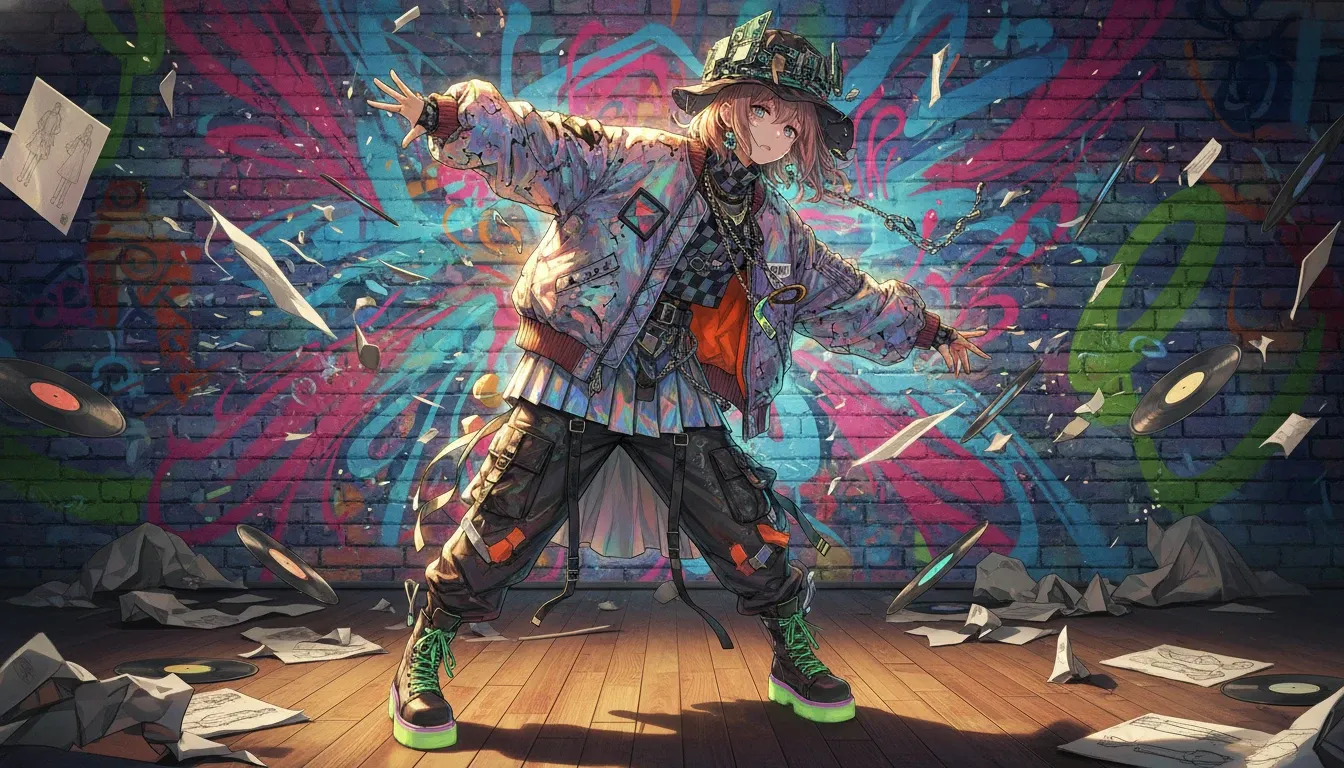
Kaori Miyazono in avant-garde streetwear, chaotic blend of styles, vibrant contrasting colors, textures of reflective fabrics, oversized jacket with flaking coating, eclectic accessories, dynamic pose in a cluttered urban setting, warm museum lighting highlighting failed designs, vinyl records scattered, hints of emotional instability, graffiti backdrop, surreal ambiance, shadows dancing, capturing her essence as a disruptive melody against the rhythm of the city
The Day I Learned to Wear a Wrong Note
It started with me crouched on the floor, sliding open a clear acrylic box like I was handling evidence. The plastic squeaked—just a little—and for a second I wondered if I was being ridiculous. A grown adult, archiving mistakes like they’re fossils.
Inside: a phone that tried to project holograms but only managed a faint blue smudge. A sneaker with a “self-lacing” motor that whined like a trapped mosquito and died after two weeks. A jacket whose reflective coating flaked off in the rain and left the wearer looking like a fish that had been poorly scaled.
I keep my failures in those boxes because the boxes make them look important. Museum lighting for bad ideas. And yes, there’s something faintly embarrassing about that, but—this is the part I can’t sand down—failure has more fingerprints on it than success ever does.
When I tell people I collect failed products, they assume I’m chasing irony. I’m not. I’m chasing the moment where someone tried too hard—where ambition bruised itself against physics, cost, taste, or timing. That’s where design feels most human to me: sweaty, stubborn, slightly delusional.
And that’s why Kaori Miyazono, in my head, belongs in avant-garde streetwear chaos more than she belongs in any clean “anime fashion” moodboard. Kaori is a wrong note you can’t unhear. The kind you end up building an outfit around.
I Don’t Want Her “Cute.” I Want Her Unstable.
The popular instinct is to dress Kaori as “bright.” Yellow, sun, cheer, ribbon. Polished and readable.
But I’ve watched too many products fail because they tried to be readable.
Kaori—at least the Kaori I carry around like a contraband vinyl—has the emotional geometry of something that refuses to fit its own packaging. She’s not a mascot. She’s a rupture. She walks into a room and the room’s rhythm has to renegotiate itself.
So if I’m turning melodies into style, I’m not translating her into something harmonious. I’m doing the opposite: I’m letting her energy jam the silhouette, crash into the seam lines, interrupt the palette like a violin bow that catches and squeals for half a beat before the music recovers.
That squeal is the point.
And—this is where I hesitate a little, because it sounds like I’m romanticizing discomfort—I don’t mean “unstable” as a pose. I mean it as a condition. Like standing too close to a speaker stack and feeling your ribcage vibrate.
The Closet as a Test Lab (Where Most Prototypes Die)
My apartment smells like old cardboard, cedar blocks, and the metallic bite of zipper teeth. I’m typing this with my neck a little stiff, because I’ve been hunched over a rack for an hour trying to decide if a strap should sit two centimeters higher. Two centimeters. That’s the kind of obsession that makes a person hard to live with.
I’ve got racks that look like a backstage corridor: straps, buckles, asymmetry, half-finished ideas.
I design outfits the way doomed products are designed: with too many mechanisms and a suspicion of simplicity. If it can’t fail spectacularly, I’m not fully interested.
A Cold Detail Most People Never Hear About (But Designers Argue Over)
In apparel design there really is a persistent argument about “intentional discomfort.” Not the theatrical runway kind—actual, wearable discomfort that makes you hyper-aware of your body: a collar that presses, a waistband that refuses to forget you, a strap that keeps announcing itself when you inhale.
Some pattern cutters consider it unethical. Others call it honest, a way to keep clothing from becoming pure decoration.
I’m firmly in the second camp, and Kaori would be too. She’d wear a collar that presses slightly into the throat, not to be edgy, but because it keeps you awake.
(And yes, I know how that sounds. Like I’m pitching pain as virtue. But there’s a difference between harm and signal. Clothes can whisper; sometimes they need to tap your shoulder.)
Another Detail I Keep Like a Secret
A friend of mine once worked on an early prototype for a “modular” hoodie system—zip-on sleeves, detachable kangaroo pockets, adjustable hem. It failed for a boring reason that no moodboard ever shows: added hardware adds weight, and stacked zipper coils get bulky fast. When you layer modules, those stacks can rub at the ribs and flare the side seam in a way that makes the whole garment feel like it’s pulling itself apart.
They tried to solve it with softer zipper tape and rounded pulls, but then the modules sagged and the silhouette collapsed. That trade-off—comfort vs. structure—is where a lot of “cool ideas” quietly die.
I bought one prototype unit at a liquidation sale. The inside seams still have red grease-pencil marks and one panel is mislabeled. It’s uncomfortable and brilliant, like a song played too fast.
That hoodie is Kaori to me: the thing that refuses to be “fixed” without losing its soul.
The Kaori Palette: Not Yellow, Not Pastel—More Like a Bruised Citrus
Yes, she’s associated with sunlight. But sunlight isn’t always comforting. Sometimes it’s harsh noon glare that makes you see dust in the air and sweat on your upper lip. (I get that exact feeling walking out of a subway station in spring—everything too bright too quickly, like your eyes forgot to warm up.)
If I dress her in avant-garde streetwear chaos, I start with a yellow that’s slightly wrong—more sulfur than butter. Then I contaminate it with blackened navy, oxidized silver, and a red that looks like the inside of a bitten lip.
Textures matter more than colors.
- A matte nylon that feels dry and papery between the fingers
- A glossy vinyl panel that squeaks when you move
- Knit cuffs already pilling, because perfection is a lie and we all know it
I want the outfit to sound like layered instruments: crisp shell fabric for percussion, soft jersey for lingering notes, metal hardware for the accidental clink that becomes part of the track.
Kaori’s Real Signature: Controlled Mess
People who don’t collect failures think chaos is random. People like me know chaos is often just an overconfident system.
Kaori’s vibe isn’t “I woke up like this.” It’s “I decided to live like this,” which is far more confrontational.
Silhouette: The Off-Tempo Oversize
I’m allergic to the easy oversized hoodie + short skirt formula. It’s too clean, too merch-friendly. Too…approved.
Instead:
- A cropped technical jacket that ends too high, exposing an under-layer you didn’t expect
- Wide, swinging trousers that slap your ankles like a metronome you can’t silence
- A scarf-like accessory that keeps shifting, never sitting right twice
The outfit should move like a performance where the performer refuses to stand still long enough for the audience to settle.
Hardware: The Tiny Clatter That Becomes Music
Zippers, D-rings, snap tape, a strap end flicking against the thigh. I love that sound. It’s the wearable equivalent of stage noises in a recording—the breath between phrases, the fingertip sliding on string.
If you’ve ever stood close to a violinist, you know the music isn’t just the note. It’s the rosin dust. The little squeaks. The friction.
I want that in the clothes.
Speaking of Rosin (An Aside I Can’t Resist)
I once met a costume maker who kept a chunk of rosin in her pocket like a worry stone. She said it reminded her that performance is always partly about grip—on the bow, on the stage, on your own nerves.
I stole that habit. Not rosin specifically, but I keep a small object in my pocket when I’m building a look: sometimes a cracked zipper pull from a failed bag line, sometimes a bent metal aglet. When I touch it, I remember the garment is supposed to do something, not just sit there for photos.
Kaori wouldn’t dress for photos. She’d dress for momentum.
How I Translate “Your Lie in April” Into Streetwear Without Making It Fan Costume
I refuse to treat her like a character to cosplay. I treat her like a design problem: how to embody bright volatility without turning it into a caricature.
Layer 1: The “Violin Case” Logic
Not literal, but structural. A harness or cross-body rig that suggests you carry something fragile and necessary. Something you can’t put down.
- A diagonal strap system that cuts across the torso
- A pouch that sits too high, almost inconvenient
- A protective-looking shell layer that feels like armor but doesn’t fully protect
Because that’s the emotional joke: you can armor yourself and still get hurt.
Layer 2: The “Wrong Fit” That Makes It Real
Some piece must be slightly wrong. A sleeve length that’s too long and bunches at the wrist. A waistband that rides higher than expected. A collar that won’t lie flat.
This is where my failed-product brain gets evangelical: the wrongness is where the story leaks out.
And I know there’s a risk here—romanticizing “wrong” until it becomes just another aesthetic. That’s the line I keep stepping over and stepping back from…like a toe testing cold water.
Layer 3: The “Bright Accent” That Refuses to Behave
A ribbon, sure—but make it industrial. Make it seatbelt webbing. Make it neon cord threaded through unexpected channels, like a melody that keeps reappearing in different instruments.
Kaori’s brightness is not decoration. It’s insistence.
A Third Cold Detail: A Micro-Scandal About “Authenticity”
There’s a recurring, very online controversy among some streetwear collectors about whether truly experimental garments should be “wearable” in the normal sense. I’ve heard people argue, half-serious, that if you can comfortably sit, drive, and eat ramen in it, it isn’t avant-garde enough.
I think that’s nonsense. Historically, plenty of experimental fashion is still wearable; the provocation isn’t always mobility, it’s proportion, texture, signaling, the way a garment changes how you occupy attention. Wearability isn’t the enemy of experimentation—it’s just not the only metric.
The real test is stranger: can you live a full day in it and still feel a little exposed? Can the garment keep you emotionally awake?
Kaori’s whole presence is that feeling—being awake even when you’d rather not be.
Another Aside: My Favorite Failure Smells Like Hot Plastic
Off-topic for a second: one of my favorite failed items is a limited-run sneaker with embedded LEDs that warmed up as you walked. Not enough to burn you, just enough to make your foot feel vaguely feverish. The battery pack sat under the arch like a pebble. The glue off-gassed a sweet chemical odor when the lights were on too long.
Everyone hated it. I loved it.
Because it was trying to make sensation part of the design, not just appearance. That’s what Kaori does to the people around her—she makes them feel too much, too sharply, like stepping into shoes that are slightly too alive.
Turning Melodies to Style Means Accepting the Crack in the Note
When I think about Your Lie in April, I don’t think about prettiness. I think about the violence of inspiration—the way someone can change your tempo against your will. Kaori doesn’t offer comfort. She offers acceleration.
So my Kaori outfit is not a tidy tribute. It’s a wearable interruption:
- Brightness that borders on abrasive
- Layers that refuse to resolve into a single “look”
- Details that make small, honest noises
- A fit that keeps you conscious of your own body
I’m biased, obviously. I’m the person who buys the prototype everyone else returns. I’m the one who reads the failure as a love letter, not a warning label.
And maybe that’s the most Kaori thing I can admit: I’d rather wear the messy truth than the perfect lie—
But then again, sometimes at night, when the apartment is quiet and all those acrylic boxes look like little coffins of optimism, I catch myself wondering: is “messy truth” just another kind of costume I’m hiding in?
I don’t have a clean answer. I just know I still want the wrong note. Even when it rings after the song is over.