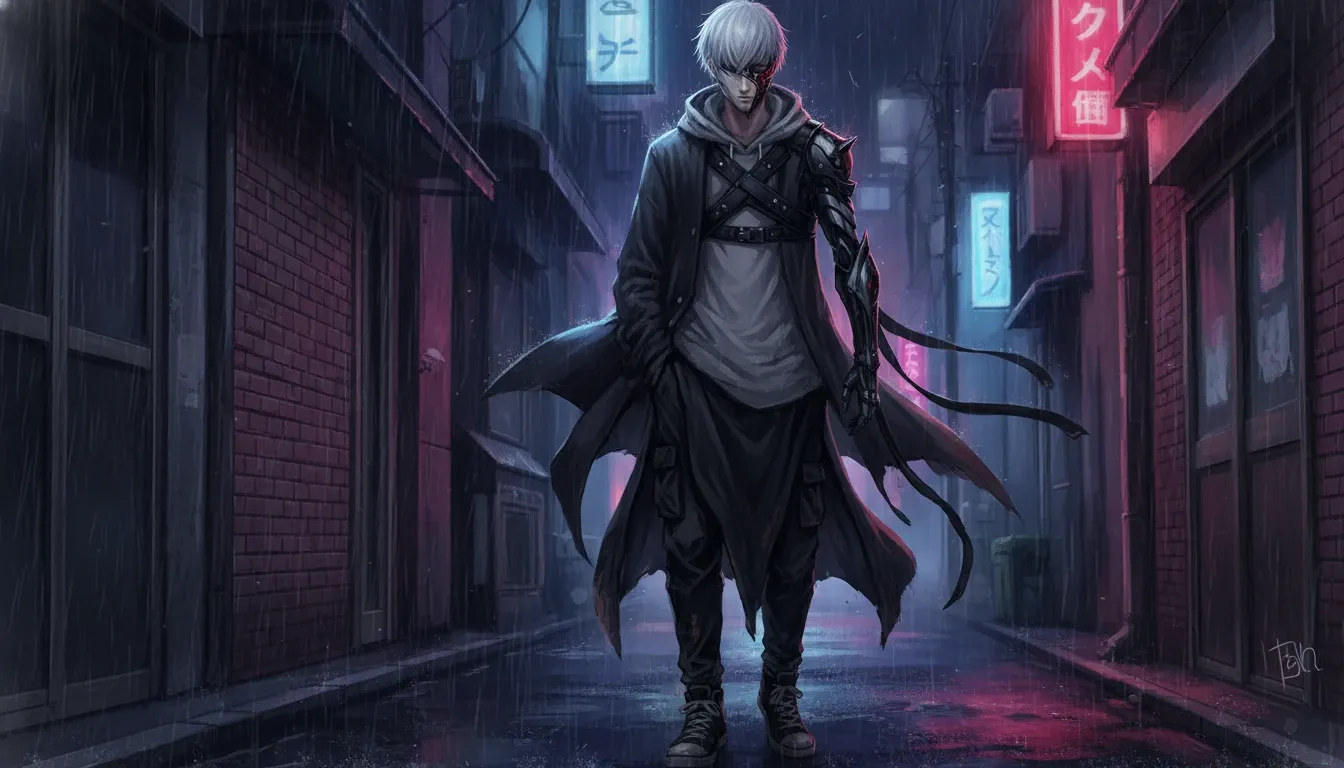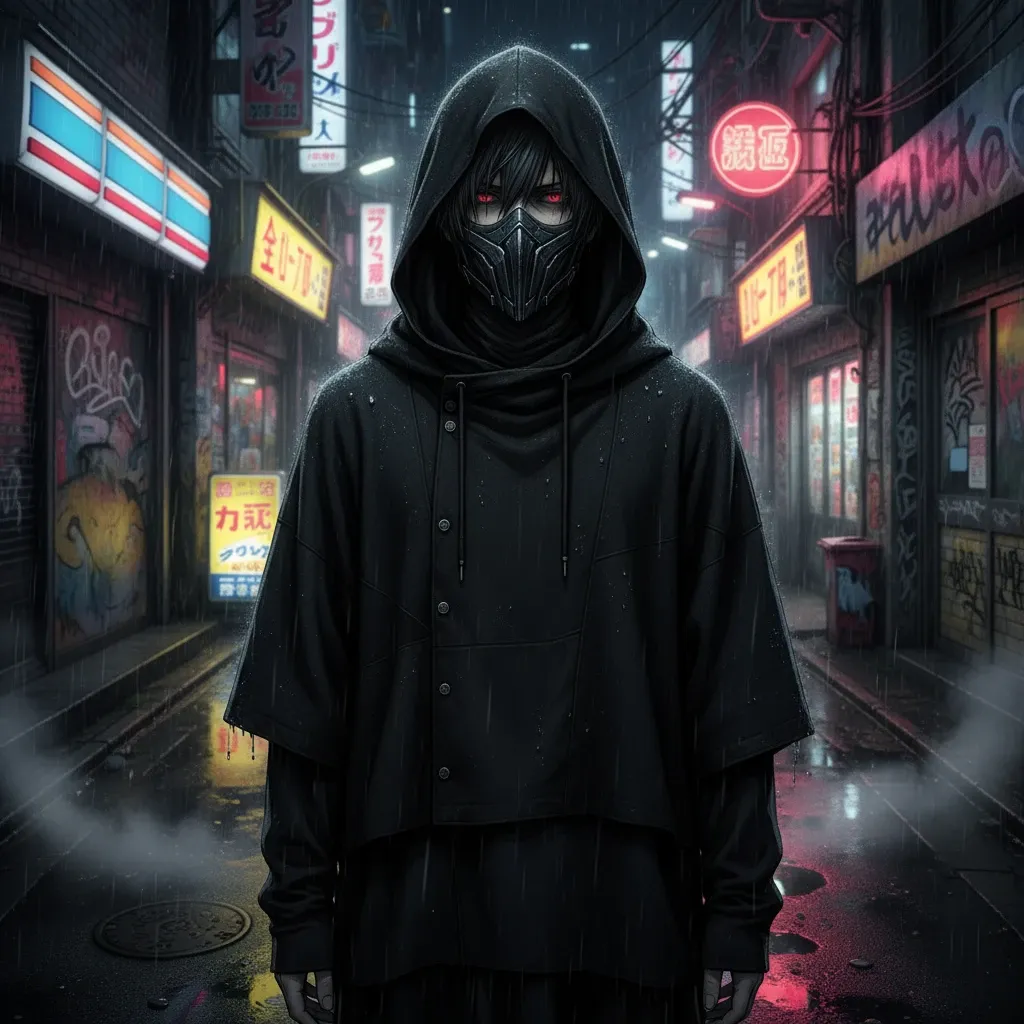
A dark urban scene in Tokyo, featuring Ken Kaneki in avant-garde streetwear, layered oversized black hoodie with high collar, shadowy eyes, and mouth covered by a textured mask. The background glows with neon lights reflecting off wet pavement, creating a moody atmosphere. Street details include graffiti and convenience stores. Focus on fabric textures, contrasting soft cotton with hard-edged design elements. Blend anime character realism with gritty city life, capturing the psychological intensity of his look
The Night Ken Kaneki Taught Streetwear to Bleed
I didn’t come to Tokyo Ghoul looking for clothes. I came for the nausea: that soft-bellied dread you get when the city lights feel too clean, too indifferent, like they’ve washed their hands and left you alone with your hunger. And then Ken Kaneki happened—quiet, shaking, stitched together—until his silhouette started showing up everywhere outside the screen. Not as cosplay. Not as merch. As a posture. As a way of stacking fabric so your body looks like it’s bracing for impact.
My biased take is this: Kaneki didn’t “influence” streetwear. He gave it permission to stop pretending it was only about comfort. He turned casual layers into night armor—avant-garde not because it was weird, but because it was honest about fear.
Soft Cotton, Hard Intent
The Hoodie Isn’t Innocent
A hoodie on a bright afternoon is a blanket. A hoodie at 1:17 a.m. under a convenience-store fluorescent hum is a decision. Kaneki’s visual language—high collar, shadowed eyes, covered mouth—trained a generation to understand that concealment can be style, and style can be self-defense.
The streetwear world loves to say “layering for function,” but most layering is just temperature math. Kaneki’s layering is psychological weather. Oversized outer shells over slimmer inner lines. Fabric that says: do not read me too quickly. The point isn’t looking bigger; it’s looking harder to interpret.
I’ve watched people in Harajuku and Shimokitazawa—kids and salarymen alike—borrow that exact trick without realizing the source: a black zip hoodie with a collar that climbs a little too high, a mask or scarf that isn’t about germs, an underlayer peeking out like a second skin. It reads as casual until you stand close enough to hear the quiet aggression of it.
The Mask as an Aesthetic Lie (and a Truth)
Kaneki’s mouth-covering iconography doesn’t just translate into masks; it translates into any gesture that disrupts the face: scarves pulled high, collars that bite the jawline, hair cut to collapse into the eyes. In streetwear, the face is usually the brand’s billboard—logo cap, clean grin, social-ready. Kaneki makes the face a battlefield you don’t get to tour.
And yes, the obvious piece is that black-and-teeth mask. But the deeper lesson is the refusal of easy access. That’s what pushed streetwear toward a darker, more tactical silhouette without fully crossing into literal military cosplay.
The Details People Miss Unless They’ve Been Close to the Scene
The Prototype That Didn’t Work: “Teeth” That Looked Like a Toy
One of the least glamorous truths behind the famous grin is that early fan-made versions of the mask looked absurd in real life: the white “teeth” were often stiff foam or glossy resin that reflected streetlights like plastic. On camera it read as menace; on the sidewalk it read as novelty. That failure mattered. It quietly steered makers toward matte finishes, softer materials, and smaller contrast—less Halloween, more wearable threat.
You can still spot the evolution if you know what to look for: the best pieces don’t shout with bright whites. They murmur with off-white, bone-like tones that swallow light instead of bouncing it.
The Quiet Argument in Small Shops: “Anime-Inspired” vs. “Anime-Literal”
There’s a low-grade dispute that pops up in tiny select shops and among independent designers: should Kaneki-coded pieces be recognizable, or should they be deniable? Some argue that if it’s not readable as Tokyo Ghoul, it’s just generic black streetwear. Others insist the whole point is to launder the reference into a mood—so only the right people feel the click of recognition.
That argument is why the Kaneki revolution isn’t just about masks. It’s about structure: asymmetry, collars, harness-like straps that never quite become functional, layered hems that look like they were torn and re-stitched at 3 a.m. The “inspired” camp won, culturally. The literal mask stayed, but the real takeover happened through silhouette.
The Underappreciated Habit: Designers Obsess Over the Neckline First
Here’s a workshop-level detail: when people build Kaneki-like outfits that actually look expensive, they start with the neckline. Not the graphic. Not the shoe. The neck. Because the neck controls the entire emotional reading—whether you look protected, hiding, or choking on your own armor.
It’s one of those craft truths you only learn after wasting money: a cheap collar collapses and turns sad; a well-cut collar holds its angle and turns predatory. The difference is felt before it’s seen, like the way a heavy door closes with a calm, final sound.
Layering as Self-Myth
Day Clothes That Want to Be Night Clothes
Kaneki’s influence pushed streetwear toward what I think of as “noon garments with midnight intentions.” Pieces that function in daylight but carry a private darkness: black cargos with a slightly too-long rise, coats that hang like a curtain, knit caps that pull low enough to blur identity.
This is where “avant-garde” becomes real. Not runway nonsense, not museum-silent conceptualism. Avant-garde as in: you walk differently. You keep your hands closer. You stop dressing to be consumed and start dressing to be survived.
The city helps. Tokyo at night has a particular scent—rain on concrete, warm metal from vending machines, the faint yeast of late bread. Under that smell, people dress like they’re stepping into a story that might turn violent. Kaneki’s wardrobe is basically that story made textile.
The Ghoul Logic: Beauty That Doesn’t Apologize
Kaneki’s transformation is not clean. It’s not aspirational in the usual way. It’s a wound you wear. Streetwear, at its most interesting, has always flirted with that: distressing, frayed hems, patched knees, garments that look like they’ve seen something.
Kaneki made that flirtation explicit. He normalized the idea that you can look good while looking haunted.
And once that door opened, everything else slipped in: the preference for monochrome, the love of sharp contrast (white hair against black cloth), the attraction to garments that seem to restrain the body—straps, belts, wrap closures—because restraint reads like control, and control reads like power.
Why This Revolution Stuck
Because It Doesn’t Require Wealth, Only Taste for Tension
A Kaneki-coded outfit can be assembled from ordinary pieces: a hoodie, a long tee, a slim jacket, dark pants, heavy shoes. The revolution isn’t in the items; it’s in the calibration. You choose lengths that misalign on purpose. You pick a fabric that drapes like it’s tired. You let one detail—collar, mask, glove—carry the threat so the rest can stay quiet.
That’s why it spread. You don’t need a rare drop. You need a mirror and a willingness to look slightly less friendly than you were trained to be.
Because It Matches the Modern Mood
A lot of streetwear today is trapped between two boring poles: loud branding or sterile minimalism. Kaneki offers a third option—emotion as architecture. Clothing that admits you’re not fully safe, not fully known, and not interested in being easily sorted.
That’s the core of “night armor”: not protection from bullets, but protection from being read like a menu.
The Outfit as a Scene, Not a Fit Pic
I think the most truthful Kaneki streetwear doesn’t photograph well in daylight. It needs sodium streetlamps, wet asphalt, the hush between trains. It needs movement—fabric shifting, hems swaying, a collar catching wind. The best versions aren’t styled; they’re lived in. They smell faintly of tobacco or detergent or rain. The cuff edges soften. The black fades into charcoal at the seams. The armor becomes personal.
That’s the real revolution: casual layers that stop being “casual” the moment the sun goes down. You’re still wearing cotton and nylon and knit, still dressed for convenience—yet the silhouette tells a different story. One where your softness is real, but guarded. One where you can be gentle and dangerous in the same breath.
What Kaneki Leaves Us With
The world doesn’t need more costumes. It needs more clothing that understands the body is an animal with memory. Kaneki’s streetwear revolution is a lesson in that memory: how fear shapes posture, how hunger shapes restraint, how a city at night asks you to become someone you can trust.
So I’ll keep saying it, even if it sounds dramatic: this wasn’t anime drip. This was a new permission slip. To layer not for warmth, but for distance. To wear black not as a trend, but as a boundary. To turn everyday pieces into something that feels like it could take a hit—and keep walking.