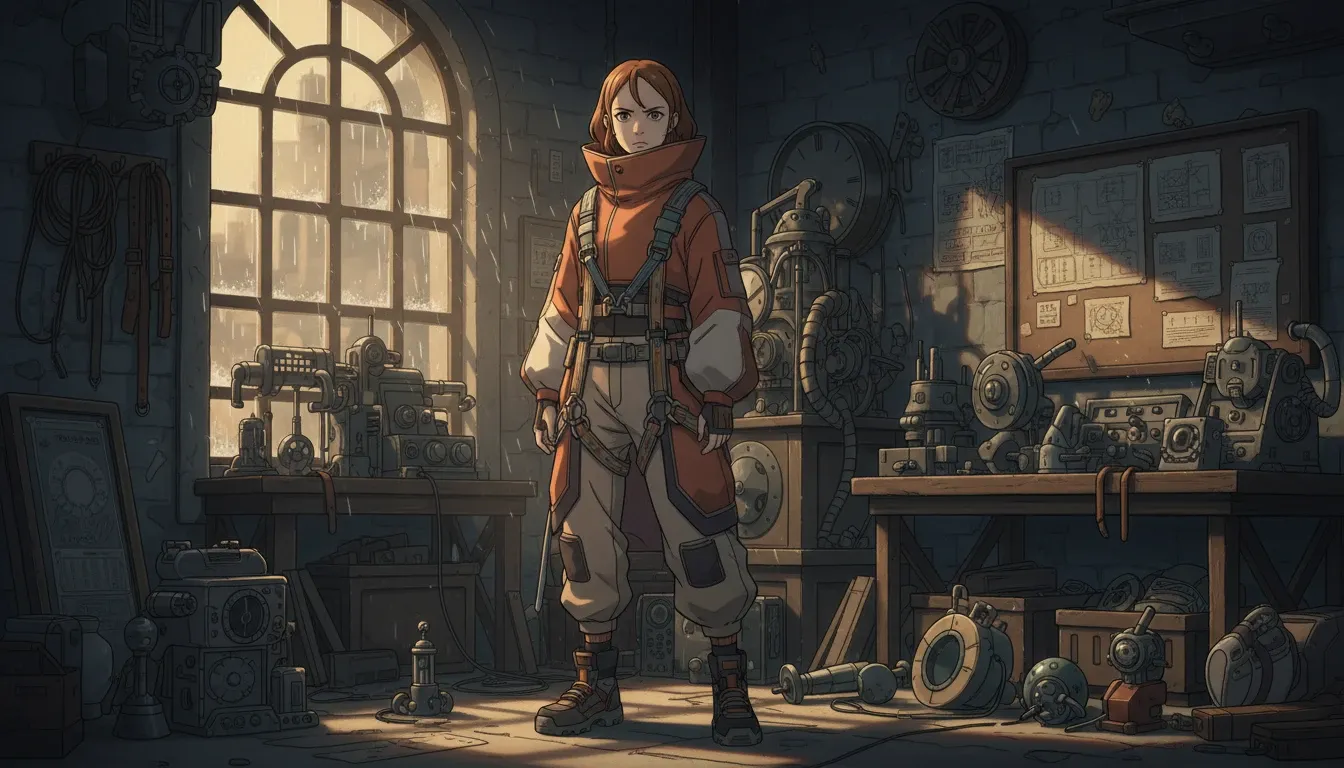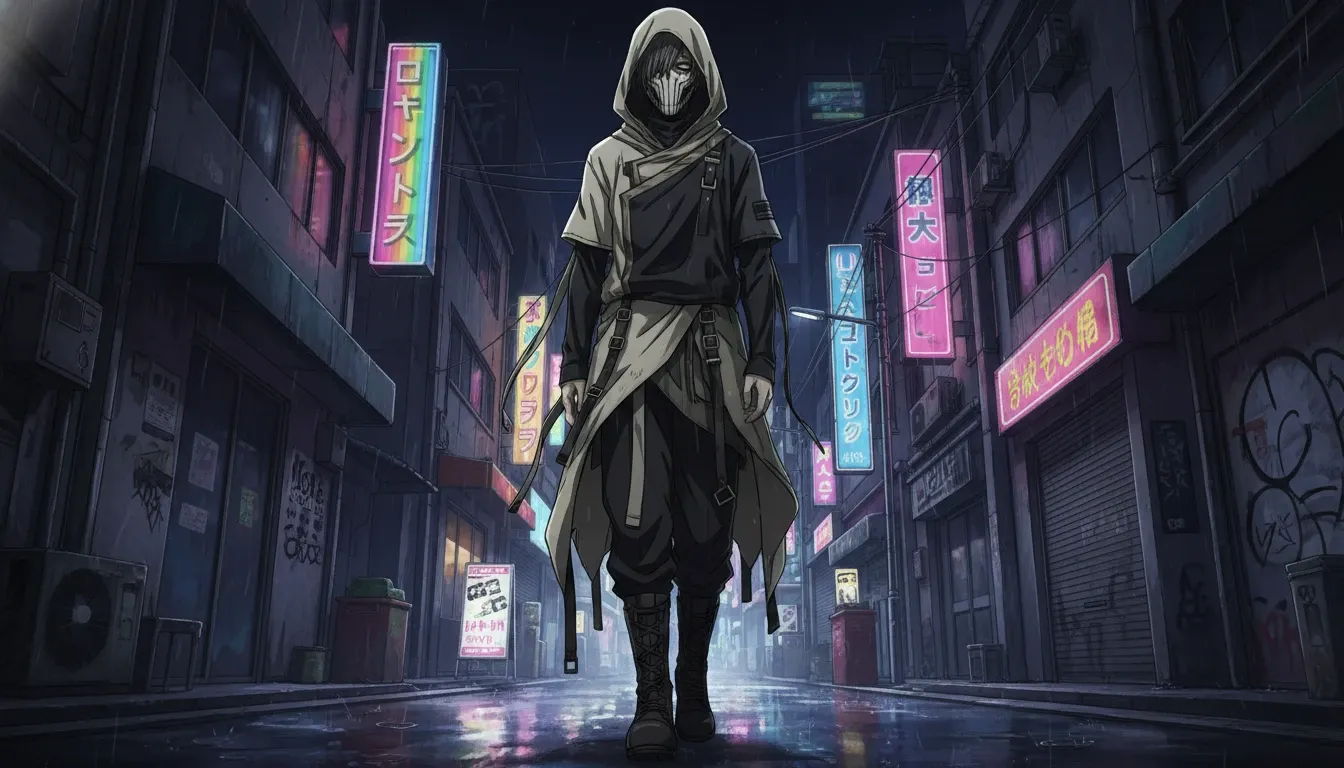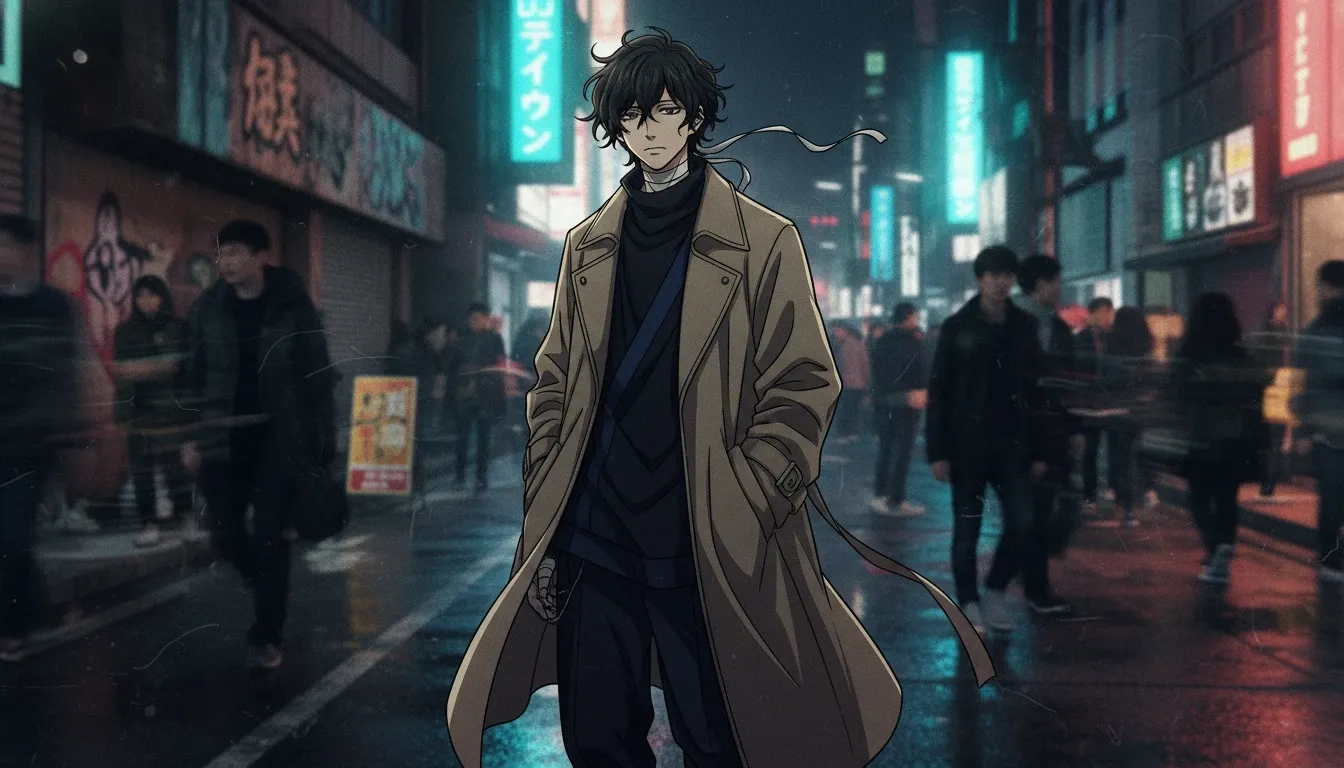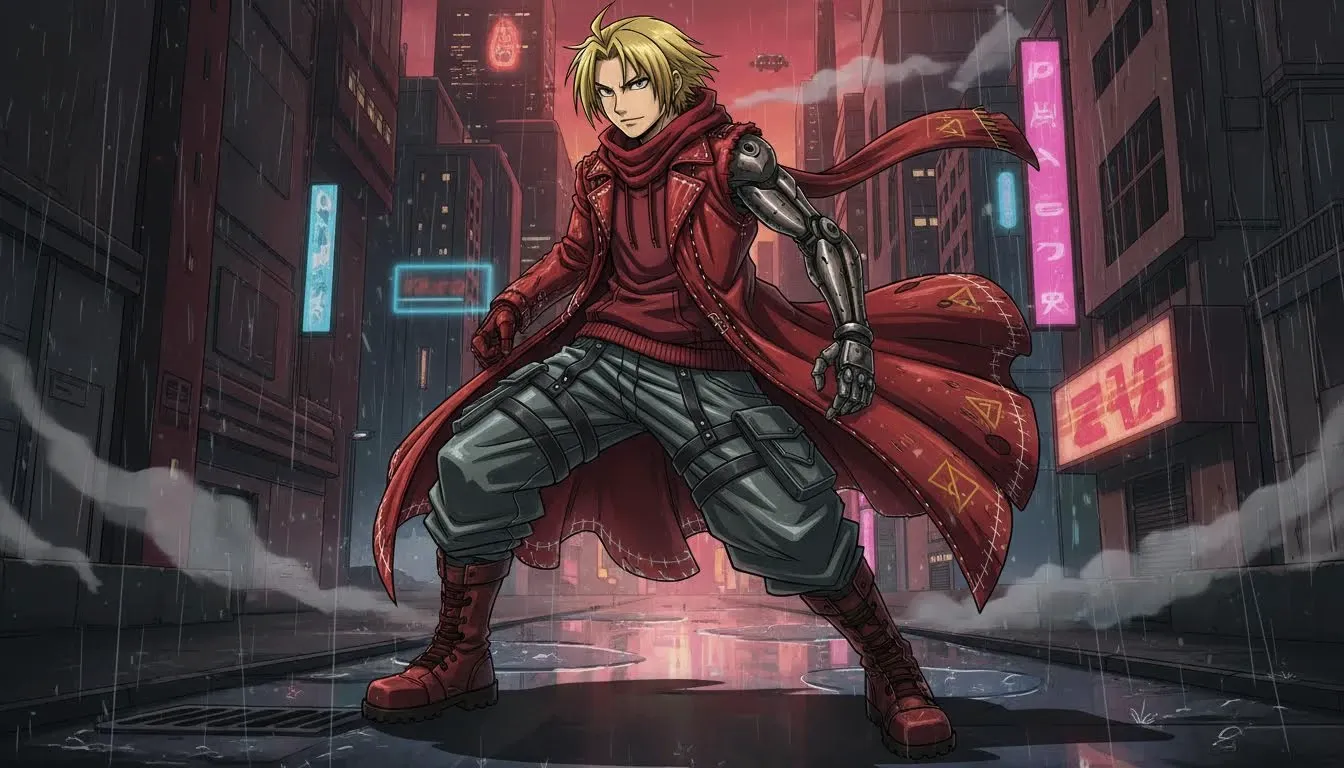
Kaneki Ken inspired streetwear scene in rainy Tokyo alley, moody neon lights. Thin and introspective male figure in layered casual clothes: long draped tee, oversized lightweight hoodie, slightly too big dark jacket, slim black pants, worn sneakers. On one arm, avant-garde ghoul chic: biomechanical mask, asymmetrical leather harness, sharp metallic accents, flowing straps. Atmosphere of inner conflict, double life, slow rebellion against fast fashion, cinematic anime realism, soft diffused lighting, high detail, painterly digital illustration
The Day I Quit Fast Fashion, Kaneki Was on My Moodboard
The day I quit, the office air still smelled like reactive dye and burnt coffee. My hands were dry in that specific way—like the skin had been rinsed too many times and never forgiven. The fluorescent lights were doing their usual slow violence, the kind that makes your forehead feel tight even when you’re not stressed. My resignation email was short. The shame wasn’t.
For years I’d been the person who could make a “new drop” look inevitable—like it had always been waiting in the warehouse shadows, perfectly folded, perfectly forgettable. A clean arc. A neat narrative. The kind of story a brand deck loves.
And then Tokyo Ghoul kept showing up in my head at the wrong moments: on the subway, in the studio, while I was approving another batch of “distressed” hoodies that were distressed by a machine, not by life. Kaneki Ken—half boy, half hunger—felt less like cosplay fuel and more like a confession.
I’m not saying a manga character taught me ethics. I’m saying I recognized the split. The double life. The “I can live with this” voice that keeps negotiating with the stomach.
And—this is the part I still hesitate to write—there was a second voice, quieter, pettier, more human: don’t be dramatic, it’s just clothes. I hated how convincing it sounded.
Casual Layers: Where the Ghoul Hides in Plain Sight
When people talk about Kaneki style, they jump straight to the mask. I start earlier, before the violence becomes a costume. I start with layers that look like they were grabbed in a rush: the kind of clothes that don’t announce themselves, the kind that let you slip through a crowd like steam.
In fast fashion, we built that anonymity on purpose. You’d be shocked how much money gets spent to manufacture the feeling of “I didn’t try.” Soft brushed knits that pill after three washes. Jerseys engineered to collapse at the shoulder so the silhouette looks “effortless” on camera but dies in real life. I used to call it trend-reading. Now I call it planned fatigue.
I’m typing this and my neck is doing that stiff little protest it always does when I’ve been hunched over too long. It’s funny—when you’re in a high-speed system, your body becomes background noise. When you slow down, it starts filing complaints.
So when I style “casual Kaneki” in my head, I’m not thinking about cosplay accuracy. I’m thinking about a nervous body that wants to disappear: a long tee that hangs like a curtain, a lightweight hoodie that smells faintly of detergent because it’s always being washed, a jacket that’s just a little too big because you want air between you and the world.
And here’s my biased take: the most Kaneki thing you can wear is not a mask, it’s a garment that looks like it’s been forgiven for existing. It doesn’t beg to be photographed. It doesn’t beg to be purchased. It just sits on your skin like an apology.
The First Time I Tried “Ghoul Chic,” I Failed in a Way Nobody Posts
I’ve been making sustainable textiles for a few years now, and I still carry a private museum of failed prototypes—things that taught me more than any “innovation” panel.
One of those failures was my first attempt at a Kaneki-inspired outer layer: I wanted a jacket that could shift from ordinary to unsettling, like a person whose reflection doesn’t match their voice. I used a bio-based polyurethane alternative (the supplier claimed it was “more responsible,” which is a phrase I now treat like a used car salesman’s smile). I laminated it onto a lyocell base to get that slick, wet sheen—something between rainwear and a fresh bruise.
It looked incredible for exactly one afternoon.
Then the lamination started to micro-crack along the elbow folds. Under studio lights, the fissures caught the glare like dry riverbeds. The whole piece began to feel less “avant garde ghoul” and more “cheap seat on a budget airline.” I kept it anyway. I keep it because Kaneki isn’t a smooth transformation. He’s rupture.
That prototype is still in my closet, and when I pull it out it has a faint plasticky smell that no amount of airing can fully erase. Sustainable doesn’t automatically mean pure. Sometimes it just means you chose a different compromise… and you’re honest enough to look at it.
Streetwear Alchemy Is Not Magic—It’s Heat, Pressure, and Guilt
I call it alchemy because streetwear has always been about turning the ordinary into the desired. A hoodie becomes armor. A sneaker becomes a passport. A graphic tee becomes a flag you can buy.
When I worked in fast fashion, we had a specific internal argument that never made it outside the building: whether to chase “anime-core” with direct references or to mimic the mood without licensing anything. The design room split into two tribes—one wanted literal eyes, masks, kanji; the other wanted “vibes” and plausible deniability. The “vibes” team usually won, because vibes are harder to sue.
I remember a failed graphic test—nobody talks about this stuff, because it’s embarrassing and also because it reveals the machinery. We had a Kaneki-adjacent illustration on a tee, but we pushed the red too far and it read like a medical diagram. The print vendor warned us: the specific pigment load would crack after a few washes on that cotton blend. The merch lead said, essentially, “People won’t wash it that much.”
That sentence stuck to my brain like syrup on a countertop. Not because it was uniquely evil—because it was normal. Because everyone nodded like it was simply… math.
Alchemy, in practice, was always: how little can we give, how much can we take?
Now, from the sustainability side, I still feel the temptation—just wearing a different lab coat. Because “responsible” streetwear can become its own performance. It can become a new kind of mask: look ethical, feel edgy, spend more, post louder.
So my rule for Kaneki-inspired streetwear alchemy is cruelly simple: the piece has to survive intimacy. It has to survive sweat, rain, the back of a chair, the elbow crease, the nervous fidgeting. If it only works on a photoshoot day, it’s not Kaneki, it’s a Halloween decoration.
Avant Garde Ghoul Chic: The Beauty of Hunger, Without Romanticizing It
Kaneki’s “ghoul chic” isn’t just dark color palettes and asymmetry. It’s the tension between refinement and need. The way a clean line can cut like a blade. The way a soft fabric can still feel predatory when it clings in the wrong places.
I’ve been obsessed with one silhouette lately: a long, narrow coat with a high throat and a front closure that doesn’t quite align—like it was tailored by someone who kept getting interrupted. The closure is the point. In fast fashion, we’d make it symmetrical for “commercial appeal.” In my studio, I keep it slightly off because the body is rarely centered when it’s under stress.
Material-wise, I prefer textiles that have a “quiet menace.” Not faux leather that squeaks. Not shiny PVC that screams nightclub. I want matte surfaces with depth—like dried ink. I’ve been working with a hemp-silk blend that has an irregular slub; when you run your fingers over it, it’s both smooth and stubborn. It feels like it remembers being a plant.
Here’s a detail that sounds like a flex until you actually live through it: I once spent three weeks trying to reproduce a blood-like black-red that doesn’t bleed in wash, using a lower-impact dye system. The trick wasn’t the color recipe—it was the pre-mordanting and the rinse schedule. If you rush the rinse, you get a red halo at the seams after the first wear, like a wound that won’t close. Some designers would call that “character.” I call it disrespectful to the person who paid for it.
Also, quick audit, because I don’t want to pretend this is cleaner than it is: “low-impact dye” is a slippery phrase in the industry. It generally means less harmful chemistry and lower water/energy relative to conventional processes—not some magical absence of footprint. And “pre-mordanting” can be done with different agents; some are far less benign than people assume when they hear the craft-y, historical vibe of the word. The point isn’t to sound pure. The point is to admit there’s always a lever somewhere.
Kaneki’s palette, for me, is that discipline: blacks that don’t turn dusty, reds that don’t migrate, whites that aren’t sterile but also aren’t tragic.
(Off Topic) I Still Miss the Speed Sometimes, and That Freaks Me Out
Say it plainly: I miss the adrenaline of fast fashion. I miss walking into a sample room and seeing ten versions of an idea hanging like fresh fruit. I miss the speed that made me feel important.
And I hate that I miss it.
Because now my weeks are slow in a different way. I spend hours just waiting—waiting for enzyme treatments to finish, waiting for a mill to reply, waiting for a test swatch to dry so I can see whether the hand-feel is honest or just wet. Sustainability has a tempo that forces you to hear your own thoughts. Sometimes my thoughts are not flattering.
I think that’s why Kaneki stays relevant to me: he’s not a neat “before/after.” He’s a person who keeps living inside the mess.
The Mask Problem: The Most Iconic Piece Is Also the Most Dishonest
The Kaneki mask is iconic. It’s also, in a sustainability context, a trap.
Most of the masks people buy are made of synthetic leather, cheap zippers, elastic that fatigues fast. They’re built for a convention, not for a life. They peel. They crack. They end up in a drawer that smells like dust and regret.
When I design “ghoul chic” accessories, I prefer hints over replicas: a collar detail that suggests restraint without becoming a fetish; a zipper placement that looks like a scar; a face-covering scarf knit in a way that lets the mouth area distort, like a grin you can’t control.
I once tried to prototype a mask using a mycelium-based leather alternative. The supplier promised “animal-free, plastic-free.” The surface looked beautiful—soft, slightly suede-like, with pores that caught light like skin. But the durability was terrible around tension points. The mouth area tore after repeated flexing. That’s the kind of detail you only learn by wearing it around your studio while you’re cooking, talking, laughing—living. A mannequin won’t tell you the truth.
And I should say this plainly, because marketing copy muddies it: plenty of “mycelium leather” materials still rely on polymer binders or coatings to meet performance needs. Some are closer to “bio-based composite” than a clean replacement. So when I say that prototype failed, I’m not declaring the whole category a scam. I’m saying the gap between promise and daily flexing is… real.
So I stopped chasing the mask as an object. I started chasing the mask as a mood: concealment, not costume.
(Also Off Topic) There’s a Tiny Industry Fight About “Recycled” That Makes Me Cynical
This is a petty insider gripe, but it matters. In the sustainable space, people throw around “recycled” like it’s holy water. Recycled polyester, recycled nylon—great, sometimes. But there’s a quiet argument in the supply chain about whether certain “recycled” claims are basically bookkeeping theater when the input streams are too clean, too controlled, too far from actual waste problems.
I’ve sat in meetings where a supplier’s recycled content certification was technically valid, and still the whole thing felt like a magic trick designed for marketing decks. I’m not naming names because I’m not trying to get sued. I’m just saying: if your Kaneki-inspired piece is built on a lie that’s been polished, it’s not ghoul chic. It’s corporate cosplay.
And yes, I know the counterargument: clean, controlled input streams can be what makes recycling mechanically viable at scale. I’ve used that line myself. It’s just that sometimes—sometimes—the story is doing more work than the material.
What I’m Trying to Make Now: Clothes That Can Turn, Like Kaneki, Without Falling Apart
If I had to describe my current Kaneki streetwear project in one image, it’s this: a person standing under a streetlight in light rain, water beading on a coat that looks almost ordinary—until they move, and the seams catch the light in a way that feels…wrong. Not broken. Just other.
I want casual layers that read like daywear: breathable knits, modular overshirts, a vest that can be worn inside out. But I also want avant garde disruptions: asymmetric plackets, hidden ties, panels that shift. Transformation, but practical.
And I want the textiles to carry the narrative honestly. Plant-based fibers where they make sense. Recycled synthetics where they earn their place. Finishes that don’t poison a river just to achieve a dramatic sheen. I’m not naïve; I know every choice has a shadow. I’m just tired of pretending the shadow isn’t there.
Kaneki’s story isn’t about becoming a monster. It’s about learning what you are when you’re forced to metabolize the world differently. That’s how I feel moving from fast fashion to sustainable design: my appetite didn’t disappear. It just got harder to feed without hurting someone.
I Don’t Want “Ghoulcore.” I Want Clothing That Admits the Split
If you ask me what “Tokyo Ghoul Kaneki Ken Streetwear Alchemy From Casual Layers To Avant Garde Ghoul Chic” means in my hands, it’s not a trend report. It’s a warning label and a love letter at the same time.
I’m making clothes for people who don’t feel entirely human at 8 a.m. on a platform, who want softness but also distance, who want to look normal until they don’t. I’m making pieces that can live through repetition, not just through attention.
And maybe this is my most immature confession: I don’t trust garments that look too resolved anymore. I don’t trust perfect symmetry. I don’t trust a black that’s too clean. I trust the seam that holds even when it’s slightly off, the fabric that keeps its dignity after sweat, the jacket that doesn’t crack at the elbow because someone decided the customer wouldn’t wash it.
I used to design for speed. Now I design for survival.
Outside my window, there’s a streetlight that flickers like it can’t commit. Every time it stutters, the room looks briefly like a different room—same furniture, different reality. I keep thinking about that, and I keep thinking about Kaneki, and I keep wondering:
When the light changes again… what will I be wearing, and what part of me will it be trying to hide?