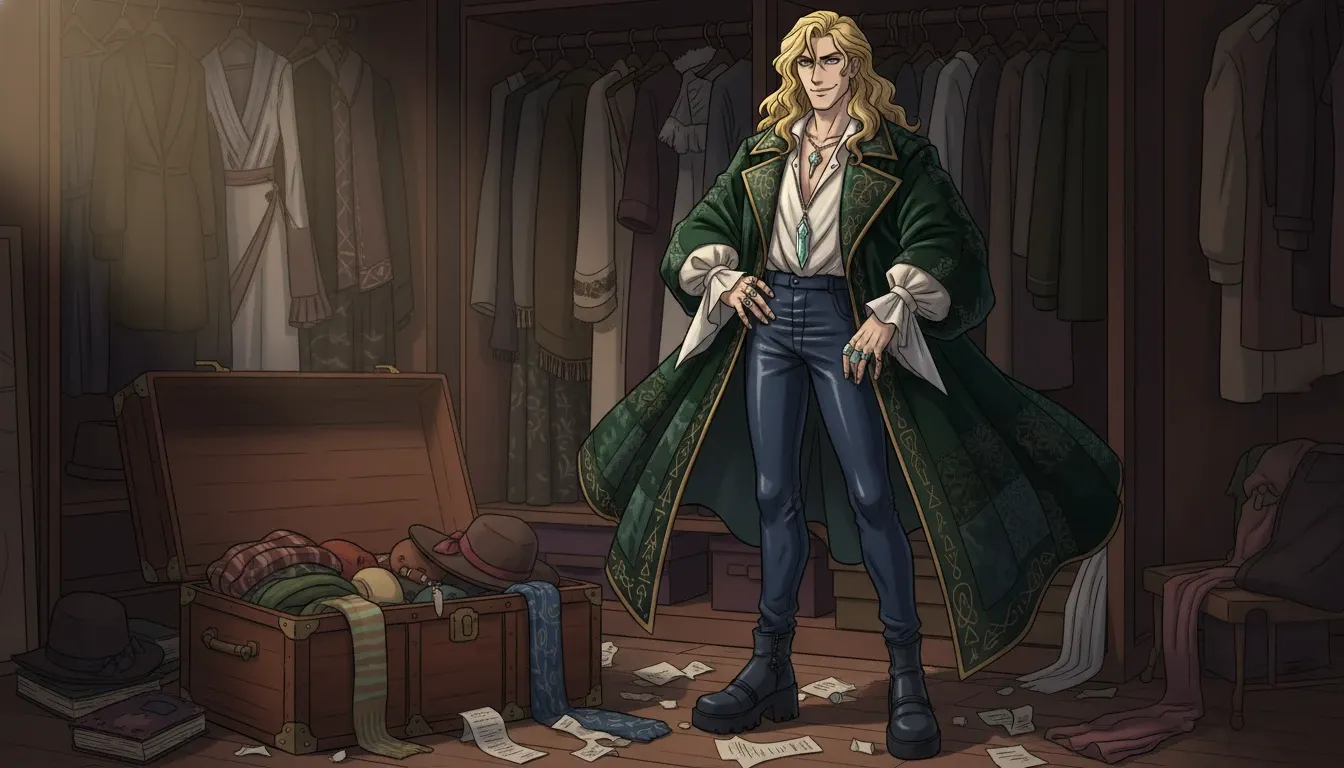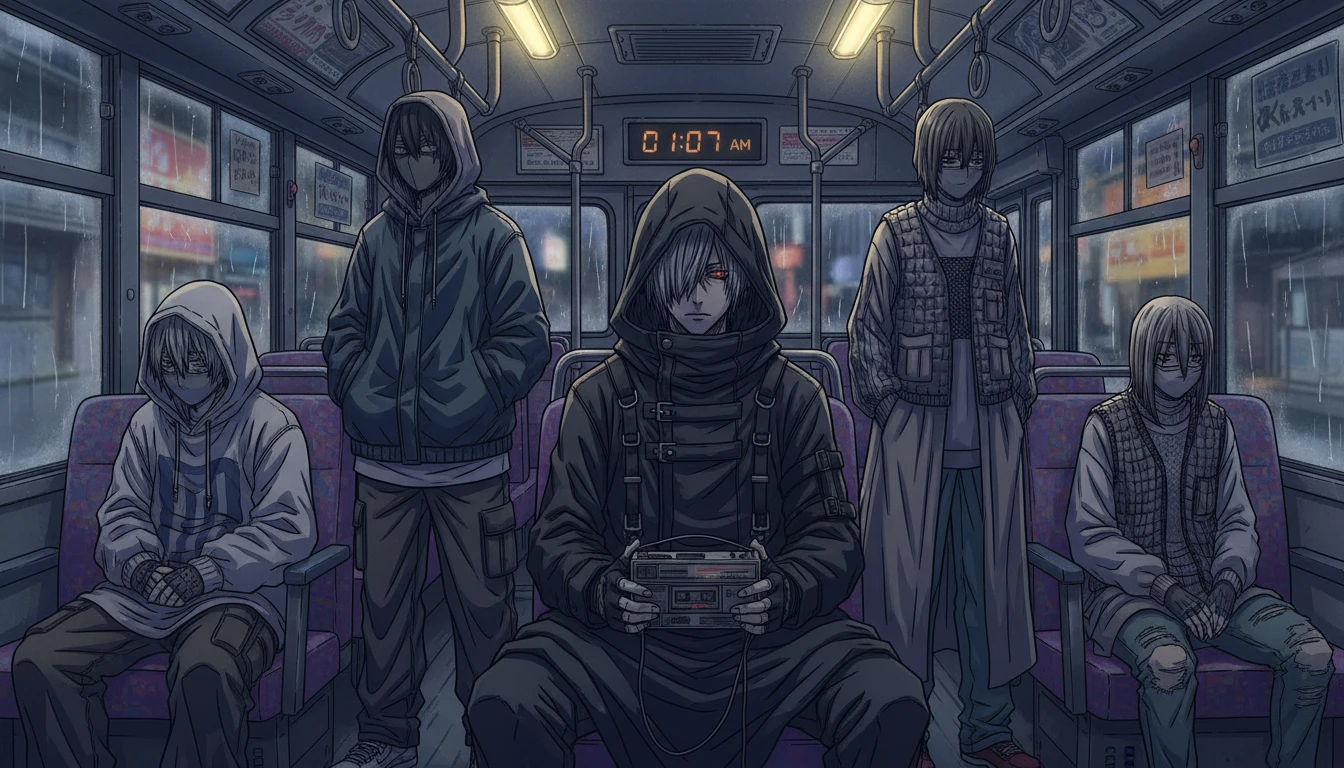
A dimly lit Tokyo bus interior at 1:07 a.m., featuring Kaneki Ken in avant-garde streetwear, hood up, observing surroundings with a quiet intensity. Three stylish youths in layered streetwear, textures of nylon, cotton, and wool, create a triangle around him. The atmosphere is moody, with flickering fluorescent lights casting shadows. Include details of a scuffed cassette recorder in Kaneki's hand and the wet rubber scent lingering in the air, evoking a sense of nostalgia and urban grit
I have driven the last bus long enough that the city has stopped pretending in front of me.
At 1:07 a.m., the depot smells like wet rubber and instant coffee burned twice. My hands carry a permanent graphite sting from counting coins and folding transfer stubs. The steering wheel is glossy where thousands of palms have polished it; on cold nights it feels like touching a sleeping animal’s spine. I bring my old recorder the way other men bring prayer beads—quietly, superstitiously, never letting anyone see how much it matters.
It’s a cassette recorder, not digital. The plastic is scuffed to a dull gray, the “REC” button sunk like a tired tooth. I wrapped the microphone in a strip of denim so it doesn’t click against my jacket when I breathe. People think I keep it for nostalgia. They don’t know what I use to repair it when the tape starts to chew: a tiny screwdriver made for eyeglasses, the kind you can lose in a pocket forever. The handle is shaved flat by years of my thumbnail. I never let that tool leave my body. If you drove nights for fifteen years, you’d understand why you don’t trust daylight shops to save what holds your midnight.
The bus pulls out, hissing, as if it resents being awake.
Tokyo at this hour is not neon; it’s the color of dishwater in a sink that won’t drain. The streetlights make everything look damp even when it’s dry. In my mirror, I watch mouths move. I don’t stare at faces too long; you learn that a face is a door, and doors swing both ways. But I listen. I always listen.
Tonight the city delivers me a story dressed in black.
He steps in at Shinjuku-sanchōme with a hood up and hands tucked like he’s hiding heat. His walk is careful, like he’s trying not to wake something inside his own ribs. There is something about him—young, but already carrying the weight of a second life. I think of Kaneki Ken the way I think of certain passengers: not as a manga character, but as a shape of hunger, a boy whose gentleness learned to wear teeth.
He doesn’t look at the fare box at first. His gaze slides along the bus interior, taking inventory of exits, corners, shadows. Then, as if remembering he is supposed to be ordinary, he taps his card and sits near the back, where the fluorescent light flickers like a nervous eyelid.
A few stops later, three kids climb on—streetwear kids, but not the loud kind. Their layers are intentional, heavy with philosophy. One wears an asymmetrical jacket where the zipper drifts off-center like it’s trying to escape. Another has a long shirt under a cropped vest under a coat that hangs open, the fabrics whispering against each other with every step: nylon on cotton, cotton on wool, wool against bare wrist. Their shoes squeak faintly with newness. They smell of cold air and metal handrails and a sweet citrus body spray that can’t quite cover the scent of late-night ramen.
They sit in a triangle around Kaneki without meaning to—three points of style, one point of silence.
The recorder is already running in my coat pocket, the tape turning with its soft, secret purr. I keep the volume low; the bus is its own instrument. The engine thrums in E minor. The suspension adds percussion when we hit the patched potholes near Yotsuya. Above it all, the city’s breath comes through the vents—stale, warm, carrying the faint iodine smell of the river.
The bold layering look starts as a conversation you can barely hear, the way a bruise starts under skin.
“Your silhouette,” one of them says, voice scratching like sandpaper, “it’s too clean. You need a break—something that doesn’t obey.”
“Like an asymmetric hem,” another answers, and you can almost see their hands drawing lines in the air. “Not symmetry. Not comfort. Controlled wrongness.”
Kaneki says nothing for a while. When he finally speaks, his voice is gentle but thin, like paper held up to a lamp. “If it’s wrong,” he murmurs, “people will look.”
“That’s the point,” the sandpaper voice says. “You want them to look at the clothes so they don’t look at… the other thing.”
The other thing. Hunger. Teeth. The hidden self. Every midnight bus has passengers who are trying to dress as an alibi.
Kaneki’s outfit—if you call it that—is an apology: dark hoodie, plain pants, nothing too loud. But his posture is already a kind of styling: shoulders forward, chin slightly down, trying to fold into invisibility. The kids are offering him a different method. Avant-garde streetwear is not just fabric; it’s a way to wear your fracture openly so nobody can use it against you.
Outside the window, vending machines glow like small hospitals. Inside, the bus smells of damp umbrellas and old seat vinyl. I can taste the metallic dryness of the heater air on my tongue.
The kid with the vest leans closer. “Bold layering isn’t about stacking random pieces. It’s about thickness in the right places. Weight where you feel light.”
Kaneki’s fingers flex. I see it in the mirror: the slight tremor, the way he grips his own sleeve. As if his body is remembering something hungry. He asks, almost politely, “What about color?”
“Black isn’t a color,” the third says, voice surprisingly soft. “It’s a hiding place. If you’re going to do black, do it like a confession. Different blacks. Different textures. Matte next to shine. Cotton next to leather. Make your darkness have vocabulary.”
The phrase lands in the bus like a coin in an empty cup.
I’ve heard a thousand versions of this conversation—people trying to translate pain into something wearable. A girl once told her friend she kept “smell samples” in tiny jars—laundry soap, rain on asphalt, old library paper—because after an accident she couldn’t smell anymore and needed proof the world still had a scent. Another man practiced love confessions by whispering them into the bus window, fogging glass with his breath like a temporary letter.
But this one has teeth. This one has a boy who learned what it means to be split, to be hungry and ashamed of hunger, to be gentle and still dangerous.
Kaneki tilts his head. “Asymmetry,” he repeats, like he’s tasting the word. “Like… one sleeve longer?”
“Yeah,” says sandpaper voice. “Or a strap that doesn’t match. A belt that’s not holding up anything. A chain that looks like it could be used for restraint, but it’s just decoration. The city loves a hint of violence when it’s aesthetic.”
I swallow. My hands tighten around the wheel. The bus stays straight.
There are details about me no passenger knows. For instance: I keep a milk crate under my seat filled with cassettes, labeled only by dates and weather. Rain / 2:14 a.m. / someone singing. Snow / 12:52 a.m. / a breakup whisper. Clear / 3:03 a.m. / a man laughing alone. I never show that crate. Not to the new drivers, not to my wife, not to the depot manager who thinks I’m too quiet. It is my private museum of moving nights.
And there is one tape I have never replayed.
It is labeled with no date at all—just “K.” The cassette shell is cracked and held together with yellowed tape. I recorded it three years ago, when a passenger sat exactly where Kaneki sits now, and spoke into his phone in a voice so calm it made my skin crawl. He said, “Don’t worry. I can eat later.” Then he laughed softly, like someone petting a knife. After he got off, the bus smelled faintly of iron, as if someone had carried a pocketful of pennies with warm hands.
I told no one. I kept the tape. I didn’t listen again. Some stories are too real. Too close to the bone. You don’t invite them back into your ears unless you’re ready to become part of them.
Tonight, as the streetwear kids build their fantasy of silhouettes and bold layering, I feel that old cassette under my seat like a sleeping animal. The bus hums. The tape in my pocket turns.
Kaneki finally allows himself a small smile, not happy, more like relieved to have a language that isn’t blood. “If I layered,” he says, “what would you start with?”
“Base layer: something long,” the vest kid answers. “A shirt that covers your hands if you want it to. Then a cropped piece to cut your torso. Then an outer layer that moves—like a coat that flares when you turn, so people remember you as motion, not as detail.”
“Details,” sandpaper voice adds, “are where you hide the truth. A mask. A high collar. A scarf that can be pulled up. Sunglasses at night if you have the guts. It’s not about being seen; it’s about controlling what’s seen.”
Kaneki’s throat works like he’s swallowing a word he doesn’t deserve. He looks down at his own hands, pale in the fluorescent light, and for a moment he seems younger than he is—a kid trying on a new self the way you try on a coat in a shop and hope it will change the weather.
The bus hits a rough patch of road. The overhead rail shivers, and the sound is like a thin bell.
Somewhere near Kanda, an old man in the front begins to hum. Not a song anyone recognizes, not quite melody, more like memory trapped in a throat. The hum weaves itself around the streetwear talk. The city, the fashion, the hunger, the engine—all layered, bold, imperfect, alive.
This is what I mean when I say the real story happens here. Not on billboards, not in bright cafés with curated lighting. In a moving room that belongs to nobody, where strangers tell each other truths disguised as styling tips.
Kaneki stands two stops later. He pauses, hand on the pole, as if he’s listening for something inside himself. The kids look up, waiting.
“Thank you,” he says, and the words are so earnest they sting. Then, almost inaudibly, as if he’s speaking to the bus itself: “If I can choose how I look… maybe I can choose what I become.”
He steps out. The doors sigh shut.
The kids fall quiet, suddenly aware of their own breath, their own layers, their own fragile bodies under all that fabric and attitude. One of them laughs softly, the laugh of someone who has just brushed against a myth and isn’t sure if it brushed back.
I keep driving. The recorder keeps turning.
At the last stop, I park the bus and turn off the engine. The silence is heavy, like a coat soaked in rain. I take the cassette out and label it with the time and the smell: “Clear / 2:38 a.m. / black fabrics talking.”
My old screwdriver rests against my thigh, a small weight of certainty. The hidden crate waits under my seat like a secret archive. And the tape marked “K” stays unplayed, because even after fifteen years, I still believe in boundaries—the kind you draw not to keep people out, but to keep yourself intact.
Tomorrow night, another bus, another set of strangers. Another conversation that sounds like fashion but is really survival.
The city’s truest stories don’t live in books. They live in bodies—layered, asymmetrical, bold in the dark—riding home on my last route, leaving their breath on the windows like temporary graffiti, while my little recorder eats it all, quietly, faithfully, one soft click at a time.