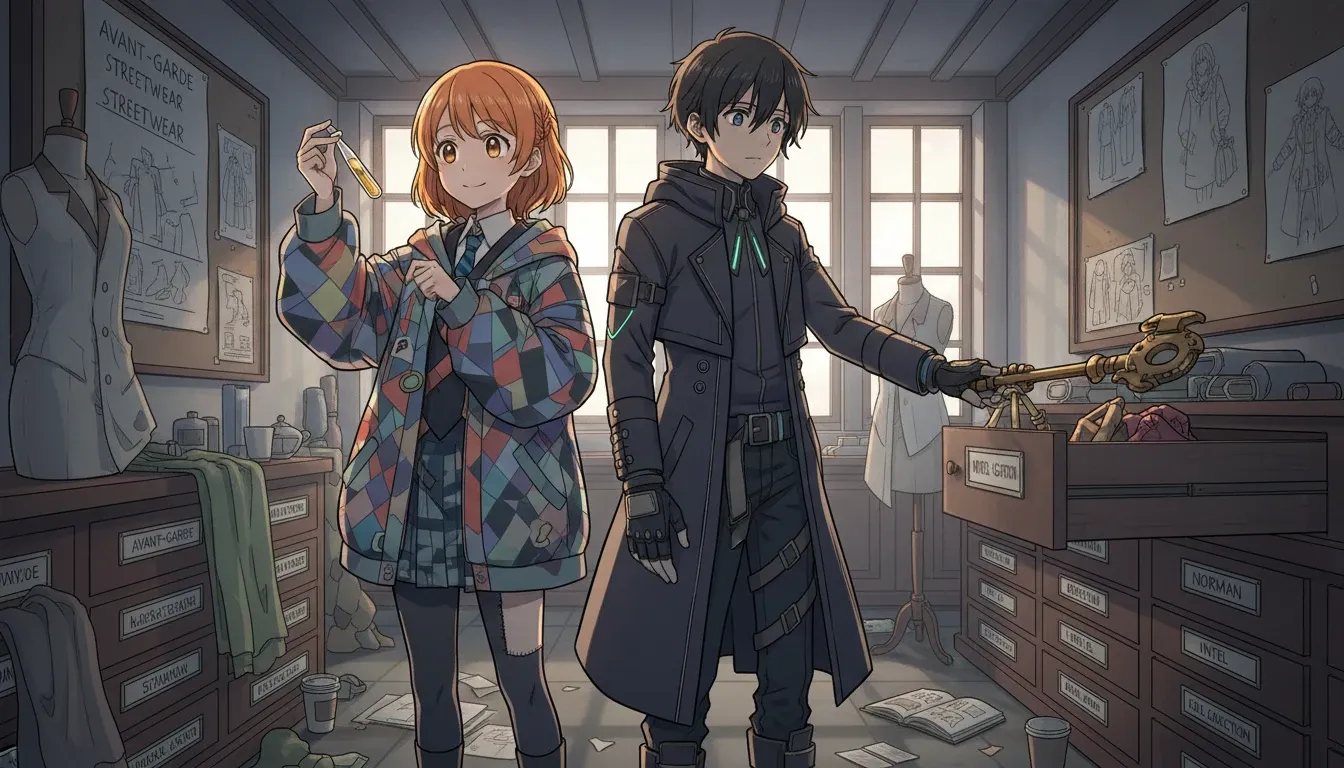
A dimly lit perfumer’s studio filled with labeled drawers, showcasing avant-garde streetwear styles for The Promised Neverland characters. Emma, with her warm expression, inspects a glass vial; Ray observes, intrigued by an antique brass atomizer wrench. Norman reaches for a drawer, with the atmosphere thick with creative tension. Soft shadows and muted colors emphasize their youthful yet weary faces. Clothing features asymmetric cuts, unique textures, and rebellious designs, blending anime aesthetics with a realistic urban environment
My studio doesn’t have a waiting room. It has drawers.
They are shallow, museum-flat, and labeled like dates on bruises: “Tokyo Underpass, 02:13, Rain-roted Concrete.” “Kanto Classroom, Chalk Dust + Citrus Peel.” When clients come, they don’t sit—they lean forward, nose-first, and read me the way you’d read an archive with your palms. I am a perfumer only in the way a coroner is a doctor: I preserve what time tries to erase.
Tonight the air changes when the door shuts. A cold draft, fabric-static, the faint pepper of freshly cut synthetic threads. Streetwear has always arrived before the person wearing it, a silhouette that enters like a rumor. And rumor, I’ve learned, is simply a scent that hasn’t been named yet.
They arrive in a cluster—children, really, but with eyes that have already rehearsed escape. “The Promised Neverland” characters, pulled from their bright peril into my dim room, are not here to be made trendy. They are here to be translated: fear into seams, tenderness into a collar, strategy into asymmetric closures that never quite align—like a plan you can’t admit you have.
I open Drawer 47. Not a perfume, not a “fragrance.” A specimen: “Orphanage Corridor, Sun on Waxed Wood, Milk-Sweet Linen.” The smell is clean the way a knife is clean. Emma leans in first, because she always leans in first. Her breath fogs the glass.
“Too pure,” she says, and her voice does something my blotter strips can’t record: it warms, then sharpens.
“Purity is an aesthetic,” I tell her. “Not a truth.”
Streetwear—real streetwear, the kind that grows out of necessity and rebellion—has a distrust of symmetry. Symmetry is what institutions love. Symmetry is uniform. So I build their looks like I build my accords: with a planned imbalance. A sleeve that drags like a memory. A hem that slants as if the wearer is always mid-turn, already leaving.
Ray doesn’t lean in. He watches. His gaze moves along my shelves where glass vials catch the low light like insects pinned for study. He notices the thing almost nobody does: my old tool.
It hangs from a hook, a length of dull metal with a thumb-worn hinge—an antique brass atomizer wrench from a defunct Grasse workshop, its handle wrapped in cracked black tape. I never lend it. I never replace it. The tape still holds a faint scent of clove cigarettes and machine oil because, years ago, I used it to pry open a jammed valve while listening to a recording I swore I’d destroy.
Ray’s eyes flick to the locked cabinet in the corner. The cabinet is not on any tour. It’s where I keep the crate of failures—a wooden box with no label, full of vials that never became anything anyone would pay for. I don’t show them because the failures are too honest. They smell like the moment you realize you were wrong.
He says, very quietly, “You keep the wrong answers.”
“I keep the attempts,” I correct him. “Attempts are where people hide.”
Norman reaches for Drawer 12, and his fingertips hover before the latch, polite as a well-bred lie. He has the sort of composure that smells like clean paper and pressed wool—an elegance that can suffocate if you mistake it for gentleness. I pull out a different drawer for him: “Library Stairwell, Old Glue, Pencil Shavings, Cold Stone.” The scent is dry, intelligent, and lonely in a way that makes the throat tighten.
We begin the styling the way I begin any reconstruction: not with color boards, but with air.
For Emma: avant-garde streetwear that refuses to sit still. A jacket cut so the left side sits higher, exposing a slice of ribbed knit like a secret. Straps that cross the torso not to decorate but to tether—because she is always tethering people back to life. The fabric is matte, almost chalky, like a school uniform that decided to run away. I dust the inner collar with a specimen I rarely use: “Summer Field, Crushed Stems, Sweat Salt, Sun-Hot Denim.” Green violence and human warmth. Her look becomes a sprint you can wear.
For Ray: a silhouette that looks like it has already calculated the exits. Layering that doesn’t add bulk but adds options—zips placed where the hand naturally falls, pockets hidden behind false seams, a scarf that can become a hood in one motion. Black, but not one black: charcoal that smells of burnt paper, oil-black that smells of rain on asphalt. I give him a thin line of scent at the wrist: “Basement Stair, Damp Concrete, Overheated Plastic.” It’s a nod to places where plans are whispered and the lights flicker like weak alibis.
For Norman: a coat that is almost formal until you notice the wrongness—one lapel longer, one shoulder slightly dropped, buttons that don’t line up like a polite smile that hides teeth. His trousers taper sharply, then flare at the ankle in a way that reads like a decision made too late. I thread a clean, metallic aldehyde through his specimen, the smell of a blade wiped and put away. It’s the scent of perfection practiced until it becomes dangerous.
They move as I dress them, and the room fills with the rasp of textile on skin, the soft click of hardware, the whisper of nylon that always reminds me of cheap umbrellas and hurried departures. Streetwear is often treated like armor; avant-garde streetwear admits armor can be beautiful, and that beauty can be a warning.
I don’t tell them everything. Archivists rarely do.
But in the back of my mind, the third cold detail hums—my unspoken recording. It lives on a microcassette, smaller than a thumb, hidden beneath the false bottom of Drawer 3. Years ago, I recorded my own breathing as I tried to recreate a scent from a place I could never return to: an evacuation shelter where the air held instant miso, wet coats, and the metallic tang of fear. I was young, arrogant, convinced I could trap it like a butterfly. Halfway through, you can hear the moment I understand I’m failing. The breath changes. It becomes ragged, embarrassed—human. I kept the tape because it reminds me that memory is not obedient. It is not a dog. It is a feral animal that bites if you corner it.
Emma, dressed now in her asymmetry, turns toward the mirror. The mirror is not for vanity; it is for verification. She lifts her chin and the jacket collar catches the light like a blade that chose mercy.
“Do we look… different?” she asks.
“You look accurate,” I say, and I mean it the way I mean a specimen is accurate: not flattering, not marketable, but true to the conditions that made it.
They step closer to my workbench, where my scent strips lie like pale tongues. The air between us is dense with a new kind of story—one stitched, strapped, buckled, and deliberately off-balance. They are characters, yes, but also bodies in motion, carrying histories the way fabric carries heat.
Avant-garde streetwear doesn’t dress the future. It interrogates it. It asks what you’re willing to wear when the world insists on uniforms. It breaks lines on purpose. It leaves seams exposed so you remember the garment was made by hands, not conjured by a logo.
As they leave, their footsteps fade down the hall, and their scents stay for a moment—green stem-crush, damp concrete, cold pencil wood, the faint sweetness of laundry that tried too hard to be clean.
I return to my drawers. I return to the crate of failures, to the brass wrench that still smells faintly of smoke and oil, to the microcassette that holds my shame like a pressed flower. This is what I do: not perfume, but preservation.
Somewhere outside, the street is wet and loud. The city breathes through polyester and exhaust and the bright plastic sting of new things. Inside, in my archive you read with your nose, three children have just worn their escape in the language of fabric—and I have bottled, for a brief hour, the scent of bold new looks that were never meant to be safe.