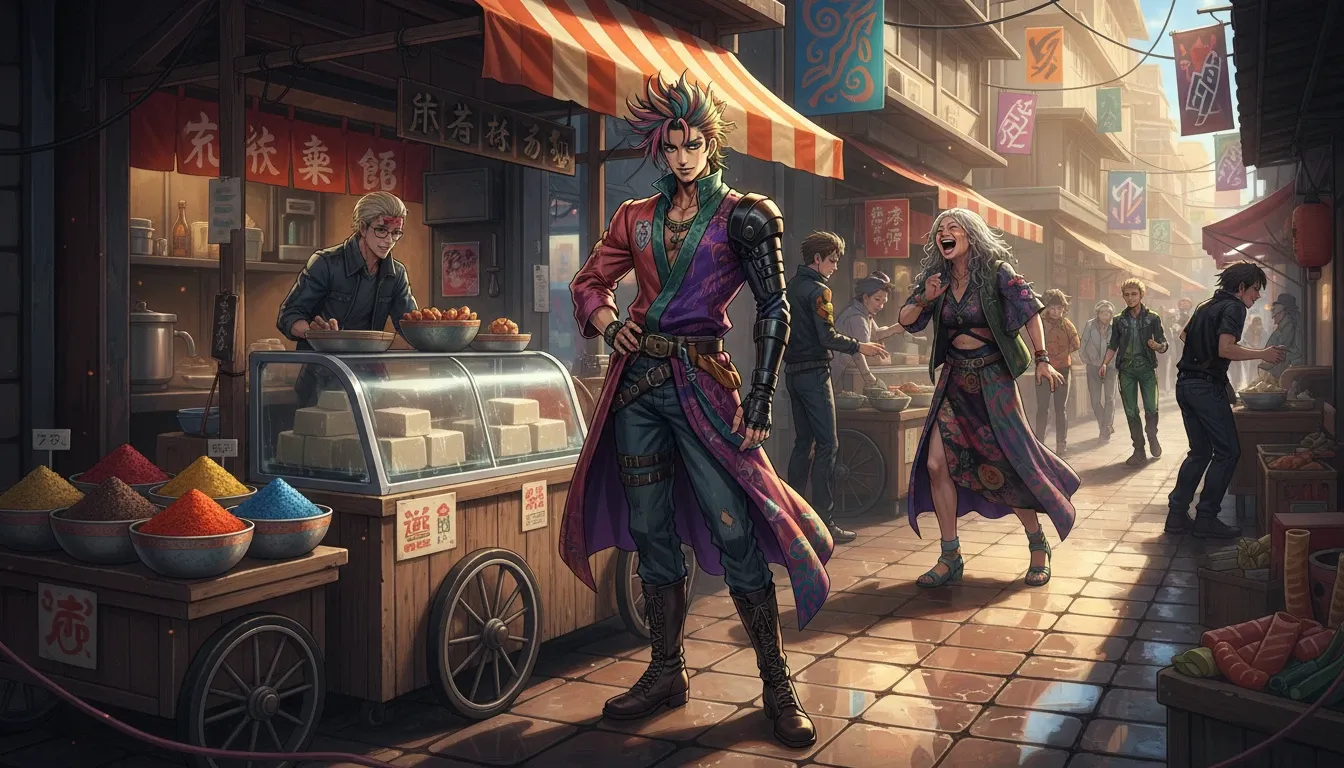
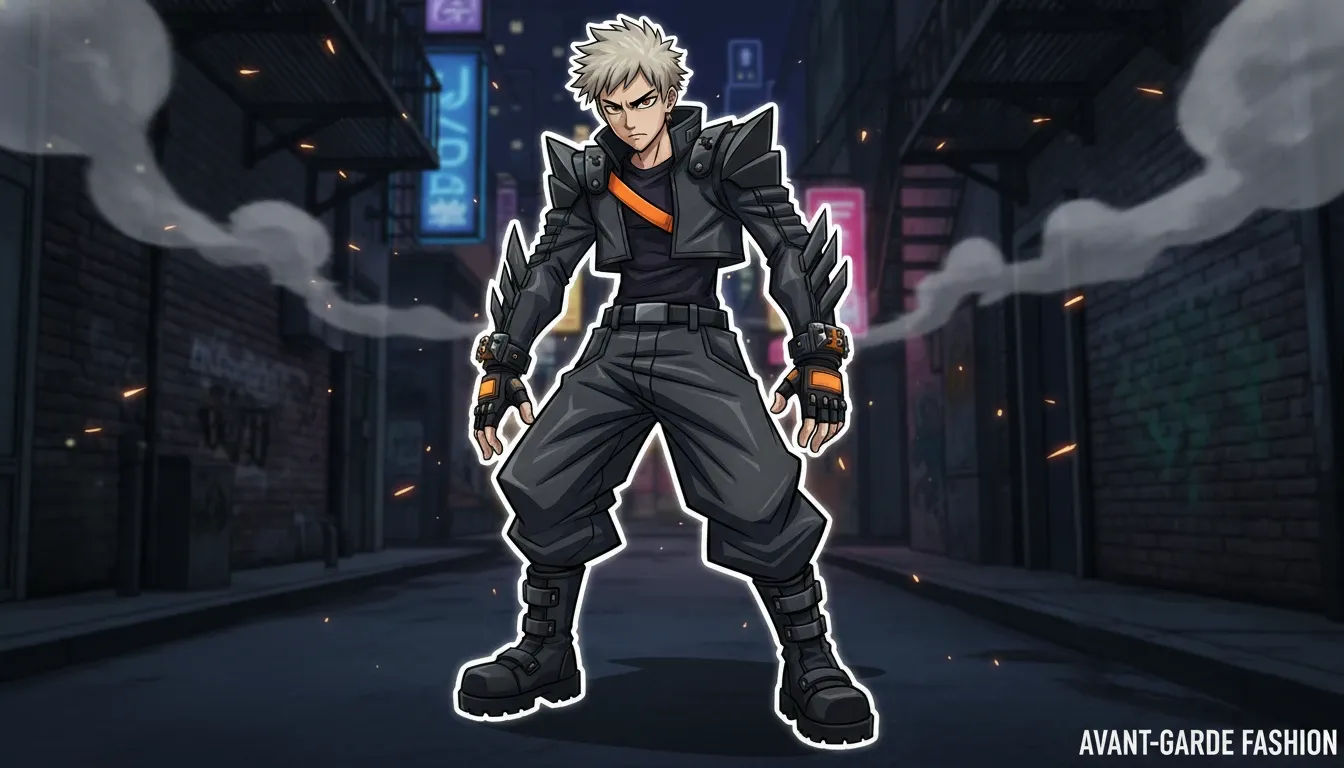
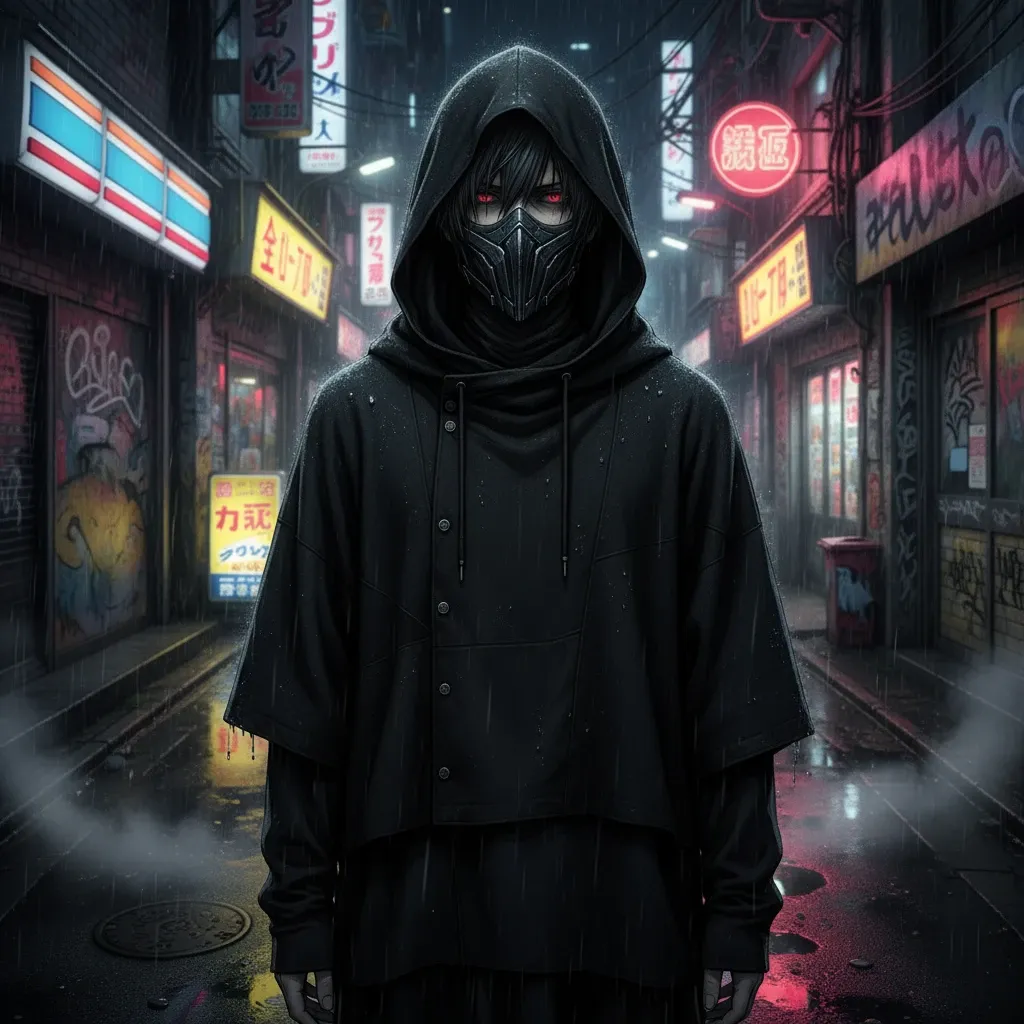
A street market at dawn, vibrant with sounds and colors. A figure resembling Saitama in avant-garde streetwear, bold silhouettes layered, apron stained with soy foam, picking yellow soybeans. Light filters through the market stalls, casting soft shadows, creating a warm, inviting atmosphere. The background filled with animated aunties, fish stalls, and burlap sacks. Textures of fabric contrast with the wet surfaces of fresh produce. Saitama's expression is thoughtful, embodying both strength and softness, surrounded by the bustling life of the market
The market wakes before the sun. It wakes by sound first: knife-on-wood clacks from the pork stall, the damp slap of fish against enamel basins, the sing-song bargaining that rises and falls like breath. My corner—two folding tables, a tin scale with a needle that trembles when someone exhales near it—smells of wet burlap sacks and warm soy. I used to teach philosophy under fluorescent lights, chalk dust on my cuffs, sentences arranged like neat rows of desks. Now I teach with my hands in cold water.
The aunties call me “Tofu Socrates,” half-teasing, half-claiming me as theirs. They say it the way they say “Doctor” when they point at a man who knows where the veins hide in a fish. I don’t correct them. I just keep picking beans.
I pick yellow soybeans the way I once picked arguments: slowly, with an eye for the hairline crack. Good beans are smooth and heavy, their skins tight like well-rested faces. Bad ones are shriveled, mouse-bitten, or the color of old teeth. You can’t lecture a rotten bean into becoming sweet. You can only remove it before it poisons the pot.
A woman in a red apron leans in, her hair still damp from washing rice. “Teacher,” she says, though she never knew me at the university, “my son refuses to take the civil service exam. He says the world is pointless.”
I roll a handful of beans between my palms. They sound like dry rain. “When you grind them,” I tell her, “they lose the shape they were proud of. They become paste, then milk. If a bean insists on staying a bean, it never becomes breakfast.”
She snorts. “So you’re saying he should be ground?”
“I’m saying he should choose what he’s willing to lose,” I reply. “Not what he’s afraid to lose.”
That is how our conversations begin here: with the body. With weight and heat and the stubborn physics of a day. The market is a better classroom than the campus ever was, because a question asked beside a steaming vat is always urgent. You can smell the stakes.
Some mornings, I think about Saitama—One Punch Man, the bald hero who can end the argument of violence with a single, bored gesture. People come to him the way they come to my stall: wanting a simple answer that tastes clean, wanting certainty wrapped in paper. But Saitama’s power is also a kind of exile. When every fight ends in one punch, what’s left is the awkward silence after the applause, the itch you can’t scratch because there is no longer any resistance.
Streetwear understands that itch. It understands that the body wants armor even when it knows the bullets are imaginary. That is why the idea of a “Saitama Streetwear Fusion With Avant Garde Layering And Bold Silhouettes” makes sense to me in the same way tofu does: it is softness pretending to be structure, or structure admitting it is soft.
In my stall’s cracked mirror—leftover from when the previous owner sold phone cases—I sometimes catch my reflection: apron stained with soy foam, sleeves rolled, wrists speckled with okara. And I imagine Saitama not as a gag, not as a meme, but as a man in the market, feeling the air stick to his skin. What would he wear if he had to stand here six hours, lifting water, dodging scooters, letting strangers evaluate him with a glance?
He would wear layers, not because he needs warmth, but because he needs friction. A long, asymmetric overshirt that swings when he turns, forcing the world to notice movement even when the face is blank. A high-collared inner piece that covers the throat like a vow. Wide trousers with a generous, sculpted drape—bold silhouettes that refuse to apologize for taking space, because the body has spent too long being asked to shrink.
Streetwear, when it is honest, is not decoration. It is negotiation. It says: I will not be reduced to your single label. It is a refusal as physical as crossing your arms.
Avant-garde layering goes further. It doesn’t just dress the body; it questions the body’s outline. A sleeve that ends too soon, exposing the forearm like an unfinished sentence. A hem that tilts, making the hips look like they are stepping out of alignment with the world. Fabric that is stiff where you expect it to be soft, soft where you expect stiffness—like tofu skin, yuba, that forms a membrane on hot soy milk: delicate, but it resists tearing if you lift it with respect.
That membrane is where philosophy lives. Not in the center, not in the conclusion, but in the thin place where heat meets air and becomes something new.
An older uncle comes to buy tofu, his hands smelling of machine oil even though he has been retired for years. He presses a thumb into the block as if testing a bruise. “It’s not as firm as last week,” he complains.
“The beans are different,” I say. “The millstone is the same.”
He lowers his voice, as if confessing a shame. “The last parts factory shut down two streets over. The one that still knew how to cut gears for old fans. My grandson said, ‘Why do you care? Just buy a new one.’” His eyes flick to mine, sharp and wet. “What do you do when the old system collapses and nobody even misses it?”
I pour soy milk through cloth. The liquid is warm, the steam smelling like grass after rain. The cloth bites into my fingers as I twist it; my knuckles whiten. “You do what the bean does,” I tell him. “You accept you cannot remain whole. You become useful in a new form. But you don’t pretend the loss is nothing.”
This is a detail outsiders don’t see: in the back alley behind the market, under a loose brick, I keep a small, flat wrench from the tofu grinder’s original maker. The company name is stamped faintly, almost erased by years of sweat. That maker no longer exists. When their last workshop closed, there was no announcement, no obituary, just a silence where spare parts used to be. The wrench is not valuable in money. It is valuable as proof that a hand once understood this machine intimately. When it breaks, I will not be able to replace it quickly. I will have to learn to improvise, to file metal by lamp light, to make do. That is what collapse feels like: not drama, but delay.
In clothing, collapse shows up as a seam that can’t be replicated because the original patternmaker is gone. A fabric that can’t be sourced because the mill shut down. A silhouette that can’t be mass-produced because it requires stubborn, slow labor. So you layer, you patch, you tie, you re-route the garment’s logic. You make your outfit a small act of resistance against the clean efficiency that erases stories.
Saitama, fused with streetwear and avant-garde layering, becomes less about cosplay and more about confession. The bald head is the blank canvas; the clothes become the brushstrokes. Imagine a cape reinterpreted as a detachable back panel—technical straps, hardware that clicks like chopsticks against a bowl, a piece you can remove when you’re tired of performing heroism. Imagine gloves not as superhero costume, but as work gloves, scuffed, meant for carrying crates, reminding you that strength is also repetition.
A young woman with a shopping basket pauses, watching me skim foam from the soy milk. “Teacher,” she says, “my husband says my dreams are childish. He says I dress weird to get attention.”
The foam gathers in my ladle like pale clouds. “When soy milk boils,” I tell her, “it rises. If you don’t watch it, it spills, and you lose it all. Is rising childish? Or is it just what heat does?”
She looks at my hands, then at her own, chapped from detergent. “But if I keep rising, everything changes.”
“Yes,” I say. “That’s the point.”
Here is another small, time-earned truth outsiders don’t know: I once taught a seminar on cynicism—Diogenes, the barrel, the refusal of convention. After the semester ended, one of my best students stopped coming to class entirely. Years later, I saw him here in the market, not buying tofu, but carrying a sack of ice for the seafood stall. He avoided my eyes at first. Then he said, almost angrily, “You told us to question everything. I did. And the only job I could get was this.” His shoulders were hunched as if bracing for a punch.
I handed him a cup of hot soy milk for free. “Questioning is not a staircase,” I told him. “Sometimes it’s a shovel. It digs up what hurts.”
He drank it, and his face softened for one second, as if the warmth reached a place inside that words never did. I have never told anyone that. It is my quiet reminder: philosophy has consequences that are not graded, not abstract, and not always noble.
Streetwear, too, has consequences. A bold silhouette can invite stares, invitations, accusations. An asymmetric layer can make an auntie whisper, “Is she okay?” A monochrome palette can look like mourning. But sometimes mourning is appropriate. Sometimes the world deserves your grief displayed openly, like a long coat that drags the dust of the street.
Saitama’s blankness in One Punch Man is often played for laughs, but it is also a form of suffering: the boredom that comes when meaning is too easy to destroy. Avant-garde layering offers him a different kind of fight—not against monsters, but against sameness. Against the flattening of identity into a single gag: bald, strong, done.
If I were to dress him here, in my market, I would give him garments that require care: fabrics that crease and remember, straps that must be adjusted, pockets that force you to decide what to carry. I would give him weight—not armor, but intention. A long vest that swings behind him like a question mark. A cropped jacket over it, forcing the eye to accept contradiction. Trousers wide enough to feel like air, but structured enough to hold their stance.
Because when life refuses to give you a worthy opponent, you must create a worthy practice.
I lift the curds from the vat. They look like soft white weather, trembling. I press them into a mold lined with cloth. The tofu takes shape not through force alone, but through patience—the steady pressure, the time, the willingness to let water leave. That is also how a person becomes themselves: not by adding, but by pressing away what they no longer need, by accepting the ache of reduction.
In the market, the air is full of shouting and fried dough and exhaust. My apron is damp against my stomach. My fingers smell of soy no matter how much I wash. And in this noise, I think of Saitama walking past my stall, not as a joke, but as a man learning to dress his emptiness with form.
A passerby might see only clothes—avant-garde layers, bold silhouettes, a streetwear swagger stitched onto a superhero. But the ones who have stood over boiling soy milk know better. They know that style, like tofu, is the art of transformation under heat: the courage to let your old shape dissolve, and the patience to press yourself into something that can be held, sliced, shared.
“Two blocks of firm,” an auntie calls, waving a ten-yuan note. “And tell me, Teacher—if I keep doing the same things every day, is that living or just lasting?”
I wrap the tofu in paper. It leaks a little; the warmth fogs my glasses. “Lasting is living,” I say, “when you choose it. When you endure on purpose, not by accident.”
She takes the parcel like it’s fragile. She nods once, as if tasting the answer.
The knife-on-wood clacks again. The market breathes. I return to my beans, picking carefully, because even in a world where some can end everything with one punch, most of us build meaning the slow way: with layers, with pressure, with hands that remember heat.