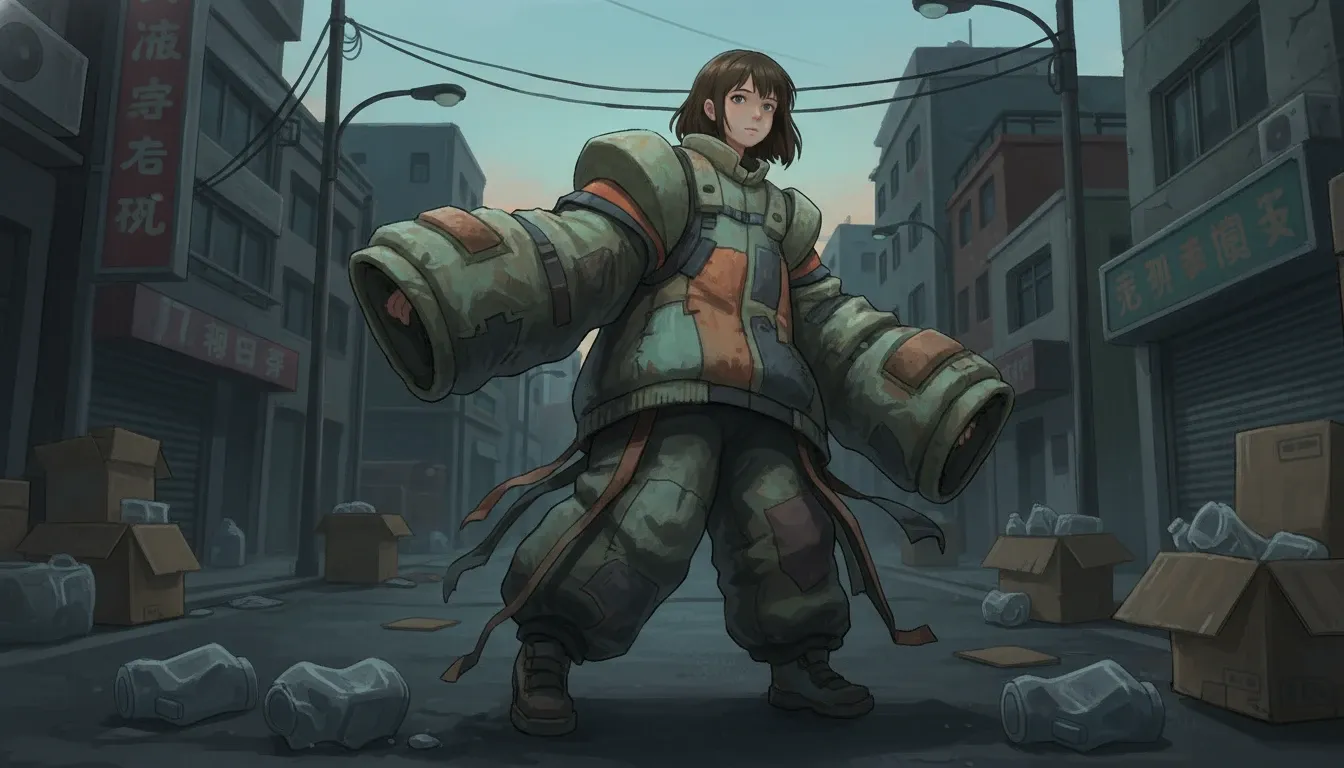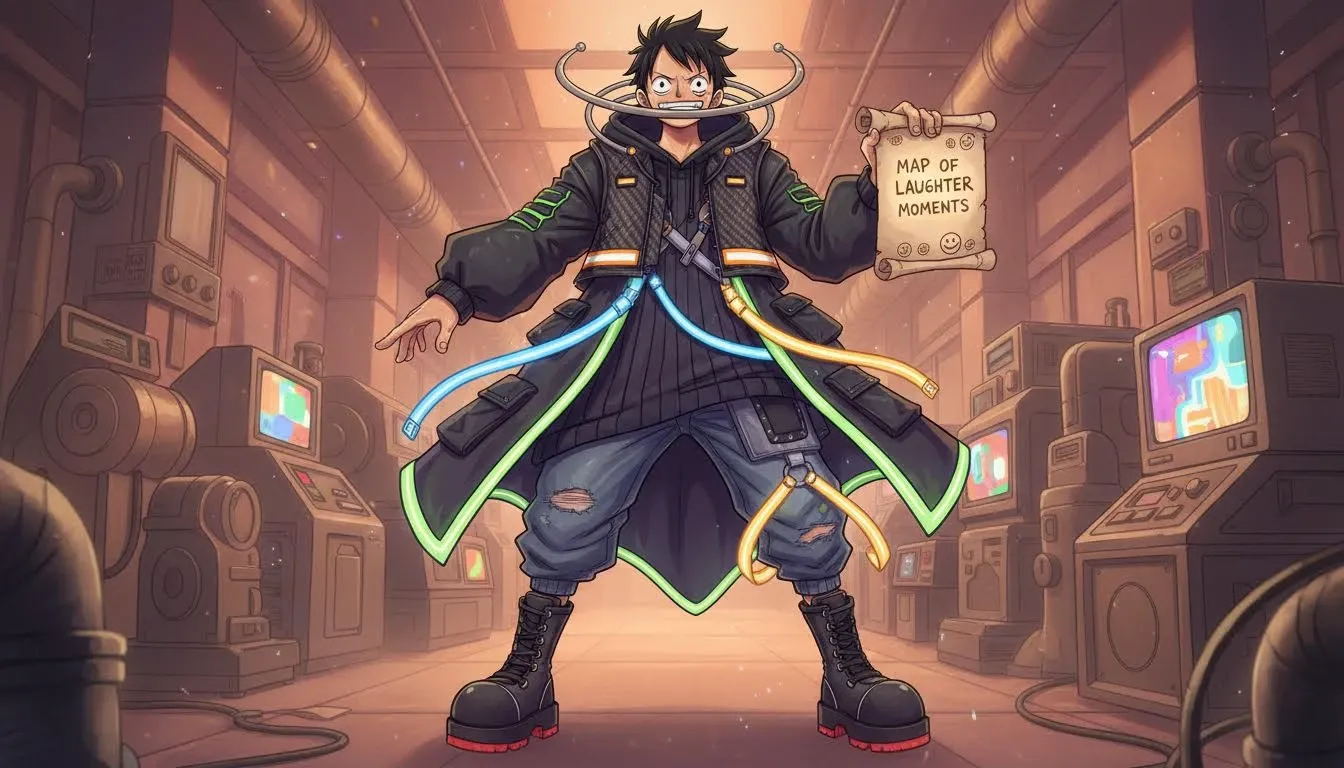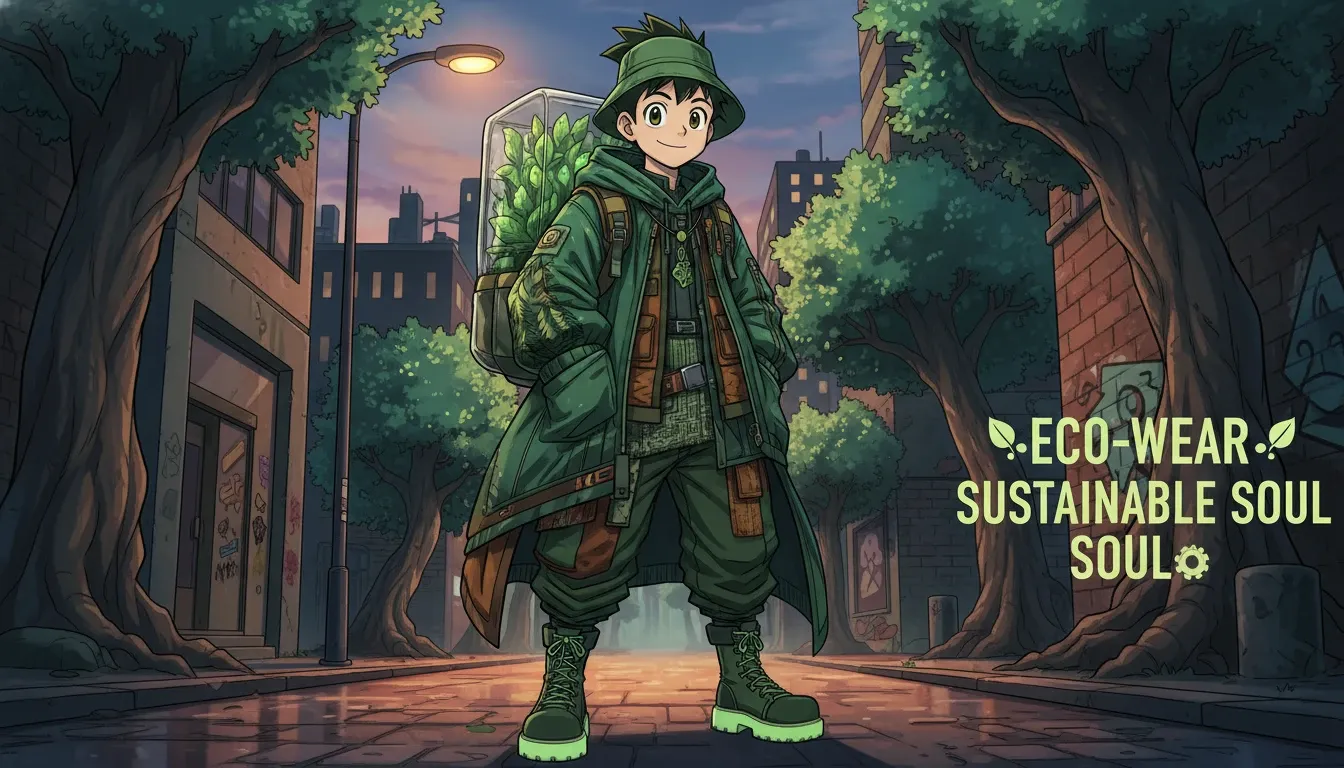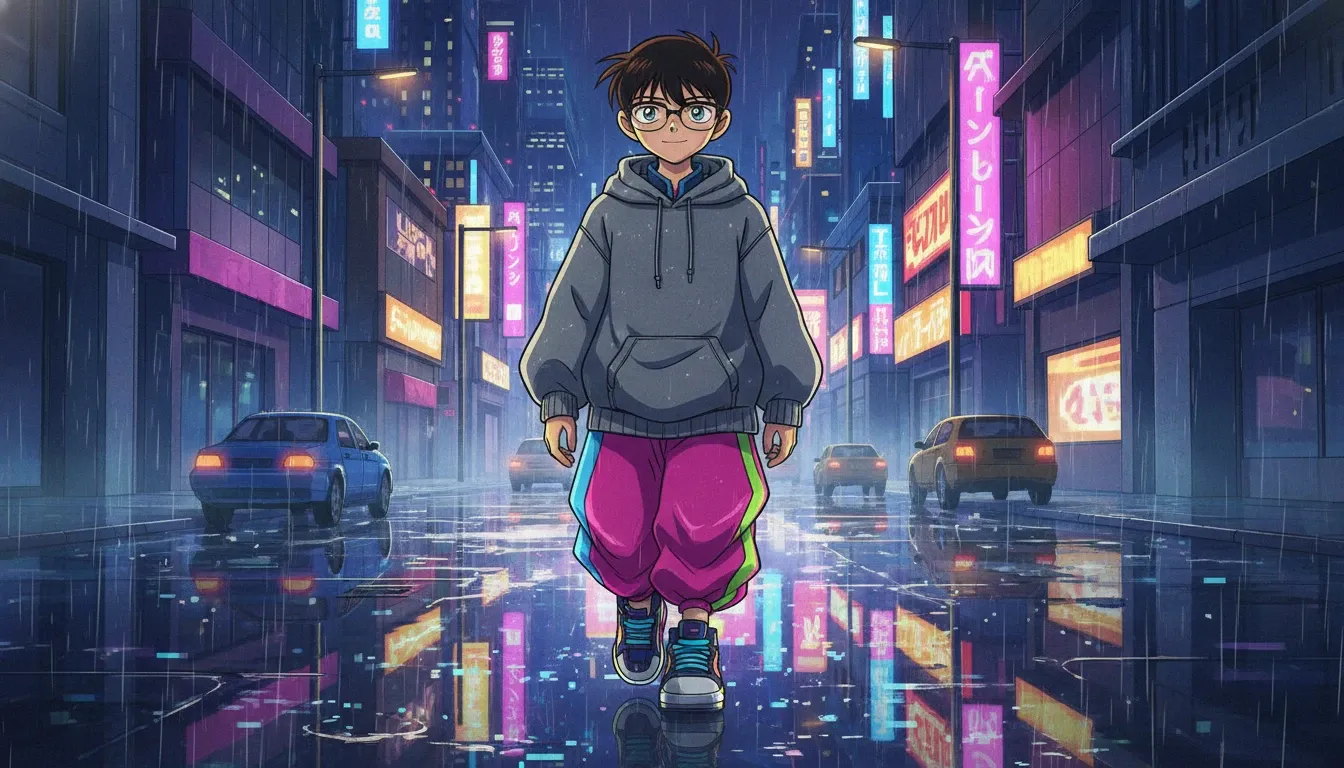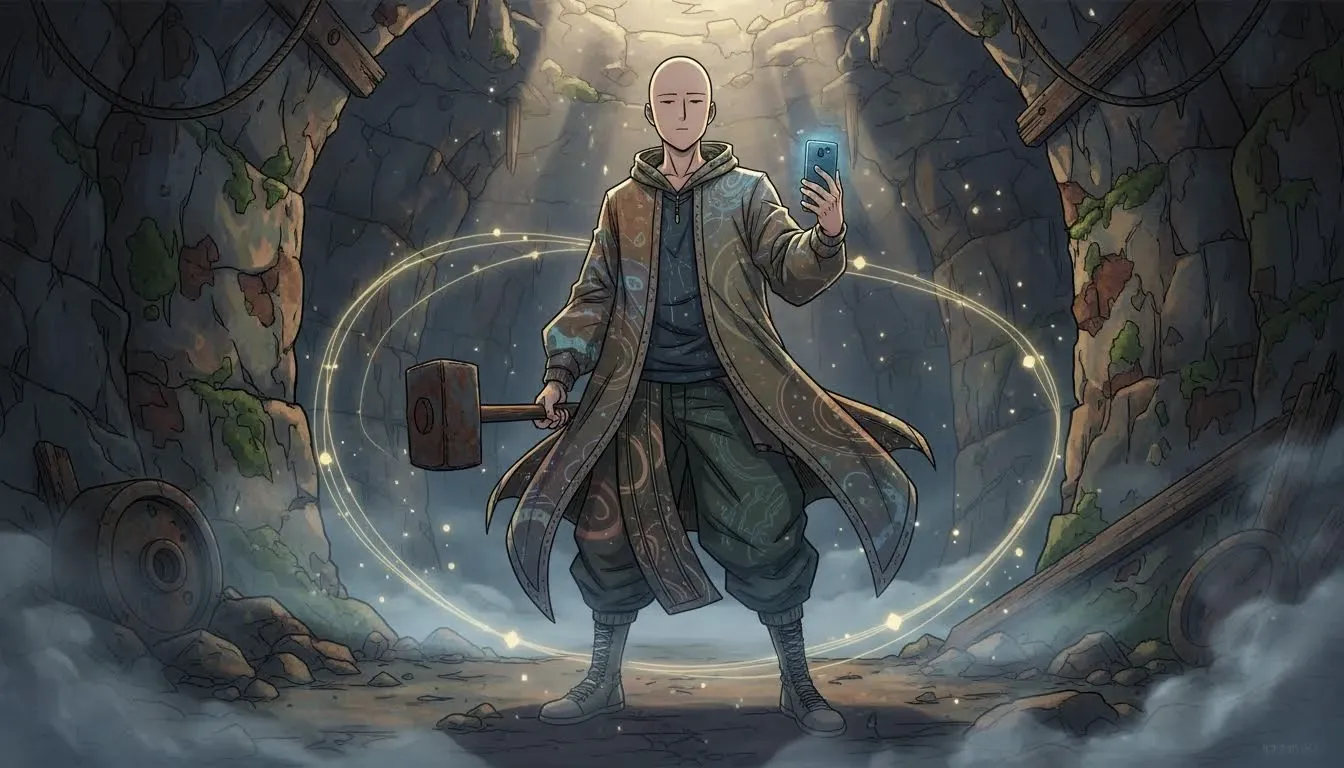
Saitama, in avantgarde streetwear, stands in a rusty mine, illuminated by soft, ethereal light. Layers of fabric drape lazily, blending earthy tones with cosmic patterns. The environment is gritty, with cracked rock walls and fog, while his expression remains blank yet powerful. He holds a weathered hammer in one hand, a smartphone glowing in the other, capturing the moment. Shadows play across the scene, accentuating the juxtaposition of decay and strength, embodying a quiet rebellion against societal expectations. A sense of cosmic energy pulses through the air, merging comic and realism
The Mine Turns Into a Catwalk When I Stop Apologizing
I quit my stable job on a Tuesday that smelled like copier toner and dead ambition—like the kind of day that convinces you you’re “being reasonable,” which is its own quiet threat. Then I drove back to the mining town where my father, a geologist, once taught me to read mountains the way other parents teach bedtime stories. Our mine is nearly shut, the kind of place that appears in policy speeches as a statistic, then disappears again behind fogged bus windows. The gate creaks like an old knee. The concrete is salted with rust. The air tastes faintly of iron and wet slate, like you licked a cold nail on a dare.
People here ask why I came back. I say work. I say family. I do not say that I wanted to see whether a place can be loved back into existence, the way you rub circulation into a hand that has gone numb.
And yes, I know how it sounds: romanticizing decay, turning rust into poetry. But standing there, with the wind pushing grit into my teeth, I can’t help thinking about how “reasonable” systems are designed to forget towns like this—quietly, efficiently, without malice. Like a product with a handle on the “wrong” side that never gets a second prototype, because the majority didn’t complain loudly enough…
Saitama would understand. Not the fame part, not the merchandising. The quiet, blank persistence. The power that looks like boredom until it moves.
My Father’s Hammer, My Phone’s Camera, One Ridiculous Hero
The mine is a grid of habits stamped into rock. Boots find old ledges. Fingers find old cracks. I carry my father’s field hammer, the one with the handle repaired by copper wire after he snapped it in a freeze and refused to buy a new one. The wire bites my palm, a thin, familiar pain, like a reminder in metal. I keep it with me not because I need it, but because it makes me move like a geologist, not a scavenger.
My other tool is my phone, held close to my face while I live stream from the lip of a flooded shaft. The screen glows against my cheeks. My voice comes out confident, almost theatrical, and I hear it bounce back from the rock walls. The audience scrolls fast, hungry for spectacle. They want danger. They want sparkle. They want a girl in a hard hat to pronounce words like “pegmatite” as if she’s casting a spell.
Sometimes I give them what they want.
Sometimes I think about Saitama standing in a grocery aisle, staring at discounts like they are the true final boss. People call him lazy, but it is something else. It is refusal. He refuses to decorate his strength with drama. He refuses to perform effort.
That refusal is a kind of avantgarde streetwear itself, if you look at it right—
or maybe I’m just trying to justify why I trust a bald cartoon man more than I trust the “hustle” voices in my feed.
Avantgarde Streetwear Chaos, but Make It Geological
Here is my biased thesis, and I know it will annoy someone with a fashion degree. Lazy layers are not laziness. They are tectonics. You stack fabrics the way the Earth stacks time, one unremarkable season on top of another, compressing and compressing until heat and pressure do their private work. A hoodie slumped under a sculptural coat, a skirt over work pants, a scarf tied wrong on purpose, all of it looks like chaos until you realize it is a record.
In the mine, I find crystals that grew in the dark with no audience at all. Quartz points like frozen breaths. Mica that flakes like old gossip. Garnet knots that look like stubborn little hearts. Their beauty is not designed. It is accumulated.
So when I watch avantgarde streetwear shows online at night, my hands still stained with clay, I do not see costumes. I see metamorphism. I see a runway where the models are moving cross sections. I see a sleeve that drapes like a fault scarp. I see a collar that rises like a tilted stratum. I see asymmetry as honesty.
And “asymmetry as honesty” sounds like something you’d print on a tote bag, doesn’t it. I hate that I like it. But then I remember my aunt—left-handed—spending her whole life forcing her fingers into right-handed scissors, cutting fabric with a tiny daily violence no one ever named. Most “good design” is just the majority’s comfort dressed up as universality. So when a collector rubs a “failed” object and feels the wrongness, maybe what they’re touching isn’t failure at all. Maybe it’s a whole excluded handshape, finally acknowledged.
Saitama, dropped into that chaos, would still wear his plain suit. And somehow, that plainness would become the loudest silhouette in the room, like a single uncut crystal among rhinestones.
The Secret Details I Never Put on the Stream
There are things I do not tell the chat.
The Tool I Will Not Lose
That copper wired hammer handle. Under the wire, my father burned two tiny marks into the wood, so close together you would think it is accidental. It is not. They are coordinates. Not GPS, older than that, paced out from a specific boulder outside the west adit. He taught me to find the spot by counting steps on uneven ground, because uneven ground makes you honest. I followed those marks once, alone, and found a pocket of smoky quartz that looked like it had been waiting for my hands, patient as buried history.
I never mention that on camera. Some maps are not meant to be shared.
Also: the “coordinates” thing is not a cute metaphor. Old-timers really did pace and sight off landmarks when paper maps got wet, when compasses got weird near iron-heavy rock, when batteries were a fantasy. It’s not mystical, it’s just stubborn field practice—
and it works.
The Box of Failures Under My Bed
I sell polished specimens in my online shop. They ship clean, labeled, boxed like small certainties. But under my bed is a plastic crate I never open on stream. It holds my failed resin casts, crystals trapped in bubbles, labels smeared, stones I cracked too hard because I wanted symmetry, because I wanted perfection, because I thought the audience would punish me for a fracture.
The box smells faintly of acetone and shame. I keep it anyway, because it is proof I am not a curated person. It is my private geology of mistakes, layers of effort that did not turn into a product, only into me.
“Acetone and shame” is melodramatic, I know. But smell is how the body tattles. You can talk yourself into bravery; your nose will still remember every bad decision you tried to sand down.
The Recording I Have Never Played for Anyone
In the deepest part of the old haulage tunnel, where the walls sweat and the air goes thin, I once found an intact patch of drill marks, perfectly spaced, like a dotted line leading into the rock. That pattern is from my father’s last survey shift before he got sick. I recorded the sound down there, just the drip, the distant creak of timbers, my own breath loud inside my helmet. And at the end of the recording, you can hear my father’s voice, faint, because I had accidentally hit play on an old voicemail while my phone was still recording.
He says, not about love, not about pride, but about strata. He says, You can always tell where the story changes if you stop trying to hurry it.
I have listened to that line so many times it has become a pulse in my wrist. I have never posted it. Some epic lines are too sharp to hand to strangers.
And maybe I’m scared the chat would turn it into content. Clip it. Caption it. Sell it back to me as a “moment.”
I don’t want my father’s voice to become a sticker.
The Runway I Build With Mud on My Knees
In the mornings, I climb down with a rope that rasps my gloves. My knees find gravel. My fingertips brush cold crystal faces, slick as teeth. When I pull a specimen free, it makes a small sound, a reluctant pop, like the Earth letting go of a secret.
Then I go home and wash the stones in a plastic basin. The water turns cloudy. The grit slides under my nails. The crystals catch sunlight from my kitchen window and throw it back in slanted shards, turning my cheap table into a cosmic disco. I set up my live stream with a chipped mug as a phone stand, because I refuse to buy a ring light when I can borrow the sun.
I talk about the stones like they are characters. This quartz grew in a fracture when the mountain was under stress, then it healed itself slowly with silica, the way a body grows scar tissue. This fluorite remembers hot fluids rising like gossip through cracks. This banded agate is a patient loop of repetition, a lazy layer becoming a masterpiece because it did not quit.
I used to say things like that with more certainty, like I was reading from a textbook. But the truth is, half the time I’m guessing the story the stone wants. The chat loves confidence; the rock doesn’t care. The rock just sits there, ancient, refusing my narrative—
and that refusal is oddly comforting.
The chat asks for outfit links. I laugh. I hold up my work jacket, stained with rust and mineral dust, and say this is my runway look today. There is avantgarde in survival. There is streetwear in a town where the street is cracked and the wind carries fine grit that polishes your boots whether you want it or not.
When Saitama Meets My Town, He Does Not Save It With Punches
I keep imagining Saitama standing at the mine gate with his blank face and cheap gloves. He would not deliver a speech. He would not cry. He would not promise to fix the economy.
He would do something smaller and weirder. He would show up, day after day, and carry things. He would stack sandbags. He would sweep dust. He would help me drag a heavy bucket of specimens up a slope without making it a heroic moment. That is the kind of strength my town needs. The kind that looks like laziness until you realize it is consistency.
Avantgarde streetwear chaos is not chaos when you wear it long enough. It becomes your map. It becomes your skin. Lazy layers become cosmic power when you stop performing urgency and start building pressure, quietly, in the dark.
That is what I am doing here, with my father’s hammer biting my palm, with my secret failures under my bed, with that recording in my phone that I treat like a relic. I am building a runway out of rubble. I am telling geological epics to people who have never tasted iron in the air, who have never heard a tunnel breathe.
And sometimes, when the crystal catches the light just right, I believe the town can catch it too.
Or maybe it doesn’t “catch” anything. Maybe it just keeps existing—stubborn, unglamorous, refusing to be a footnote…
and maybe that’s the only kind of salvation I trust.