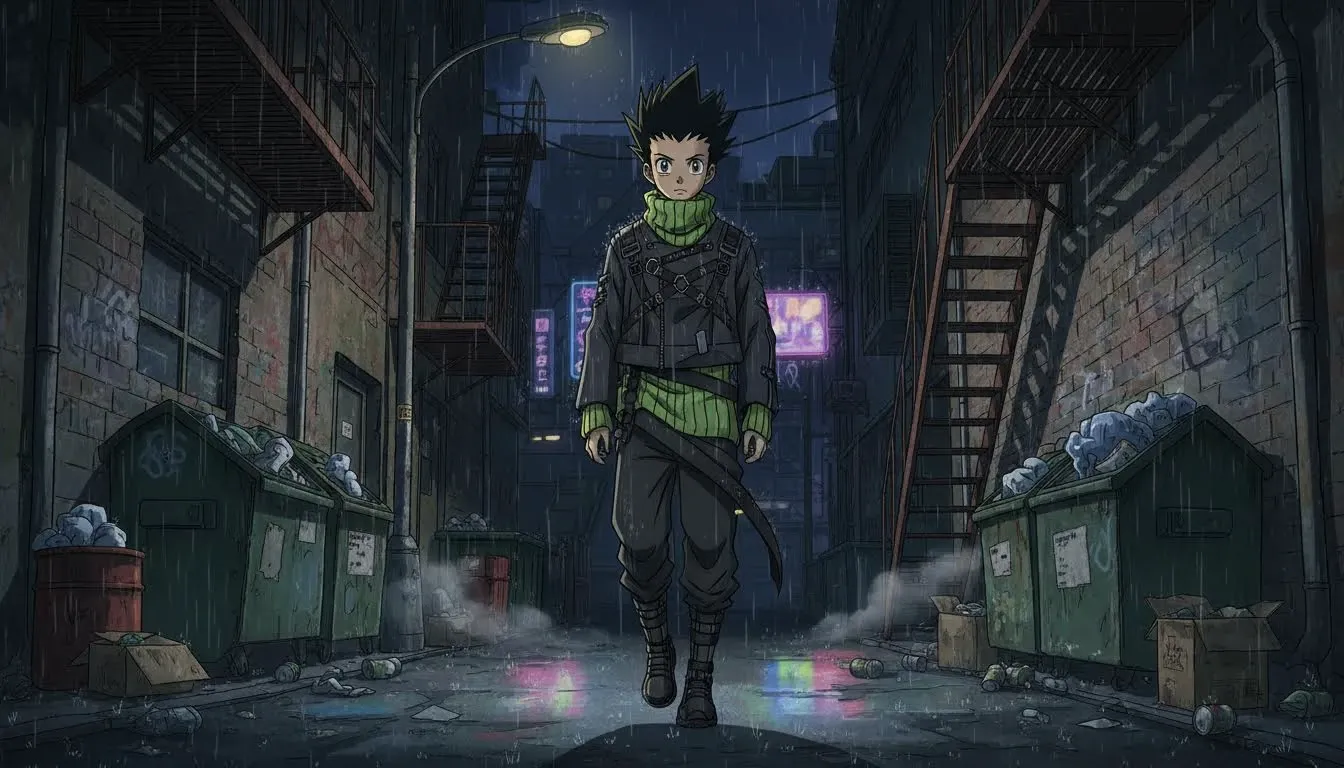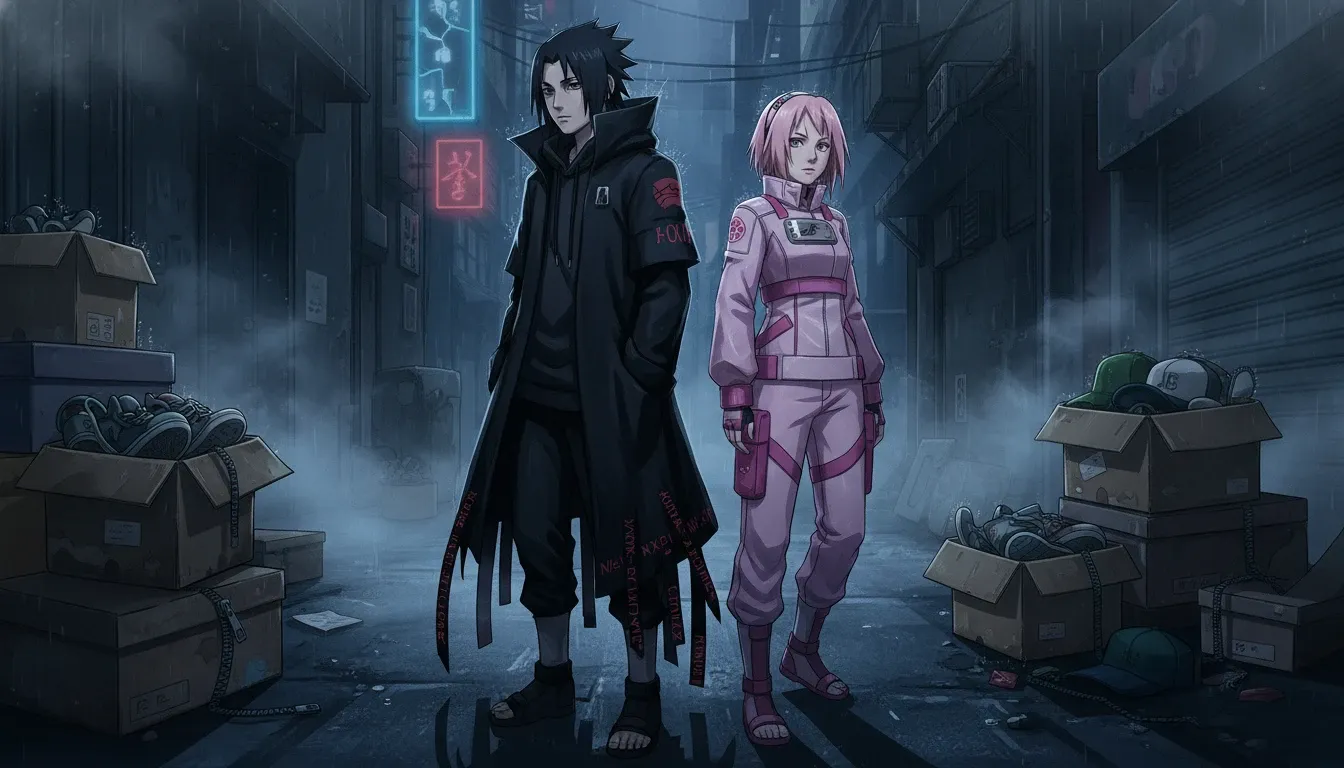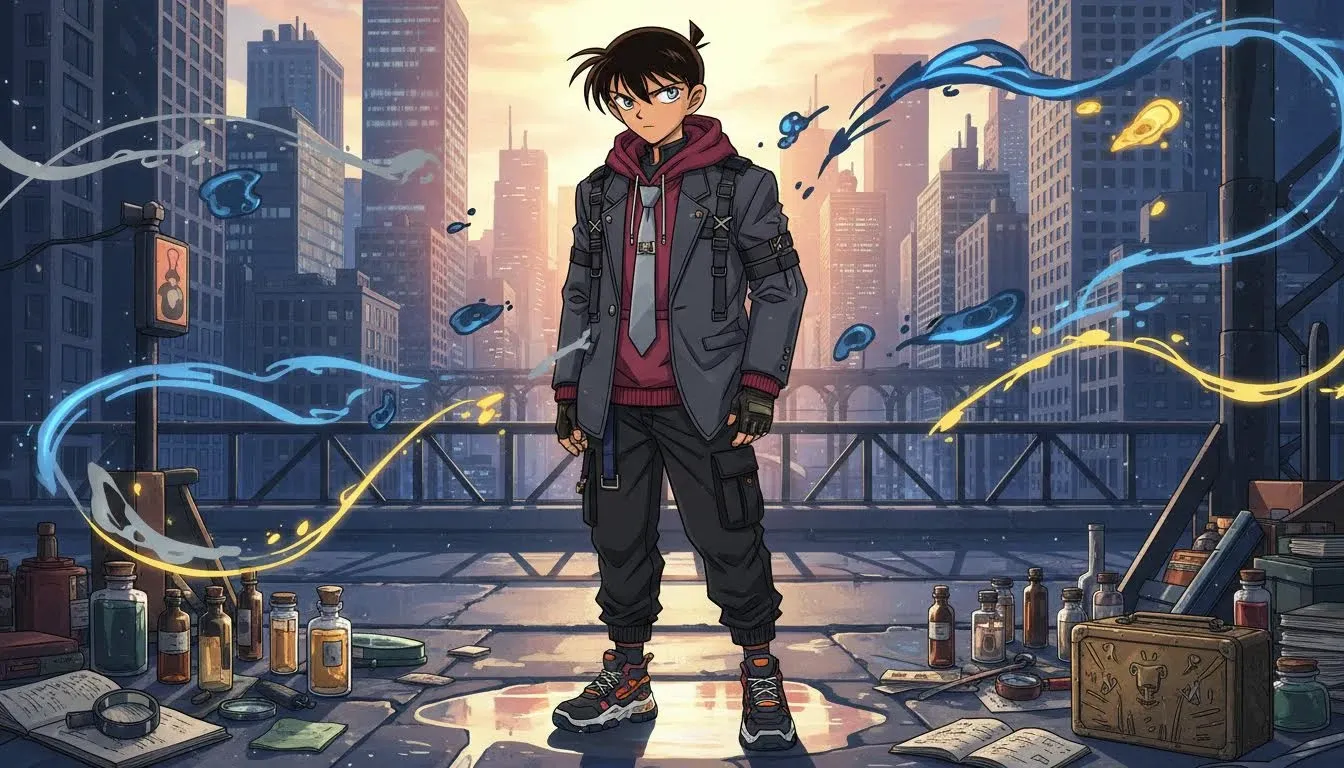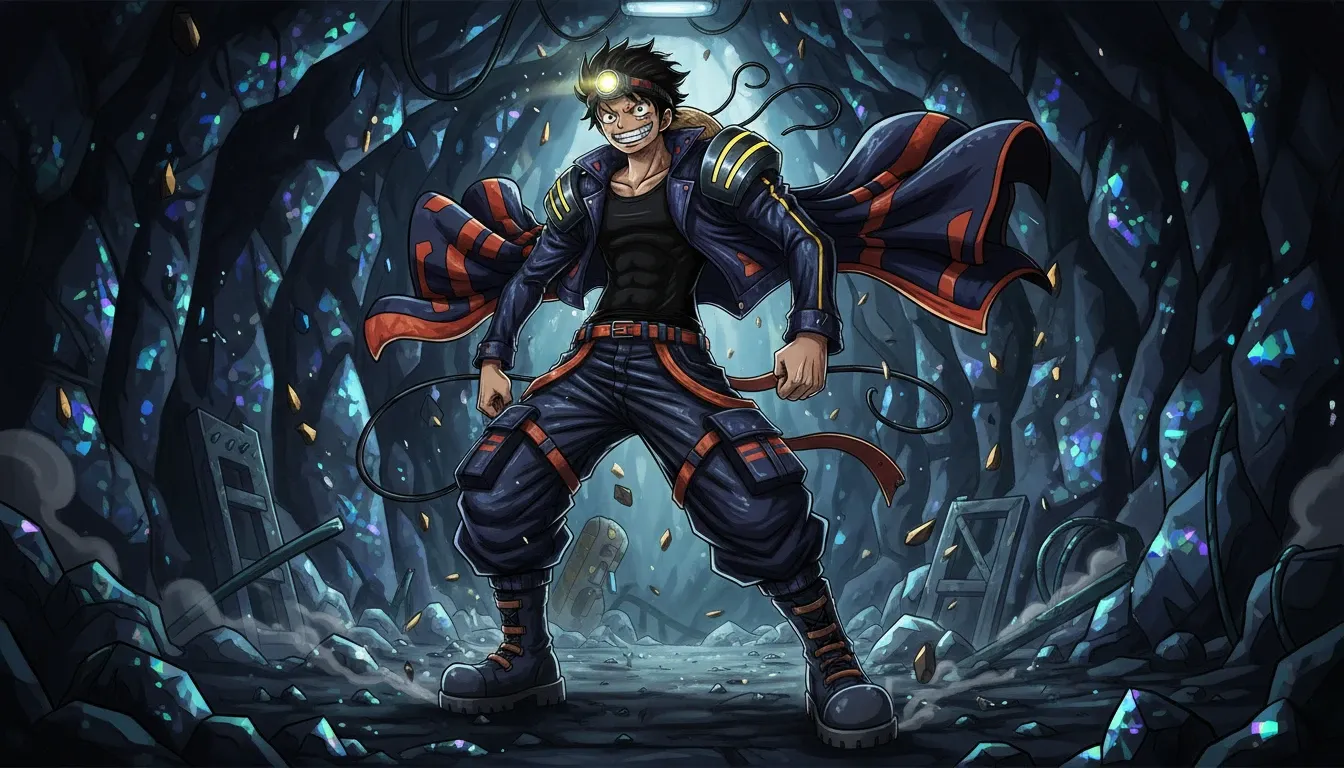
A dynamic blend of Luffy in avant-garde streetwear, layered outfits with bold silhouettes. The undershirt clings to the body, a cropped asymmetrical jacket flaps like a flag in stormy winds. Futuristic rubberized shoulder armor contrasts with the gritty mining backdrop, illuminated by the harsh beam of a headlamp. The environment features crystalline walls glimmering with mica, while Luffy’s expression embodies reckless hunger and defiance. The scene is infused with a sense of movement and resilience, highlighting the tension between past struggles and vibrant creativity
The mine taught me to read time by touch.
When I resigned from my stable job in the city, the HR office smelled like printer toner and lemon disinfectant—clean, obedient, forgettable. My suitcase smelled like dust even before I packed it. I went back to the mining town where my father mapped faults with a pencil worn down to a splinter, and where the last shift whistle had already begun to sound like a dying bird. The mine was “temporarily suspended” on paper, “nearly closed” in conversation, and in truth it was just a body left on the table—still warm in some places, already stiff in others.
I slipped into the abandoned pit at dawn with a headlamp, gloves, and a plastic box for crystals. The air down there had its own flavor: iron, wet stone, a faint bitterness like chewing aspirin. In the beam, the walls glittered with tiny mica flakes like someone had spilled crushed mirrors and then forgot. When I found a pocket of quartz, it wasn’t “beautiful” first—it was cold, slick, and stubbornly heavy, like truth. Only after my palms started to ache did it turn into something I could hold up to the camera and call a miracle.
That’s how my work began again: not with a title, but with weight.
At night I livestream from my old bedroom, the wallpaper still printed with faded constellations. I show the stones close enough that people can see inclusions like trapped smoke. I tell them the epic behind each piece: volcanic breath cooling into glass, oceans retreating and returning, pressure stacking its invisible hands for millions of years. And then, because life is never only science, I tell them what the rock costs me—skin scraped on shale, the way my knees tremble when the ladder flexes.
Somewhere between those stories, I started stitching Luffy into the mine.
Not the polite, souvenir-shop Luffy—smiling on keychains under fluorescent lights. I mean Luffy as a feeling: reckless hunger, a body thrown forward, a grin that refuses to negotiate. My town needed that kind of refusal. My customers needed it too. In their comments they wrote about dead-end internships, about apartments with windows that never open, about the tiredness in their mothers’ voices. They didn’t ask for fashion tips. They asked for a reason to keep moving.
So I built a “One Piece Luffy Streetwear Remix With Avant Garde Layering And Bold Futuristic Silhouettes” the way I build a mineral specimen box: careful, risky, and willing to look a little insane.
The first layer is always the skin: a breathable undershirt that clings slightly when you sweat, like the mine’s humidity clings to your throat. Over that, a cropped jacket with asymmetrical closure—one side buckled, the other left to flap. I want the garment to behave like a flag in storm wind, because Luffy doesn’t walk like a diagram; he moves like a dare. The collar sits high and slightly twisted, inspired by the way fault lines never meet politely. One shoulder is armored with a matte, rubberized panel—futuristic, yes—but I choose it for the same reason I wear elbow pads in the pit: impact is not theoretical.
Then comes the layering that makes people lean closer. A long, semi-transparent overshirt—organza or technical mesh—printed with contour-like lines, like a topographic map that got tired of being flat. Under the studio light it looks like water. Under streetlight it looks like smoke. When you raise your arms, the fabric reveals and hides, the way a quartz cluster reveals and hides its faces depending on the angle. The hem is cut unevenly, one side grazing the thigh, the other ending at the hip—an imbalance that feels like the first step onto a loose rock.
If you want bold futuristic silhouettes, you can’t be afraid of volume. I love wide-leg cargo trousers with sculpted knees and pocket flares that catch air. They create a shape like a ship’s sail—soft geometry that suggests speed even when you stand still. The pockets are not decoration; they’re storage for the small survival objects the city forgets: a foldable mask, a snack, a stone you picked up because it looked like a piece of meteor.
And then the Luffy element: not literal straw hats pasted everywhere, but a remix of his stubborn sunshine. I use a saturated yellow strap crossing the torso like a harness, as if the outfit is ready to climb. I add a red accent—sometimes a zipper tape, sometimes a single cuff—like a heartbeat you can see. The palette is not cute; it’s defiant. It says: I’m still here, even if my whole ecosystem wants me to be quiet.
There are details I don’t put in the product description because outsiders wouldn’t understand them, and because some knowledge should stay earned.
One: deep in the mine, behind a collapsed timber support, there is a seep that locals never talk about. It’s not a stream, just a slow, stubborn leak that beads on the rock like sweat. If you leave a clean jar there overnight, the water gathers a faint metallic sweetness and a pale film. Under a cheap UV light, the film glows a bruised green—subtle, not carnival-bright—because of trace minerals the old reports never bothered to mention. I learned it by waiting, by returning, by letting my patience get dirty. When I design reflective piping for a jacket seam, I’m thinking of that glow: hidden, earned, only visible when the light is right.
Two: the day the last spare-parts workshop shut down—the one that kept the ancient conveyor belts alive with hand-cut gaskets—my father didn’t curse. He just sat on the porch and rubbed his thumb over a cracked piece of rubber like it was a worry stone. The town’s old system didn’t collapse with an explosion; it collapsed with a silence so ordinary that people missed it. That night, I posted my first “specimen + styling” livestream. I didn’t announce a business plan. I held up a smoky quartz and said, “This was pressed into clarity by time. We can be too.” I chose to build a new supply chain out of stories and stitches because the old chain had already rusted away.
Three: there is a test I do on every crystal before I sell it, a ritual my father never wrote down. I breathe on the surface—just one warm exhale—and watch how the fog breaks. On good quartz, the mist fractures into tiny islands and vanishes quickly, like a thought that knows where to go. On treated glass, the fog clings longer, smearing like regret. It’s not a laboratory method. It’s a body method. When I talk about “future silhouettes,” I don’t mean plastic perfection; I mean garments that can take your breath, your sweat, your panic, and still look honest.
Sometimes people question the meaning of what I’m doing in the most direct way: “Why not get a real job?” “Isn’t the mine dangerous?” “Isn’t this just romanticizing ruin?” Their words land like gravel in the mouth. I answer with the sounds of my day: the click of carabiners, the scrape of a chisel, the soft thud of a crystal placed carefully into foam. I answer with receipts too—because romance doesn’t pay electricity—but I refuse to let the spreadsheet become the only language.
The streetwear remix is not a costume for anime fans. It’s a portable philosophy for anyone standing inside a failing system and choosing motion anyway. Avant garde layering becomes a way to carry multiple selves: the daughter of a geologist, the miner’s child who knows the taste of dust, the shop owner packing parcels with taped fingers, the streamer speaking into a ring light like it’s a campfire. Bold futuristic silhouettes become a way to make space around the body—space to breathe, to resist, to be seen.
When I ship an order, I slip in a small card with the stone’s “geologic biography” and a photo of the pit entrance at sunrise. My fingers smell like cardboard and mineral oil from the zipper machine. The tape makes a tearing sound like fabric ripping, like rock splitting along a weakness line. Sometimes, after I hit “confirm shipment,” I go outside and look toward the mine. The hill is dark, the air sharp, and the town feels like it’s holding its breath.
But I’ve learned this: breath is not only for surviving. Breath is also for shaping. Fog on quartz. Steam rising from tea. The warm cloud inside your scarf when winter bites.
Luffy would laugh at how carefully I explain it, and then he’d punch the horizon and run anyway. I don’t have his rubber body or his impossible luck. What I have is a mine that still whispers, and a wardrobe that can carry that whisper into the street—layer by layer, asymmetry by asymmetry—until my hometown’s name means something other than “closed.”