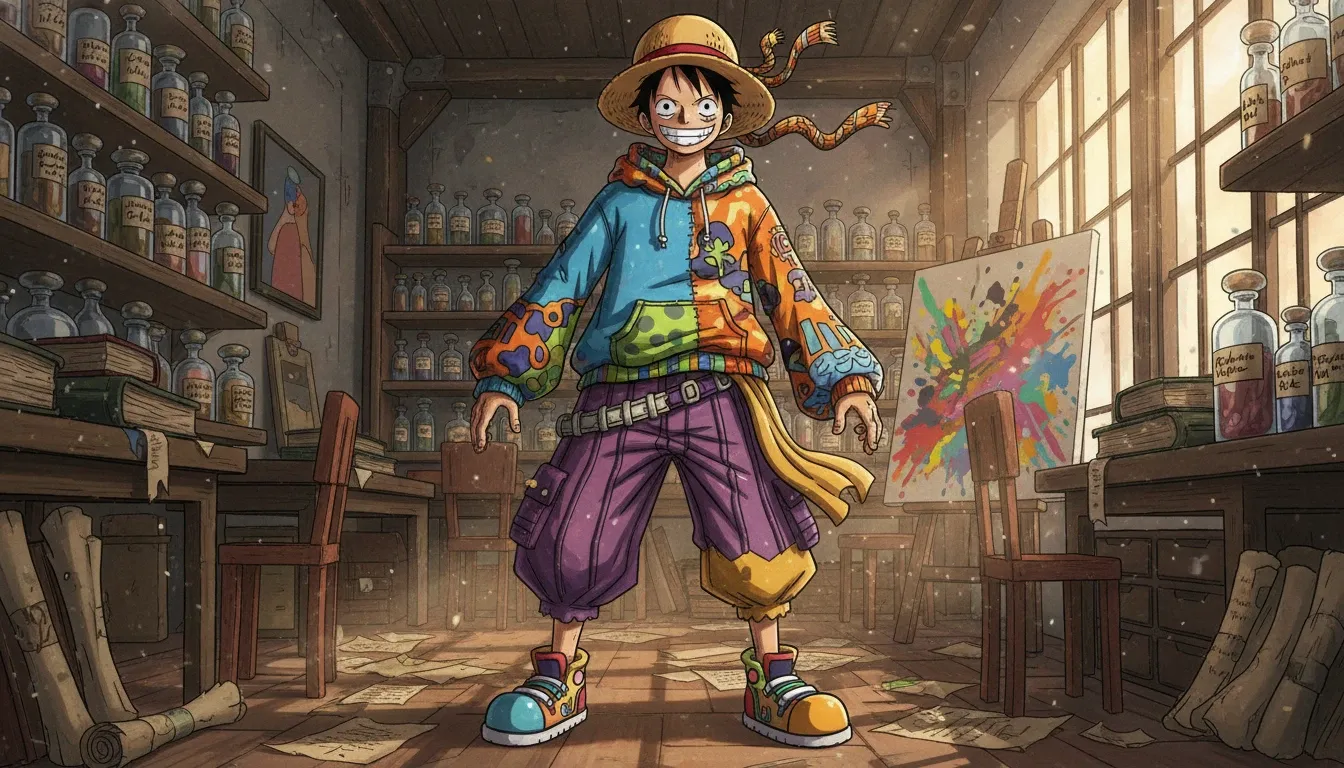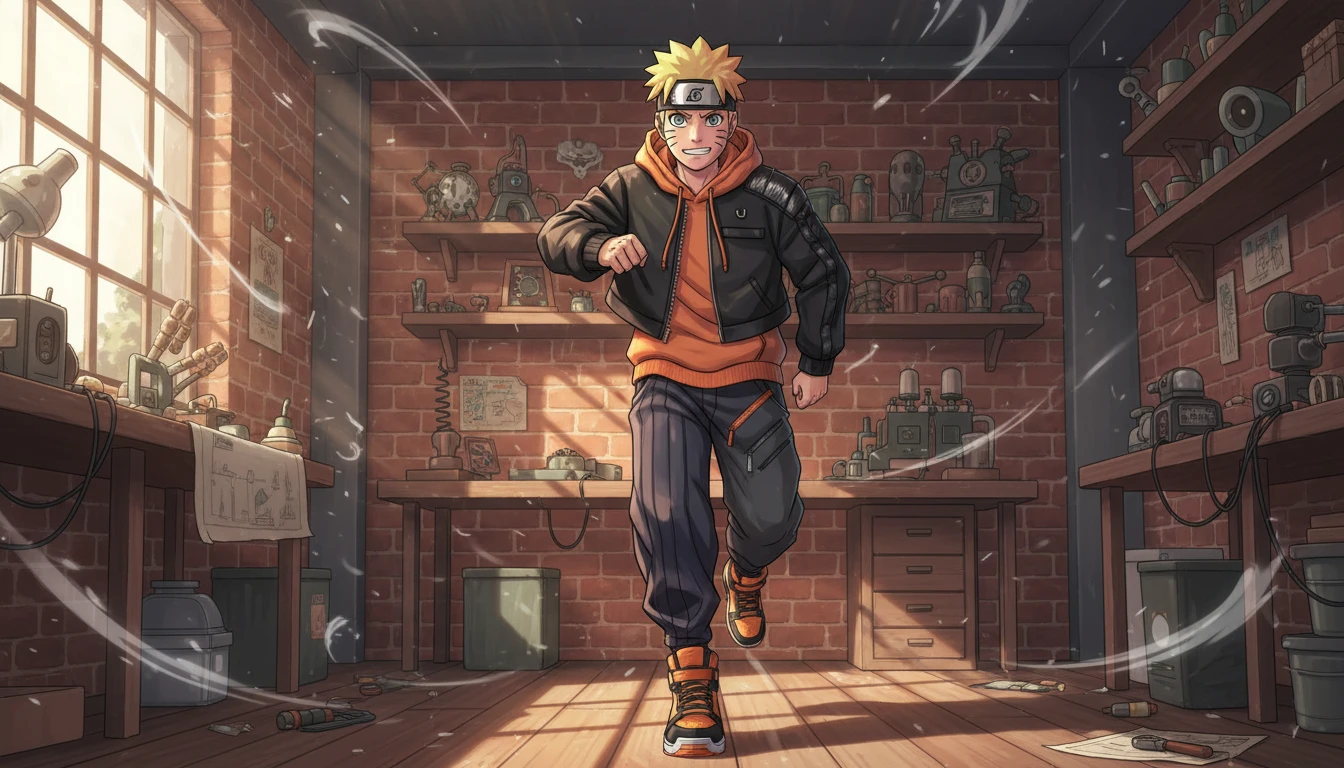
Naruto Uzumaki stands in a warm, cluttered workshop with muted brick walls, surrounded by quirky inventions. He wears bold avant-garde streetwear: a cropped utility shell with one carbon-fiber shoulder, a flame-orange longline hoodie, and exaggerated pants—one wide and pleated, the other tapered with zip vents. The sunlight filters through the window, creating dynamic shadows. His expression is lively, embodying forward motion, while the air is thick with creativity and a hint of rain. The textures of his clothing contrast with the workshop's metallic tools and wooden surfaces
At the dead end of an alley that smells like rain caught in old brick, my workshop door sticks the way stubborn ideas do. You have to shoulder it open. Inside, the air is warmer—hot with resin, scorched cotton, and that faint metallic tang that clings to your fingertips after you sand aluminum too long. On the shelves: inventions that never earned a factory line, patents that died of embarrassment. A portable cloud-making machine whose diagram promised “personal weather.” A cat piano designed with tiny weighted keys and a confidence only a nineteenth-century eccentric could possess. I rebuild these failures with modern materials, not to redeem them, but to keep their audacity breathing.
That’s how Naruto Uzumaki walked in—loud as a kettle, bright as hazard tape, carried on the kind of momentum that knocks tools off tables. Not literally, not in the way storybooks insist on literal. He walked in as a silhouette I couldn’t stop seeing in reflective surfaces: in the stainless belly of my vacuum former, in the glossy black of my curing chamber, in the slick puddle outside the door that held a trembling piece of sky.
Naruto is all forward motion. Streetwear, at its best, is forward motion too—fabric as intention, layers as weather, silhouettes as alarms. So I started building him the way I build the cloud machine: with faith in the impossible and a careful hand around the dangerous parts.
I pulled a bolt of hemp-cotton canvas from the rack. It rasped like dry leaves when I shook it out. I like hemp because it remembers. It creases honestly. It holds sweat, then releases it when you step into wind. I ran it under my palm and felt the micro-roughness catch the lines of my hand, like the material was taking fingerprints as a contract. Over it, a translucent membrane—TPU film that squeaks when folded, the same material I use to re-skin the “portable cloud” prototype so it won’t burst when the internal humidifier spikes. I wanted Naruto’s outfit to have that future-ready shine without losing the grit of a kid who grew up with ramen steam and chipped paint.
Bold layering is not just stacking; it’s choreography. A cropped utility shell, asymmetrical—one shoulder reinforced with molded carbon-fiber lattice (light as stubbornness), the other left raw-edged and stitched with thick thread that you can feel like rope under your nail. Under that, a longline hoodie in flame-orange but not the flat orange of cheap dye—this is orange that deepens near seams, like ember-core, because I overdye it and then wash it with enzyme so it blooms unevenly. The hood lining is a softer knit that smells faintly of chamomile from the finishing bath, the kind of small comfort you only notice when your ear brushes it.
The pants: exaggerated, kinetic. One leg wide and pleated like a banner, the other tapered with zip vents that open like gills. A belt system that looks overbuilt on purpose—webbing, anodized hardware, a magnetic buckle that clicks with a clean, satisfying certainty, like the snap of a well-tuned relay. Every time I test a buckle, I listen for the sound. Cheap ones clack. Good ones answer.
On the cutting table, patterns spread like a map to a country that doesn’t exist. I pin paper with brass weights scavenged from a defunct patent model: the cat piano’s key weights, polished into small moons. They’re colder than they look. When they touch fabric, the cloth holds its breath.
Naruto’s “vibe” is usually painted as sunshine. But sunlight is not a single thing. It’s glare on asphalt. It’s heat trapped between buildings. It’s the way a bright jacket becomes a beacon in a crowd and also a target. Avant-garde streetwear lets that contradiction live: the urge to be seen and the fear of being watched.
I sew late, when the alley goes quiet enough that I can hear thread sliding through needle—soft, rhythmic, almost insect-like. The machine oil smells sweet and industrial. I stitch reflective piping into seams in a way that doesn’t scream “safety gear,” but still catches headlights like a spell activated by motion. I laminate certain panels with aerogel-infused padding—thin, ghostly insulation that makes the body feel like it’s carrying its own microclimate. When you press it, it rebounds slowly, like memory foam dreaming.
There are details I don’t put online, the kind that don’t photograph well but change how a garment lives on skin.
First: hidden in the collar of the utility shell, a micro-etched code—tiny enough you need a loupe—copied from an obscure patent note I found after three nights of digging through old registries. It describes a “tactile reassurance ridge,” a raised pattern meant to calm pilots under stress. I translated it into a collar seam you can rub unconsciously. It’s for Naruto’s restless hands, for the moments when confidence is loud but nerves are louder.
Second: the lining pocket isn’t just a pocket. It’s a modular sleeve sized to fit a thin ceramic plate—impact-dispersing, the same kind I use to keep my cloud machine’s chamber from cracking when pressure fluctuates. It’s not armor cosplay; it’s pragmatic futurism. Streetwear as preparedness, not paranoia.
Third (and this is the one I would only admit to someone who understands obsession): I made a removable panel that attaches with concealed magnets along the left rib. It’s cut from a matte-black fabric that drinks light. The idea came from an argument—one that hasn’t happened publicly because the people involved prefer their conflicts to be quiet.
There’s a man who has been visiting my alley, always in shoes too clean for this part of town. An efficiency-obsessed investor, the kind who speaks in metrics as if feelings are a rounding error. He wants my “failed inventions” because he thinks failure is simply pre-market. He watches my hands more than my face. He offered to bankroll a production line of my portable cloud machine—turn audacity into subscription revenue. I told him my work isn’t a funnel.
Then Naruto, of all people, became the point of friction. The investor saw him as a brand vector: orange equals visibility, visibility equals conversion. Naruto saw him as another adult trying to turn a person into a poster. The conflict wasn’t loud. It was worse: polite. It happened over tea that went cold, over the soft tick of my curing lamp, over the investor’s insistence that asymmetry is “inefficient.”
But here’s the twist outsiders won’t predict: Naruto didn’t just reject him. He made a deal—on the condition that the investor spend one full night in my workshop, building something useless on purpose. Not a prototype for a pitch deck. Something that exists only because it’s funny and stubborn and strangely tender.
So we set him in front of the cat piano.
He fought it like it was an enemy at first—frowning, jaw tight, hands too fast. Then, somewhere past midnight, when the alley cats began their own arguments outside, he slowed down. He learned to listen to materials: the squeak of felt, the resistance of a spring, the way a tiny key can be tuned to a soft, ridiculous note. The investor’s shoulders dropped. He laughed once—surprised by himself, like laughter was a language he hadn’t practiced. In the morning, his spreadsheet brain looked different. Not healed. Just… less certain that everything needs to scale.
That night informed Naruto’s styling more than any runway reference. Because bold layering isn’t only about looking complex. It’s about carrying contradictions without tearing.
When Naruto wears the set, it doesn’t sit politely. It moves. The long hoodie hem flicks against the back of his knees like a flag in wind. The TPU panel catches streetlight and throws it back in shards. The asymmetrical shoulder makes him look slightly off-balance in the best way—like he’s always about to sprint, always about to change the rules. The hidden collar ridge gives his fingers something to do when he’s forced to stand still. The matte-black removable panel lets him disappear, just for a moment, when being bright feels like burning.
I watch him in the mirror that hangs by my soldering station, the glass stippled with old paint overspray. He is orange and shadow, noise and intent. He looks like a kid who turned himself into a future.
Outside, the alley air is cold enough to sting. Inside, my hands still smell of iron and citrus solvent. I think about all the inventions that never made it, all the patents that were laughed out of production rooms. I think about how streetwear, like those inventions, is often dismissed as trend—seasonal, disposable, hungry.
But in my workshop, nothing is seasonal. Everything is a prototype of belief.
And Naruto—Naruto is what happens when belief learns to dress itself in layers: loud enough to be found, strange enough to be free, engineered enough to survive whatever tomorrow throws like a brick through glass.