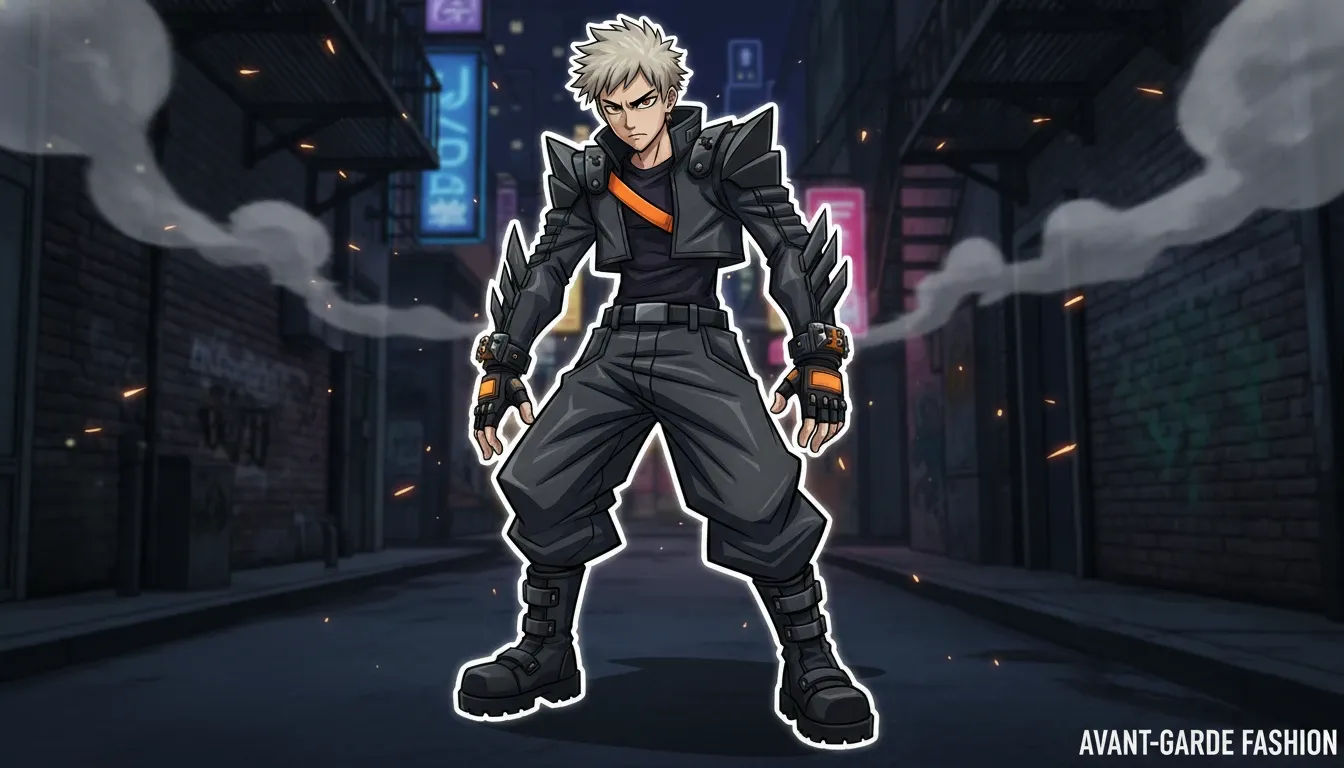
Avant-garde streetwear inspired by an explosive anime hero, a young man with ash-blond spiky hair and sharp eyes, standing in an urban alley at night. Cropped, structured jacket lifted as if by a blast, rigid shoulders with hidden boning, matte charcoal and ash tones with one violent neon orange strap. Voluminous, charged pants taper into heavy combat boots. Aggressive gloves as a focal point, industrial buckles and vents, faint smoke and sparks around him, dramatic rim lighting, high-detail, dynamic fashion illustration
A Firestorm You Can Wear, and the Misfires I Can’t Stop Collecting
The shelf is real. It sits a little too close to my desk, and on humid days it exhales this faint cocktail of old EVA foam, plasticizer, and whatever chemical optimism brands use when they swear this time the future will fit in a shoebox. Not literally scorched—most days—but the aura is there: a museum of good intentions that went sideways.
I collect failed products the way some people collect vinyl: lovingly, defensively, and with the faint dread that I’m turning into the kind of person who talks to strangers about injection‑mold seams. (Typing that, I can feel my neck stiffen, like my body is gently protesting my hobbies.)
So when someone says, “Bakugo streetwear, reimagined as an avant-garde firestorm of style and attitude,” I don’t hear hype. I hear risk. I hear the sweet crackle of a concept that might land like a grenade—or fizzle like a damp match. And I can’t resist standing close enough to feel the heat.
Bakugo isn’t subtle. He’s a walking detonation with teeth. If you translate him into clothing and you play it safe—clean bomber jacket, a couple of orange accents, a polite graphic on the back—you’ve already betrayed the point. Bakugo is not merch. He’s pressure. He’s ignition. He’s a design problem that should make your hands a little sweaty.
I like that problem.
I Don’t Trust “Streetwear” Until It Hurts a Little
Streetwear, as a word, has been ironed flat by commerce. It’s become a safe, padded room: logo, hoodie, limited drop, resale. But Bakugo demands abrasions. He should show up in your wardrobe the way a bad decision shows up in your group chat: loud, irreversible, kind of thrilling.
My bias—let me own it—is that “avant-garde” is only real if it makes the wearer slightly uncomfortable. Not unwearable. Not costume. But aware. A collar that presses your throat like a warning. A seam that insists on being seen. A fabric that sounds like it’s about to argue with you when you move.
Bakugo’s “firestorm” should be built from tension, not flame prints. The best versions I’ve seen in my head aren’t orange at all. They’re the color of ash, primer, and bruised metal—then suddenly one obscene jolt of color, like a detonator button you can’t stop touching.
The silhouette should feel like a braced explosion
I imagine a cropped outer layer that sits high, as if the blast already lifted it. Shoulders engineered upward, not in a cartoon way, but with internal structure—thin boning channels, or layered ballistic nylon panels that keep a hard line even when the body slouches. Bakugo’s confidence has architecture.
Then the pants: not slim. Not baggy. Charged. Like they’re filled with air that wants out. Tapered just enough that the energy funnels down, ending in heavy footwear that looks capable of kicking through a door you didn’t pay for.
And the hands—always the hands. Gloves aren’t an accessory here; they’re a thesis statement. But not cosplay gauntlets. Think asymmetrical glove system: one hand bare or mesh, the other armored with stitched ribs and a closure that clicks like a seatbelt buckle.
My Museum of Misfires Keeps Whispering Warnings
I can’t talk about “reimagined” anything without thinking about the failures I keep boxed up like relics. I’ve learned more from bad products than from good ones. Good products are polite; they try not to reveal the labor. Failures are honest. They show you every compromise.
Here are three little details that aren’t the kind of thing you learn from glossy design blogs—things I only picked up through collectors’ forums, ex-industrial designers who overshare at midnight, and one awkward estate sale where I pretended I knew what I was doing.
And—wait. This is the part where my “authority voice” usually kicks in. The clean little factoids, the insider anecdotes, the satisfying click of See? I know things. I don’t fully trust that voice. But I’ll use it anyway, cautiously.
1) The prototype sneaker that melted itself in a showroom
There’s a particular late‑2000s concept sneaker—never officially released—whose early samples supposedly used a heat‑reactive adhesive meant to “self‑form” around the foot with body warmth. The rumor sounds like science fiction until you see the photos: the midsole warped under track lighting during a boutique preview, like cheese on a radiator. The staff panicked, the brand buried the project, and the only pairs that exist live in private hands and smell faintly sweet, like overheated resin.
Audit note (because I can’t not): I can’t verify this as a documented, on-the-record case with a brand name and a published recall. It lives in that gray zone of collector lore—plausible materials science, convincing images, no clean citation. Which is, honestly, exactly how most “innovation” stories get told until somebody gets sued.
I keep thinking about that when people want “firestorm” materials—thermochromics, reflective films, coatings that shift under heat. Bakugo-coded clothing wants reactive surfaces, but the line between “alive” and “melting” is thin. If you chase heat too literally, the garment turns into a cautionary tale. And I say that with affection, because I adore cautionary tales. But I don’t want them on my body during a summer commute.
2) The zipper that failed because the designer insisted on sound
This one is deliciously petty: a small-run avant label once commissioned custom zipper pulls with a specific “snap” frequency—yes, really—because the designer wanted the closure to sound like a weapon being armed. It worked in the studio. Under humidity, the coating swelled microscopically, and the pullers started sticking. Returns piled up. The designer blamed the customers for “closing it wrong.” The factory blamed the coating. Everyone was right and everyone was unbearable.
Audit note: The “specific frequency” detail is the kind of thing that could be true (designers do prototype for sound; hardware does change behavior with coating and environment), but I don’t have a public spec sheet to point at. Still, the failure mode is painfully real: coatings + tight tolerances + sweat + grit = grief.
Bakugo streetwear should have sound. The rattle of hardware, the dry whisper of technical fabric, the clipped percussion of closures. But any sound-driven detail has to survive sweat, rain, and impatience. Otherwise you’re not channeling Bakugo—you’re channeling a product recall.
3) The industry argument over “fake distressing” that got weirdly personal
There’s a small civil war in certain maker circles about whether simulated wear—laser distressing, printed abrasion, pre-sanded edges—counts as design or deception. I’ve seen grown adults nearly end friendships over it. One patternmaker I met swore that manufactured “history” is an insult to time. Another insisted that time is just another tool, and tools are meant to be used.
Bakugo, in my opinion, belongs to the second camp. His clothing should look like it has already survived the consequence of his personality. Not by slapping on fake soot graphics, but through construction choices: exposed seam allowances that will fray, sacrificial top layers meant to scuff, hardware that gains patina fast. Let the garment age aggressively. Let it pick fights with the world.
The Look I Want: Not Cosplay, Not Minimalism—Controlled Violence
If I were curating “Bakugo streetwear reimagined as an avant-garde firestorm,” I’d start with a rule: no direct character print. No face. No quotes. No polite fandom. I want the outfit to feel like the physics of him.
Materials: the scent and sound of ignition
Give me waxed cotton that smells faintly oily when it warms up. Give me stiff ripstop that crackles when I sit down. Give me a lining that flashes emergency-orange only when the jacket gapes open, like you just glimpsed the engine.
And I want one material that feels wrong in a beautiful way—something glossy and fragile next to something armored. A translucent TPU panel that fogs slightly with body heat, like breath on a visor. Or a matte neoprene insert that looks like a burn scar, swallowing light.
(And speaking of smell—this is going to sound ridiculous—but some fabrics absolutely have “attitude” through scent alone. Waxed cotton can smell like a garage. New neoprene can smell like… a new pool toy. Sometimes that’s a dealbreaker. Sometimes it’s the point. I’m not sure which camp I’m in.)
Color: ash first, then the siren
Everyone expects orange and black. That’s easy. That’s the safe route. I want ash-gray, gunmetal, and dirty cream—colors that look like smoke residue on concrete—then a single jolt: hazard chartreuse, or a violent ember-red used sparingly, like a warning label someone tried to peel off.
Because the best Bakugo reference isn’t his palette. It’s his temperament: controlled until it isn’t.
Construction: straps as temperament, not decoration
Straps are often the laziest way to say “tactical.” But Bakugo straps should feel like they’re restraining something. A chest harness that actually functions—holding a modular pouch system or anchoring a cape-like back panel that flutters like heat shimmer when you move.
And the closures should be overbuilt. Metal ladder locks. Magnetic fidlocks that bite shut with a click you feel in your molars. But not everywhere. Overbuilding only matters if there’s contrast. I want one area that feels almost too delicate, like the designer dared you to rip it…
Speaking of Off-Topic: My Favorite Failure Smells Like Cinnamon
Let me take a detour—speaking of off-topic—because I can’t help myself. I own a failed “aroma-enhanced” phone case from a short-lived lifestyle brand. It was supposed to release a calming scent when warmed by your hand. The scent was marketed as “forest rain.” In reality it smelled like cinnamon gum left in a hot car. The company vanished quietly.
Why am I bringing this up? Because “attitude” in clothing is often treated as visual only. But Bakugo is sensory. He’s loud. He’s sharp. He’s friction. If you could design a garment that communicates through touch and sound—without gimmicks—you’d be closer to him than any explosion graphic could ever get.
Also: the cinnamon thing—this is going to be too personal for a sentence about streetwear—but it made me think of my grandmother’s cedar chest, that dry woody smell when you lift the lid and everything inside is a little too warm from summer. Not the same scent at all, but the same feeling: memory triggered by something cheap and physical.
The Attitude Isn’t Aggression. It’s Refusal.
Here’s where my personal bias gets almost embarrassingly moral: Bakugo’s style isn’t about being angry. It’s about refusing to be diluted.
That’s why an avant-garde reimagining works best when it resists trend language. No “quiet luxury.” No clean, expensive softness. Bakugo is not a cashmere whisper. He’s a slammed door and a laugh you hear through it.
So the outfit should refuse comfort in small ways. Not in a masochistic way—more like an insistence that you stay awake. A collar that stands tall. A jacket hem that hits just a little too high. Boots with a sole that makes you feel heavier, more planted, like you’re bracing before impact.
Another Off-Topic Confession: I Once Bought a Jacket That Actively Hated Me
Speaking of off-topic again: I once bought a limited-run technical jacket with welded seams that were “laser-finished.” It looked like the future. It also trapped sweat like a plastic bag. The first time I wore it, I felt like I was being steamed. I kept it anyway. That’s my sickness: I respect a garment with conviction, even when the conviction is wrong.
That’s how I judge Bakugo-coded fashion. Does it commit? Does it risk being hated? Or is it just trying to be liked?
The Real Firestorm Is Editorial, Not Literal
If I were styling this in a shoot, I wouldn’t put the model in flames or smoke. I’d put them in bright noon light on a bland street—convenience store signage, sun-bleached asphalt, the smell of hot tires—because Bakugo energy doesn’t need cinematic help. It disrupts normality by existing.
The model shouldn’t pose like a fighter. They should stand like they own the air around them. Jaw set. Hands relaxed, but ready. The clothes do the shouting.
And I’d make sure one detail feels like an inside joke between the designer and the wearer: a hidden stitch line shaped like a blast radius map, a lining print that looks like industrial hazard diagrams, a tiny patch of scorched-edge fabric tucked under a pocket flap. Not for the audience. For the person wearing it.
Because the best “avant-garde firestorm” is intimate. It doesn’t beg to be understood. It dares you to catch up.
What I Want to Add to My Collection
Someday I want to acquire a piece from this imaginary Bakugo reimagining that fails in a fascinating way. Maybe the reflective coating cracks beautifully after a month. Maybe the harness hardware scratches every surface it touches. Maybe the modular pocket system is inconvenient and brilliant and infuriating.
I don’t want perfection. Perfection is silent.
I want a garment that looks like it was designed by someone who watched Bakugo and thought: If this is going to be streetwear, it has to be streetwear that bites.
And yes, I’ll probably store it on that shelf of misfires, right next to the self-melting sneaker rumors and the zipper that wanted to sound like a weapon. I’ll take it down sometimes, run my fingers over the seams, listen to the hardware clink, and feel that small electric thrill I always feel when design refuses to behave.
Then I’ll put it back, shut the door, and still—hours later—catch myself thinking about that one violent jolt of color on ash-gray fabric, like a warning you don’t fully understand yet.
And I’ll wonder, again, whether the “firestorm” we keep chasing is something you can wear at all… or only something you can almost touch before it pulls away.