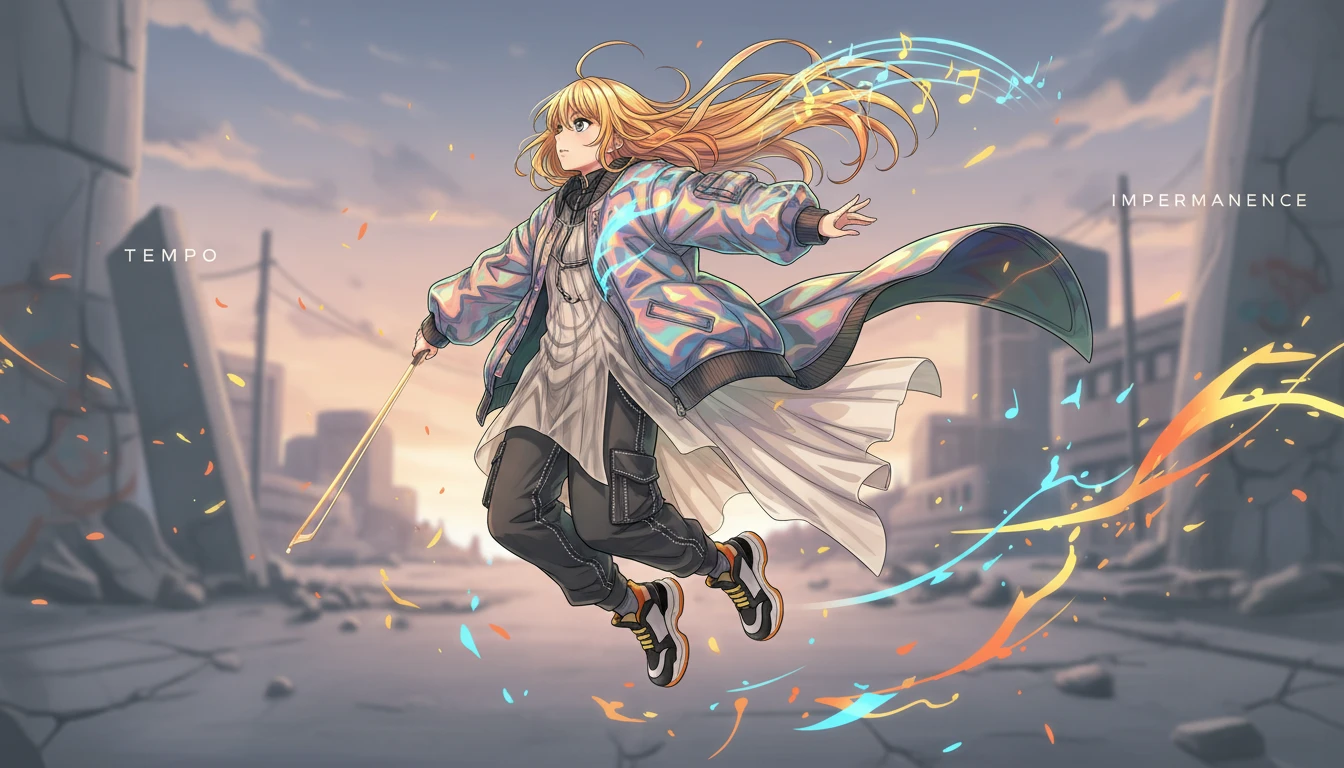
Kaori Miyazono reimagined in avant-garde streetwear, oversized oil-slick bomber with asymmetrical hem, reflective bow stroke, layered long tunic whispering like paper, deconstructed collar, misaligned cargo pants with visible stitching, bulbous sole shoes, dynamic pose in a gray urban backdrop, vibrant citrus and sunflower colors contrasting the dull city, soft light at dusk reflecting off her outfit, capturing the tension of time and impermanence, blending anime aesthetics with realistic details, evoking a sense of movement and anticipation
I used to stamp dates for a living.
Back then, the post office smelled like damp paper and metal—like pennies warmed in a fist. Ink pads kept their own weather: sharp, medicinal, slightly sweet. You’d think the job was about distance, but it was really about time. A letter is a small machine that turns breath into waiting.
Now my counter is no longer public. People come to me when their voice has begun to ration itself. I write for the dying—those sentences that cannot survive a living room, those apologies that break at the threshold, those jokes meant to land when the speaker is already absence. I seal them with instructions: deliver after the funeral, deliver on her birthday, deliver when the first snow falls, deliver at 3:14 p.m. on a Tuesday because that was “our hour.” My service is simple: I guard the last words and the promised hour. A delayed delivery at the edge of life.
Tonight, I’m writing about Kaori Miyazono—Kaori in Your Lie in April—but not the Kaori pinned flat as “the girl with the violin.” I’m writing her as a streetwear remix with avant‑garde silhouettes: not cosplay, not tribute merch, but a garment language that keeps the pulse of her contradictions. Brightness with bruises underneath. A laugh that tastes like blood if you chew it too long.
In my mind she arrives the way streetwear arrives: sudden, too close, shoulder-checking your routine. She’s a neon chord over a gray city. She’s a windbreaker unzipped in February, because she refuses the polite temperature of other people’s expectations. Her palette is not “pastel.” It’s citrus against asphalt, sunflower against railway iron, a mouthful of orange candy right before bad news.
So: Kaori, remixed.
I picture an oversized bomber—oil-slick satin that catches light like a lake at dusk—cut asymmetrically so the left hem drops lower, like a phrase that refuses to resolve. The back panel carries an abstracted bow stroke in reflective tape, but it’s broken, interrupted, intentionally unfinished. Avant‑garde silhouettes don’t flatter; they confess. They admit the body is temporary and still worth dressing with ceremony.
Under it: a long tunic with a deconstructed collar, the kind that looks like it’s slipping off the clavicle even when it isn’t. The fabric should whisper when she moves—dry, crisp, paper-adjacent—because she is always on the verge of becoming a message. Cargo pants, but not utilitarian in the usual way: pockets placed slightly wrong, angled like misread sheet music. Stitching visible, proud, the way a scar can be both ugly and holy.
The shoes? Something that can run and still look like it shouldn’t exist. Bulbous sole, split tongue, laces that dangle like loose strings. Kaori’s streetwear is movement-first, but the avant-garde twist is that the clothes never quite settle—like she never quite does. Everything carries the tension of “now” pressing against “not enough time.”
I write this and my knuckles ache, because time always has weight. In my desk drawer there’s an old brass date-stamper I kept from the post office. It’s the size of a fist, and it never leaves my room. The handle is polished smooth where my thumb worries it. Most people think it’s sentimental. It isn’t. It’s a tool for truth.
When someone asks me to delay a letter, I stamp the envelope interior—not the outside—with a private date: the day the message became irreversible. I do it because the living love to revise the dead. They rewrite the departed into saints or villains depending on what helps them sleep. My hidden stamp is a quiet anchor: this was written when the breath was still warm, when the hand could still shake, when the speaker still had skin. Kaori, too, lives in that kind of timestamp—her brightness is not naïveté, it’s urgency.
The remix needs accessories, because Kaori is a collision of charm and purpose. A crossbody bag, transparent vinyl, so you can see what she carries. Inside: a metronome key, a crumpled program, a cough drop wrapper, a cheap hair tie stretched tired. Streetwear loves showing the guts. Avant‑garde loves asking whether the guts are the point.
And then there’s the piece that makes it truly hers: a scarf, long and thin, almost like a ribbon, dyed unevenly—sunset bleeding into bruised purple. It’s wrapped not for warmth but for rhythm. It flutters like a second bow. It tells you she is not dressing to be looked at; she is dressing to conduct her own exit.
I should confess something, since you asked for the kind of details outsiders don’t know.
I keep a small cassette recorder in my coat pocket, a cheap one with a scratched window, the kind you could mistake for junk. I bought it years ago to capture addresses from trembling mouths. But it became something else: a vault for voices that never want to be overheard. Once, a client asked me to record her laugh—just her laugh—because she feared her son would forget its shape. She died two days later. The tape is labeled with a number, not a name. I have never played it since. Some sounds are too intimate to audition. They are meant for the hour they were promised.
Kaori’s streetwear remix is built on that same ethics: don’t replay what shouldn’t be replayed. Don’t turn someone’s last sprint into a loop for entertainment. Make the garment carry the feeling without stealing the secret.
There is another secret, heavier.
In a cardboard box under my bed—tied with twine, smelling of dust and cedar—I keep the “failures.” Letters I wrote that were never delivered. Not because I forgot. Because the dying changed their mind at the edge, or because the recipient disappeared, or because the world did what the world does: it broke the route. The box is full of paper that still has someone’s heat in it. I never show it. It is my own avant-garde archive: incomplete work, unresolved silhouettes, words with nowhere to land.
Sometimes, when the night is too quiet, I open it and the air changes. Old ink rises like a bruise blooming. You can feel the pressure of sentences that never got to become real. It teaches you something about Kaori: how much of her is a letter that arrives late and still punches you in the ribs. She is a message delivered after the fact, and yet it changes the living as if time were reversible.
So the outfit must include absence as design.
A jacket with a missing panel—a deliberate void where lining should be—so that when she moves, you glimpse the inside like the backstage of a performance. A sleeve that is longer than the arm, covering the hand halfway, because there is always something she is holding back. A seam left raw, because polish would be a lie.
Even the graphics should be quiet: no character face, no loud title. Instead, a small embroidered motif at the cuff: two intersecting lines, like a bow crossing strings, like a road crossing a life. On the neck tag, printed in tiny type, a date that only the wearer understands. Streetwear loves codes. The dying understand codes better than anyone.
When I seal a delayed letter, I use a particular wax—dark red, almost brown. It smells faintly of smoke and citrus peel. My clients think it’s elegant. The truth is more practical: that wax holds in humidity, and grief is humid. People cry on envelopes. They press them to their mouth. They carry them in pockets with sweaty hands. The seal has to survive the body.
Kaori’s remix should survive the body too. It should be made of fabrics that can take rain and still look honest: coated cotton, ripstop nylon, sturdy knits that don’t collapse after one hard day. Because she is not a fragile aesthetic. She is resilience disguised as play.
And if you listen closely—closer than the casual viewer ever does—you can hear how her story always had the texture of delayed delivery. A performance as a letter. A smile as a postmark. A lie that is less deceit than choreography: a way of arranging pain so it arrives at the right time, to the right heart, without killing them on impact.
That is what I do for a living: I measure impact. I set the timing so the truth doesn’t arrive like a truck.
So I imagine her standing at a crossing light, city wind lifting the uneven hem of her bomber. Neon washes her face. Somewhere a convenience store freezer hums. She adjusts her scarf like a musician adjusting a chin rest. She looks like she’s about to run. She always looks like she’s about to run.
The silhouette around her is wrong in the best way—angled, unfinished, alive. Streetwear says: I belong to the street, to now, to the crowd. Avant‑garde says: I will not be simplified. Kaori says both at once, with that dangerous sweetness that makes you want to follow, even if you already know where it ends.
I fold the page. My hands smell of paper and the faint iron of the stapler. I slide the letter into an envelope and, inside where no one will see, I press the old brass stamper down hard.
The date clicks into the fibers like a heartbeat.
Deliver it later, the way she did. Deliver it when the living are finally ready to be changed.