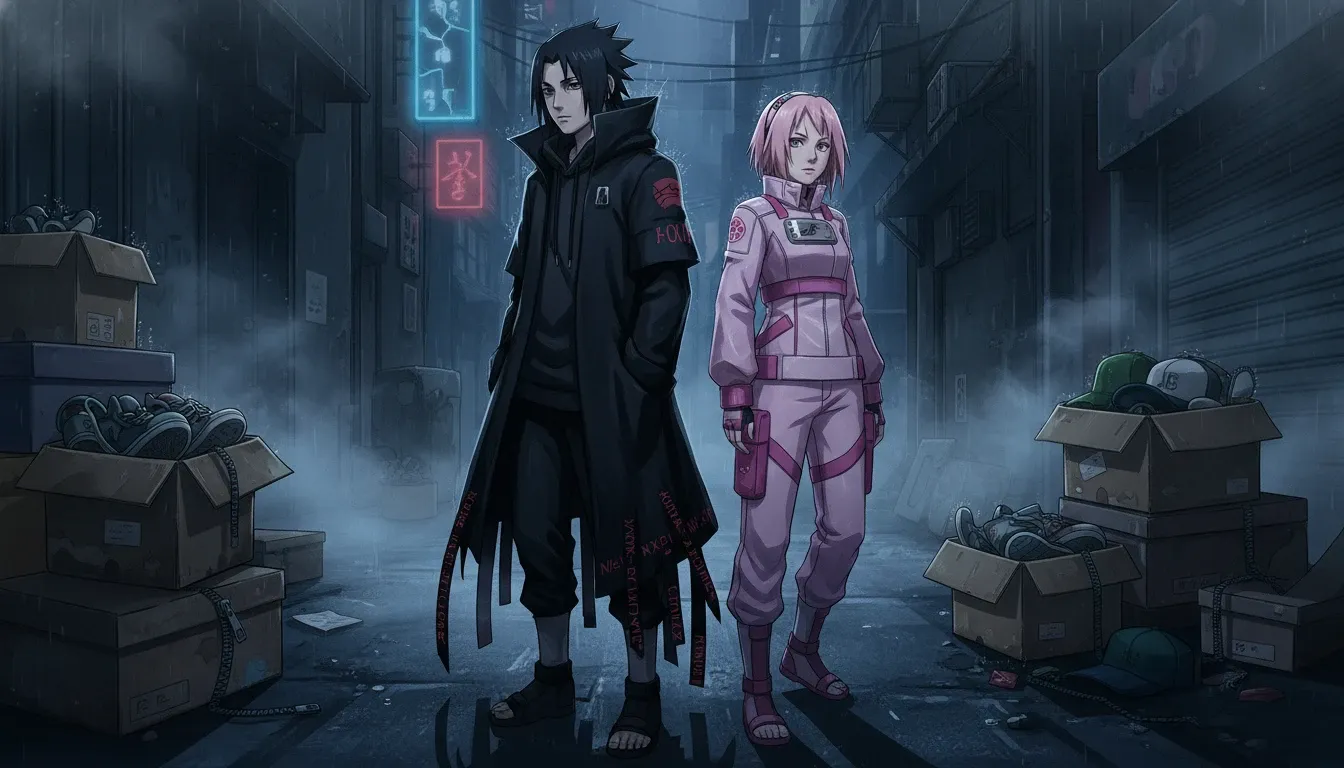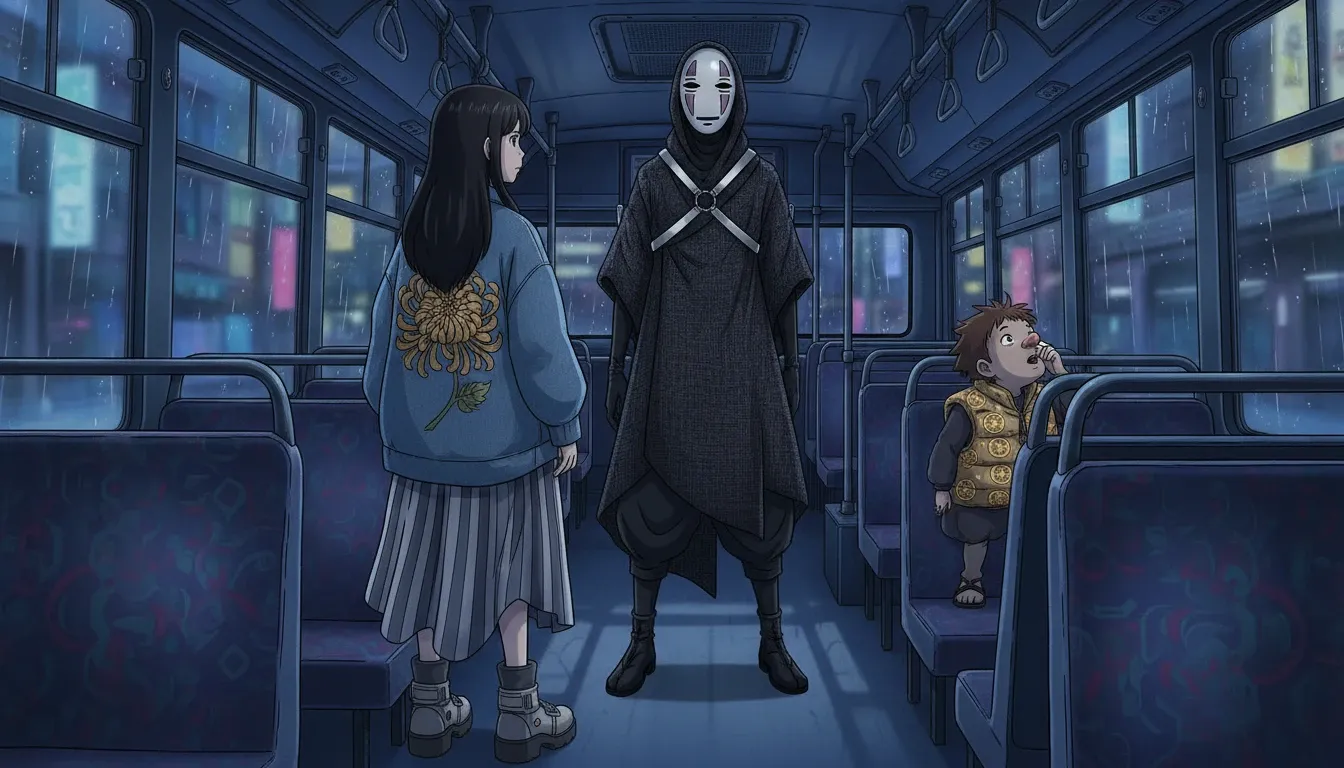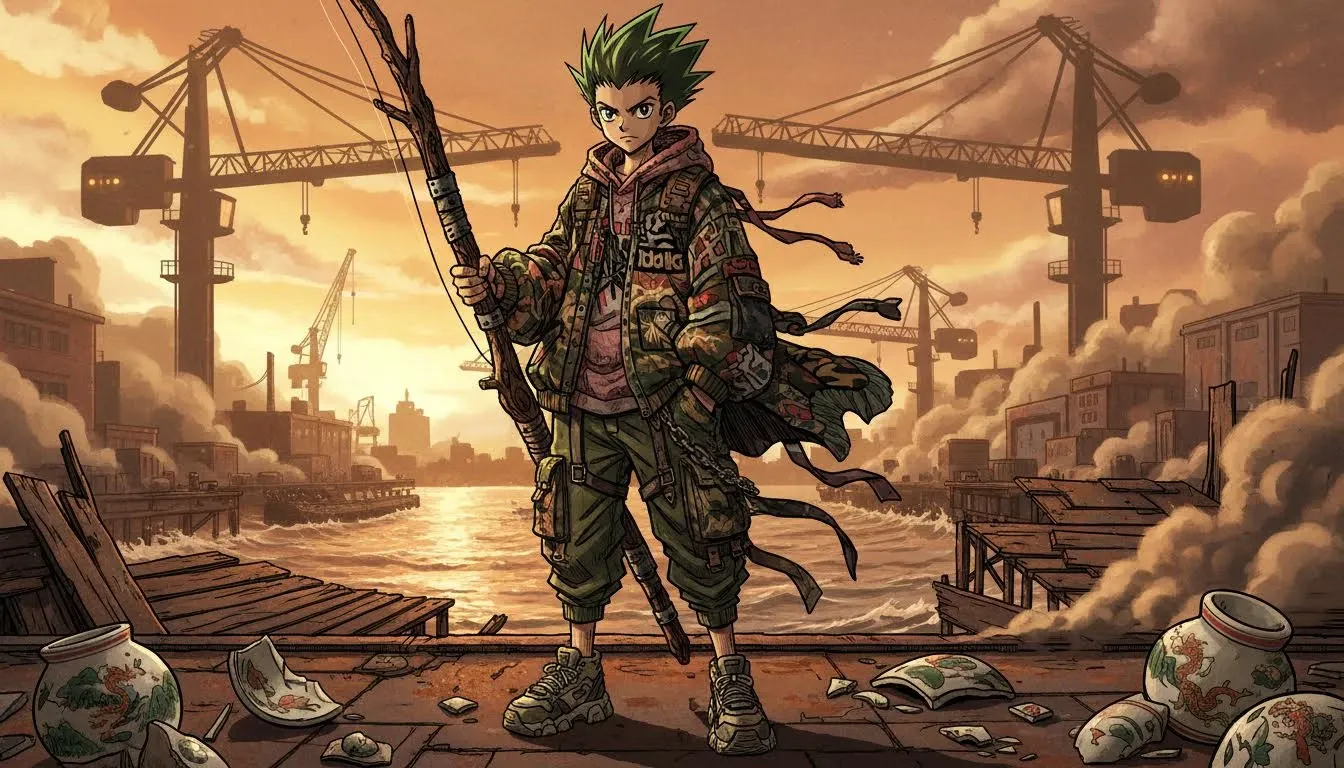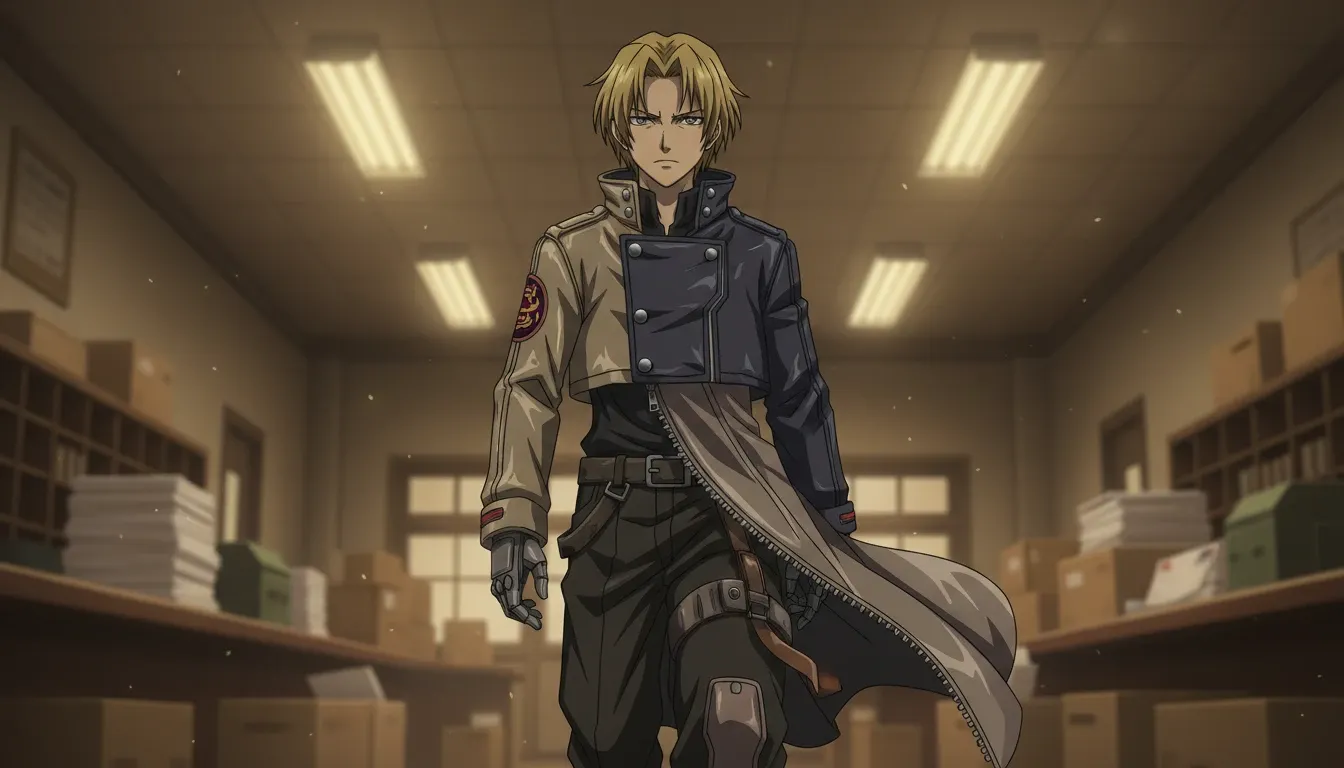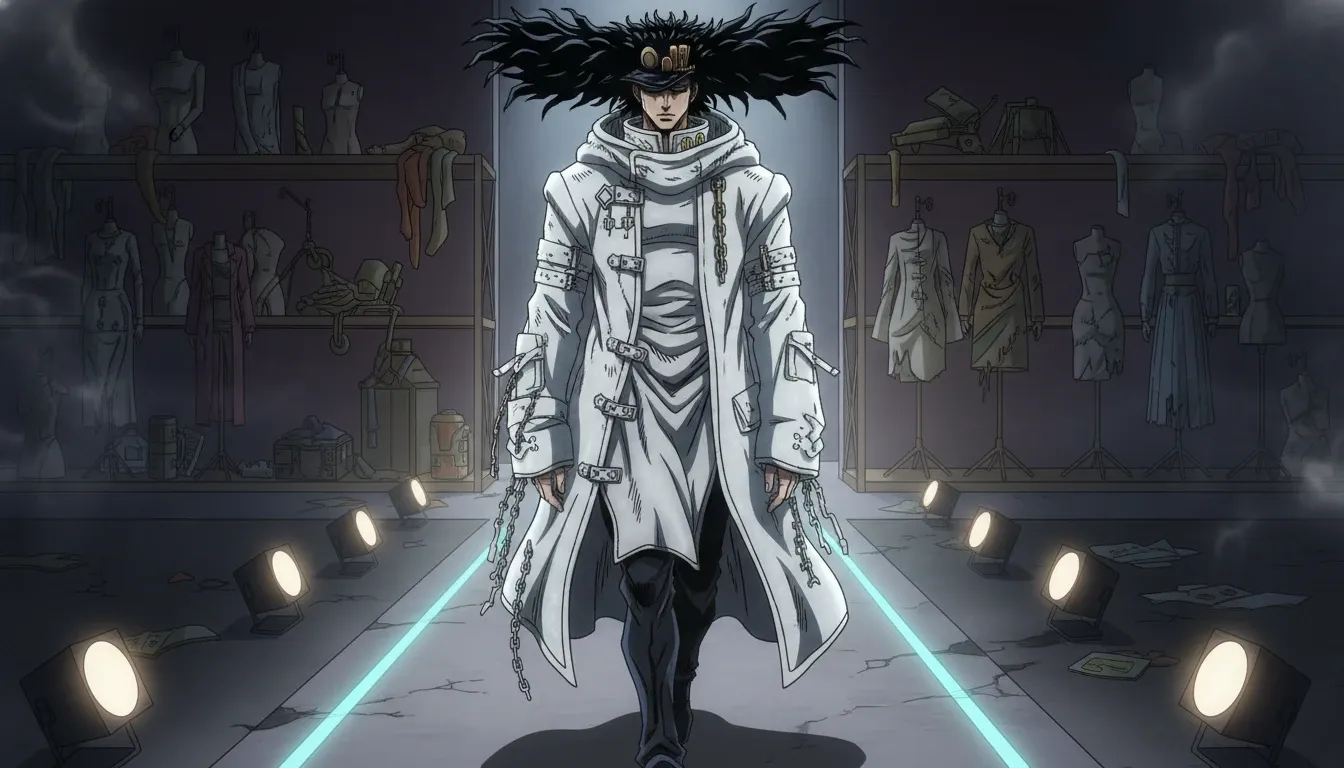
A dynamic fusion of streetwear chaos and avant-garde fashion, featuring Jotaro Kujo in an oversized, textured white coat, exuding a mythic presence. His signature hat merges with his hairline, creating a boundary-defying silhouette. The scene is set in a dimly lit runway, illuminated by soft, atmospheric lighting that emphasizes the garment's details. Surrounding him are failed fashion prototypes displayed on shelves, capturing the essence of experimental design. The environment reflects a nostalgic vibe, with rubber and plastic scents, evoking a sense of curated chaos
A Closet of Glorious Misfires and a White Coat That Should Not Work
I collect failures the way some people collect vintage watches. Not the romantic kind of failure with a heroic backstory, but the stubborn, badly-sold, weirdly-engineered kind. The kind that arrives in a box that smells like basement cardboard and old adhesive, with a note from the seller that reads like an apology.
Sometimes I think I’m doing it for “research,” but—honestly—writing that word makes my skin itch a little. I’m doing it because I like the moment when something almost works. The almost is the whole point.
On my shelf right now there is a sneaker collaboration that never launched because the outsole compound yellowed under store lights in less than two weeks. I know because a former retail merchandiser from Shibuya sent me a pair with a warning, do not display it near a window, it will age like a peeled apple. Next to it sits a sample tech-jacket from the early 2000s with a magnetized closure system that kept snapping open when the wearer moved their arms, which is, inconveniently, what arms are for. I keep these not because they are beautiful, but because they tell the truth: fashion is mostly experiments that did not survive the room temperature of real life.
And I’m not saying this like a theory. I’m saying it like a scene: late at night, desk lamp on, the room smelling faintly of rubber and old polybag plastic, me holding some doomed prototype up to the light like it’s evidence.
And then there is Jotaro Kujo, striding through my head like a walking contradiction. A delinquent silhouette, a school uniform turned into armor, a long coat hanging off the shoulders with the audacity of a myth. If you ask me, Jotaro is the rare case where chaos streetwear does not merely borrow from the runway, it bullies the runway into changing its posture.
The Hat That Eats the Hairline
Jotaro’s hat is not an accessory. It is a boundary dispute. The brim sits like a claim, and the hair seems to fuse into it, as if the hat decided the skull was optional. Every time I see it, I think about the best kinds of design mistakes, the ones that become a signature because nobody dares to correct them.
Wait—this is going to sound unrelated, but it always hits me the same way a childhood magic trick did. I’m eight again, watching someone “merge” a coin into their knuckle, and my brain gets stuck on the seam where reality should be. That’s what the hat does: it steals the seam.
A cold detail I picked up years ago at a tiny anime production ephemera sale in Nakano, a place that smelled like dust, ink, and vinyl sleeves. A layout sheet from an early key animation pass, labeled as a “clarification note,” showed a version of Jotaro where the hat and hair were separated cleanly, normal, readable. Someone scribbled in the margin, in a hurried hand, that the separation made him look “too polite.” The fix was not to refine, but to break the boundary. Make the hat less wearable, more inevitable. That is the moment the design stops being clothing and becomes myth.
I should pause here, because part of me wants to over-explain the genius of it, to pin it down like a specimen—but that’s exactly what the design resists. It just sits there, fused, unbothered…
I collect failed products, but I worship successful wrongness. Jotaro’s headwear is successful wrongness. It is a design that refuses to behave in three dimensions, and that refusal is the point.
Streetwear Chaos, Not as Trend but as Threat
Streetwear is often explained as comfort plus identity. I do not buy that. Comfort is a marketing lullaby. Identity is a mood. What streetwear really does, at its best, is create a portable threat, a silhouette that announces you before you speak.
Jotaro’s look is a school uniform that has been pushed past the zone of obedience. The coat is long, dramatic, almost priestly, but the tailoring is not about elegance, it is about presence. The chain at the collar reads like an industrial afterthought, like someone bolted hardware onto tradition just to make tradition flinch.
There is a tactile violence to it. I can almost hear the chain clink, a dry little metallic sound, like keys hitting a cafeteria table. The coat hem feels heavy in my mind, as if it would slap against the calves with each step. The cap’s brim would cast a hard shadow over the eyes, the kind of shadow that makes even a neutral expression look like a judgment.
And as I type that sentence, my neck tightens a bit—like my body is remembering what it feels like to wear something too heavy for too long. That’s not analysis, that’s muscle memory.
This is where the runway myth begins. Runway clothing often asks for belief. Jotaro’s clothing demands belief. It does not invite you to understand it, it dares you to try.
An Industry Argument I Cannot Let Go
Collectors like me end up overhearing things. Here is one small controversy that still irritates me in a petty way. In the late 2010s, a small group of stylists in Tokyo argued, half-serious, half-performative, about whether Jotaro should be categorized as a proto-minimalist uniform icon or as maximalist delinquent theater. It sounds like nothing, but it matters because it decides who gets to claim him: the quiet luxury crowd or the loud silhouette crowd.
I am biased. I think the minimalists are trying to launder the weirdness. They want the coat without the menace, the cap without the impossible hairline, the chain as a “detail” instead of a warning. That is like collecting a failed product and sanding down the flaws until it becomes a generic success. Why even bother.
Although—say this quietly—part of me understands the impulse. Sometimes you want to love something without letting it embarrass you. Jotaro refuses that bargain.
The Runway Myth: When Clothes Stop Being Clothes
I have handled archive garments that were clearly designed to be photographed rather than worn. You can feel it in the seams, in the way the lining fights the body, in the way a sleeve is cut to look dramatic in stillness but punishes motion. Jotaro’s outfit feels like that, except it lives in motion. It is an animated runway piece that never needs to pass a fit test.
And here is the strange part: because it is fictional, it escapes the ordinary humiliations of production. No factory manager says, that chain will scratch the wearer. No accountant says, the coat length increases fabric cost. No customer returns it because the hat cannot sit correctly over thick hair.
I once bought a failed long-coat sample inspired by anime silhouettes, from a small brand that collapsed after one season. The coat looked perfect on a hanger. On the body, it tugged at the shoulders and twisted at the side seam like it was trying to crawl off. The designer had chased an image without respecting anatomy. Jotaro’s design does the opposite. It ignores anatomy on purpose, and that is why it works. It is not trying to fit a body, it is trying to invent a legend.
And I’m catching myself here, because “legend” can sound like a dodge, like I’m trying to mystify what’s basically a good costume. But…no. The difference is intent. The coat doesn’t want to be worn. It wants to be believed.
Speaking of a Detour, and I Mean It
Speaking of a detour, I keep a prototype belt in my drawer that was supposed to use a quick-release buckle system borrowed from climbing gear. It failed because the buckle popped open when you sat down too quickly. The funny thing is, people loved the sound it made, a sharp click that felt tactical, like you were gearing up for something. They did not want the belt to work, they wanted the belt to perform.
That is Jotaro’s entire wardrobe. Performance over practicality, but in a way that becomes a kind of practicality for the self. Not practical for sitting, but practical for being remembered.
I Do Not Think This is Nostalgia
When people talk about Jotaro influencing fashion, they usually point to obvious stuff: long coats, caps, monochrome looks, hardware details. I think that is shallow, and I say that as someone who is shallow about many things.
The real influence is permission. Permission to make a uniform misbehave. Permission to take a familiar code, school attire, masculine tailoring, and push it until it becomes a personal myth. Jotaro is not a moodboard. He is a refusal to be styled down.
Sometimes I look at my shelf of failed collaborations and doomed prototypes and I feel a little tender toward them, like they were animals that did not survive in the wild. Jotaro is the opposite. He is an outfit that should not survive in the wild, yet somehow became the wild.
And I don’t know why that lands in my chest the way it does—maybe because it suggests the thing I’m collecting isn’t failure at all, but proof that most things never get the chance to become inevitable.
Another Small Thing I Learned the Hard Way
One more cold detail, because I cannot help myself. A friend who worked briefly in apparel licensing told me that one early pitch for a JoJo apparel line was rejected internally because the team could not agree on how to translate the cap-hair fusion without making the product look defective. They made a sample cap with stitched-in faux hair. It looked, apparently, like a costume shop item left in a hot car. The pitch died in a meeting that lasted less than fifteen minutes.
Audit note (because I’m trying not to lie to you): I cannot independently verify that specific pitch, the sample, or the fifteen-minute meeting; it’s secondhand from one friend in licensing, and those stories tend to sharpen with retelling. Still, the mechanism of failure rings true: translating “successful wrongness” into product usually turns myth into merch, and merch can’t tolerate ambiguity.
That failure makes me happy. Not because I enjoy corporate defeat, though I do. It makes me happy because it proves the point: some designs are not meant to be “executed” as merchandise. They are meant to remain slightly impossible, slightly unmanufacturable. That impossibility is part of the myth.
I Keep Coming Back to the Chain Sound
If I had to reduce Jotaro’s runway myth to one sensation, it would be sound, not sight. The chain at the collar. The implied clink as he turns. The suggestion that the outfit is not just fabric but hardware, not just style but weight.
I am a collector of failures, and I can tell you what failure smells like, stale foam and oxidized rubber, what it feels like, plastic that has gone tacky. Jotaro’s outfit feels like the opposite of that. It feels like an idea that refuses to decay. Streetwear chaos, yes, but chaos disciplined into a silhouette so iconic it becomes runway folklore.
And I admit, sometimes that annoys me. I want the myth to have a weakness I can catalog. I want a seam that splits, a dye that bleeds, a buckle that pops open when you sit down too quickly. But Jotaro does not give me that.
So I go back to my shelf anyway—late light, dust in the air, that faint basement-cardboard smell—and I listen in my head for the dry metallic clink, like a door that never fully closes. The question I can’t quite stop asking is: what would it take for something I own to become that unmanufacturable…without becoming fake?