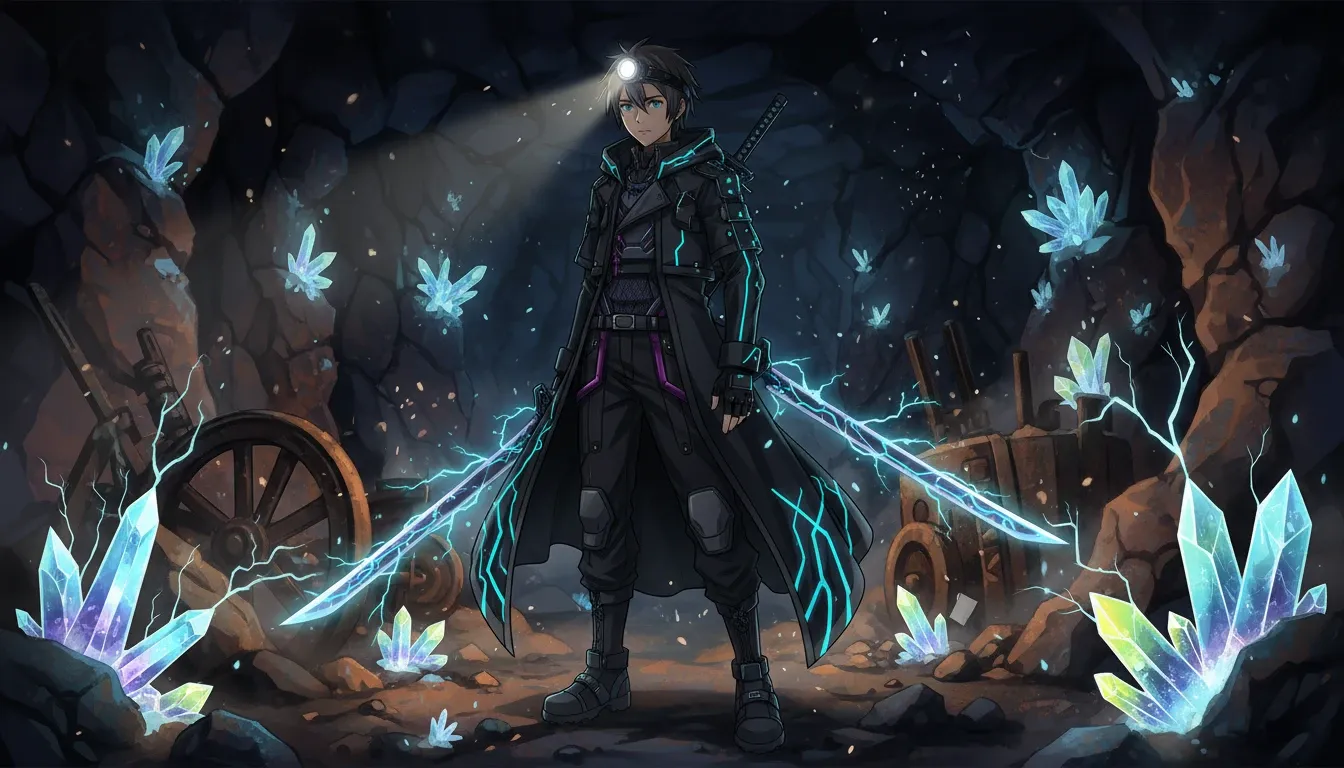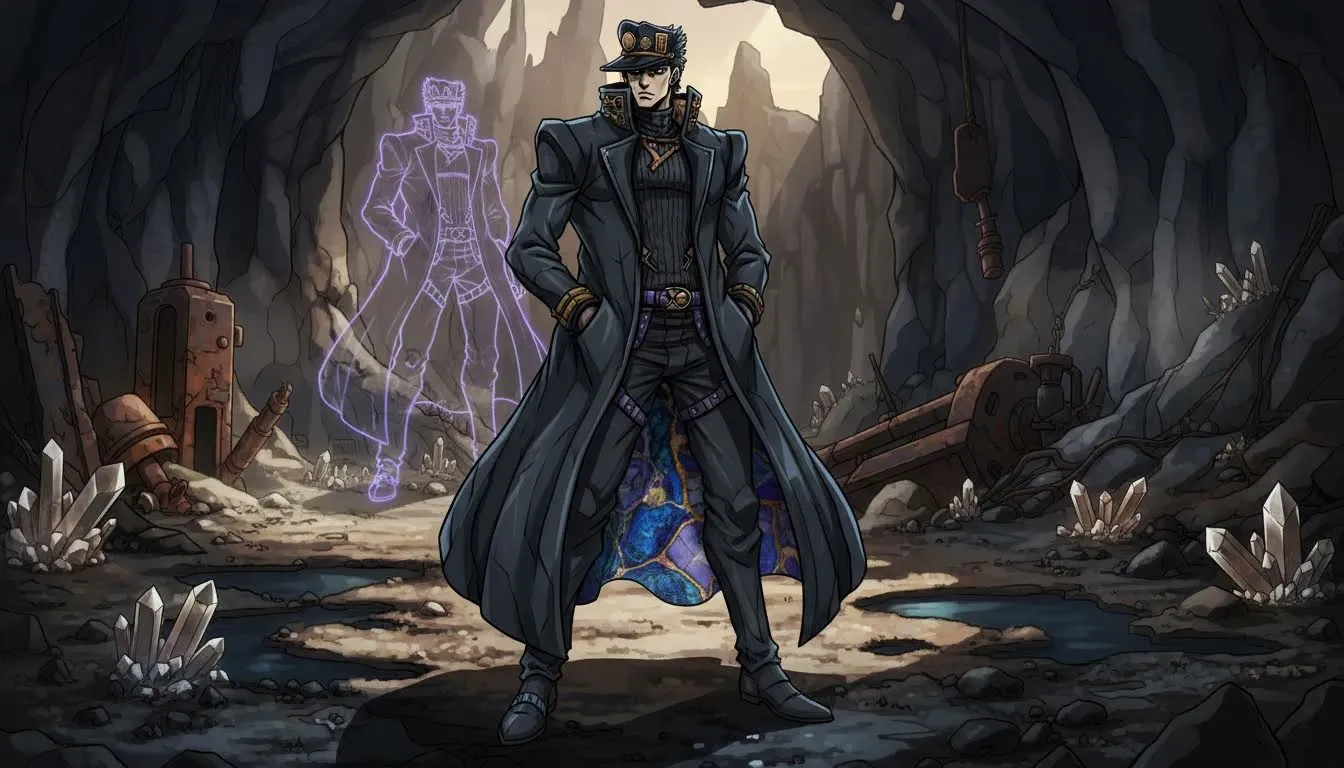
Jotaro Kujo-inspired streetwear, avant-garde fusion, matte black coat resembling basalt, asymmetric panels, cliff-like collar, mineral thin-section imagery lining, cold metallic air, abandoned mine backdrop, rugged terrain, sunlight illuminating smoky quartz, realistic textures, urban-chic vibe, expressive lighting creating dramatic shadows, anime character silhouette blending into the real world, capturing stories of geology and persistence
The mine closes the way a throat closes—quietly, then all at once. One week the conveyor belts still groan at dawn, the next week the gate is chained and the wind whistles through the rust like it has learned a new language.
I used to have a stable job in a city that smelled of printer toner and warmed plastic, a job that praised predictability the way a foreman praises a straight drill line. I resigned with my father’s rock hammer in my bag, because I am a geologist’s daughter and the ground has always been my truest archive.
Back home, the air tastes metallic after rain. The tailings pile is a gray dune stitched with scrappy grass, and the old processing plant stands like a ribcage. When I walk the haul road, my boots knock loose pebbles that clatter down the slope—tiny percussion, like a runway show heard from behind the curtain. I come here for crystals, yes: for fluorite that looks like frozen grape candy, for quartz with needle-fine inclusions, for pyrite cubes that click against each other like dice. But I also come for stories. Every specimen is a paragraph written in pressure and time.
That’s how Jotaro Kujo finds me—strangely at home in this place of collapse and persistence. Not literally; not the manga boy stepping out of panel lines. But his silhouette: the stiff brim of a cap that seems fused to the skull, the long coat with a weight that suggests authority, the attitude that says, I won’t waste words when a stare will do. Jotaro’s streetwear is not about being noticed; it’s about being unmovable. It’s a wearable cliff face.
In my livestreams, I hold a crystal up to the camera and let the light do what speech cannot. A smoky quartz point catches the sun and turns it into a bruised halo. My fingers are cold and nicked; the cuticles blackened with ore dust that soap never fully defeats. Viewers type hearts and questions. I answer while breathing the mine’s breath—wet stone, old diesel, moss.
And in my other life, the one with lookbooks and moodboards, Jotaro becomes a vocabulary for this geology: stoic forms, brutal lines, restrained drama that suddenly flares into something operatic. Streetwear fusion with avant-garde runway energy isn’t a contradiction here; it’s a fault line where two plates grind and create mountains.
I imagine a coat like his, but not as costume—more as stratigraphy. The outer shell is matte black, the color of basalt when it’s just been split. Panels overlap like thrust sheets, asymmetric, refusing the tidy symmetry of mall mannequins. The collar rises like a cliff, but one side is cut away, exposing a lining printed with microscopic thin-section imagery: feldspar twins, olivine fractures, the secret geometry of minerals that only shows up when you slice them to 30 microns and let polarized light sing through. When the model turns, the lining flashes—runway energy, yes—but it’s also a confession: inside the hard pose is an ancient shimmer.
Some people say fashion is seasonal desire: bought, worn, discarded like an empty bottle. But my hometown doesn’t have the luxury of discarding. We salvage bolts, rewire old fans, patch roofs with sheet metal that still smells faintly of oil. So my approach is different. I want garments that age like rocks—surface weathering that becomes beauty, not failure. A black denim jacket with bar-tack “fracture repairs” in contrasting thread, like mineral veins. Wide-leg trousers that crease the way sediment layers slump under water. A hat brim that casts shadow over the eyes the way a mine overhang does, making the face a cave—private, protected.
The first time I found the “cathedral pocket,” I didn’t tell anyone. It’s in a collapsed adit behind the third vent shaft, where a seam of vuggy quartz lines the wall like a miniature basilica. You have to climb a slick limestone slab, feel for a handhold that isn’t loose, and then duck under a beam that hums when the wind hits it. The crystals there are unusually clear, almost cruel in their purity, and there are faint blue sprays—celestine, if my field tests were honest—that only appear after three days of fog.
The old miners called it “the hymn room,” not because they were poetic, but because even the toughest of them would lower their voices when they stepped inside. That pocket is why I believe in runway energy: the moment you enter, your posture changes. You become a witness.
I film there sometimes—never showing the path, only the crystals. My ring light makes them look like glass teeth. Viewers assume I’m in a studio. They don’t smell the damp rot of timber or hear the distant drip that counts time in seconds. They don’t know that a coat designed with Jotaro’s silhouette can borrow this feeling: the hush before something powerful happens.
And then there’s the other secret: the investor who shouldn’t make sense in my life. His name is Duan, a relentless efficiency addict in a white shirt that never wrinkles. He arrived in town with a smartwatch bright as an interrogation lamp and an Excel model that claimed the mine could be “repurposed into a heritage experience with optimized footfall.” He spoke in metrics the way my father spoke in rock types—confident, categorical. We clashed immediately. I told him the mine isn’t a theme park; it’s a wound and a library. He told me sentiment doesn’t pay for roof bolts.
We didn’t become friends. But we became an unlikely collaboration—because he noticed something outsiders don’t: my livestream conversion rate spikes precisely when I tell the slow, unprofitable parts of the story. The metamorphic overprint. The hydrothermal episode. The way a crystal is not a “pretty object” but the fossil of a fluid, the frozen breath of the Earth. He pushed me to structure my shop like a system; I pushed him to slow down and listen. We built a limited capsule collection together: jackets dyed with iron-oxide pigments from our own tailings (safely stabilized, tested, sealed), tags printed with QR codes linking to a three-minute geology “epic” for each piece. Streetwear that can be scanned into history.
There was conflict too. He wanted to use a drone to map the old stopes for “content,” and I said no—because the bats in the northern drift are a protected colony that only returns if the humidity stays above a certain threshold.
I learned that from an elderly surveyor, not a textbook. The bats are our hidden caretakers, eating the insects that would otherwise swarm the town’s only remaining orchard.
Duan rolled his eyes until I showed him the data—temperature loggers I had placed months ago in the drift, wrapped in waxed cloth and tied to a rusted rail with copper wire. The mine’s microclimate is a fragile instrument; you don’t stomp through it with propellers.
This is the asymmetry I love: Jotaro’s controlled force meeting avant-garde risk, my village’s exhausted infrastructure meeting a future that needs both discipline and tenderness. On the runway, the model walks in boots dusted with mica so the soles glitter faintly like crushed starlight. The coat swings, heavy, like a curtain in a cold doorway. One sleeve is longer, weighted with a hidden chain that taps the thigh with each step—a sound like a pick striking stone. Under the black, a flash of mineral color: a small lapel pin made from polished fluorite, violet like a bruise that healed into beauty.
After the show, I return to the mine before sunrise. My breath is white. The ground is stiff with frost, and the rocks “ping” as they contract—tiny, sharp sounds, the Earth adjusting itself in the dark. I kneel and brush away grit from a seam, my fingertips numb, my nails scraping, and I find a cluster of quartz points so fine they look like a mouth full of light. I hold them close. Cold bites my palm, clean and honest.
People ask me why I don’t just sell fashion, why I bother with the stones. But it’s all the same work: translating pressure into form. Giving weight to what time made. Jotaro’s energy—unyielding, pared down, quietly theatrical—fits my hometown like a tailored coat fits a body that has carried too much.
If streetwear is the language of the street, and runway is the language of the dream, then this fusion is the language of a place trying to stay alive. Not by pretending the mine never hurt us. Not by turning it into nostalgia. But by listening to its mineral syllables, tasting the iron in the air, letting the cold stone teach the body a new way to stand—shoulders squared, eyes forward, jaw set like a cliff.
In the camera’s glow, I tell the epic again. Not as a lecture. As a heartbeat. A crystal is lifted. Light enters. The past flashes, brief and precise. And somewhere behind the screen, someone decides to stay—maybe in my shop, maybe in my town, maybe inside their own life—