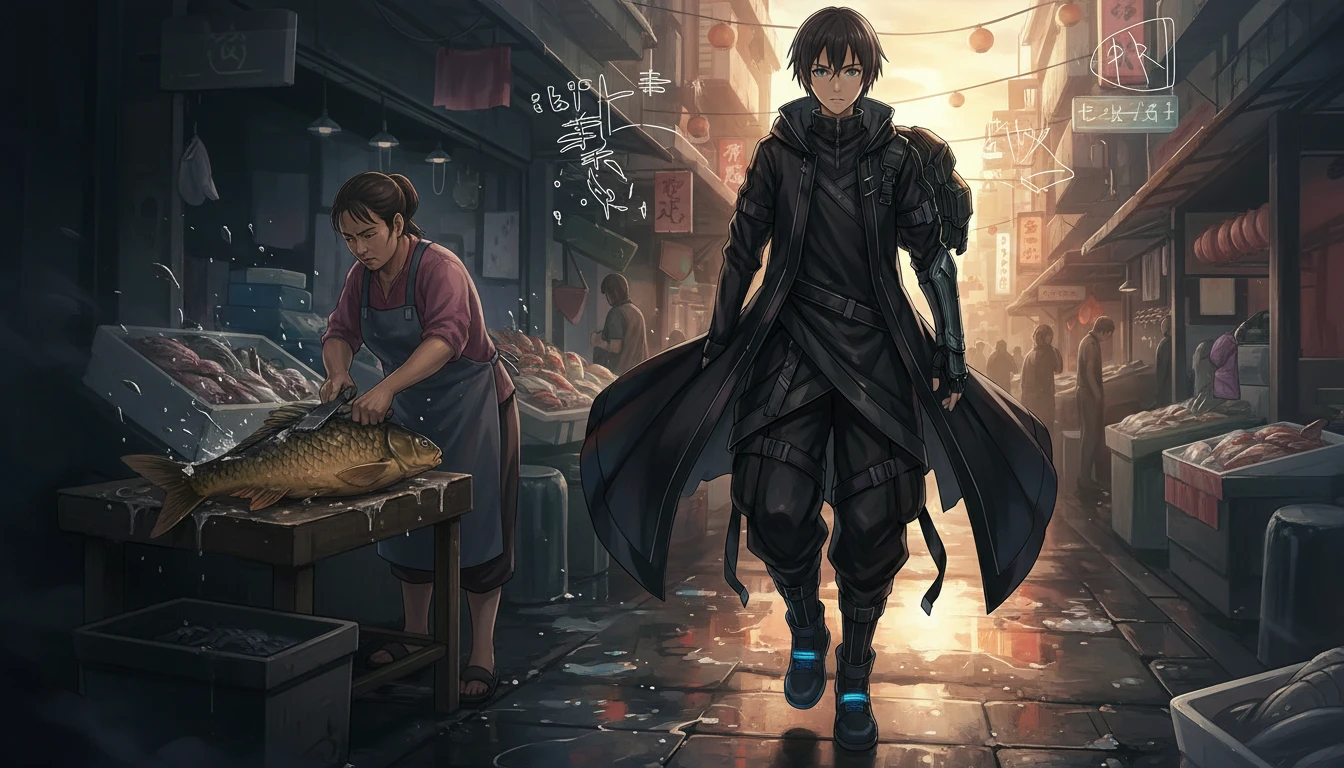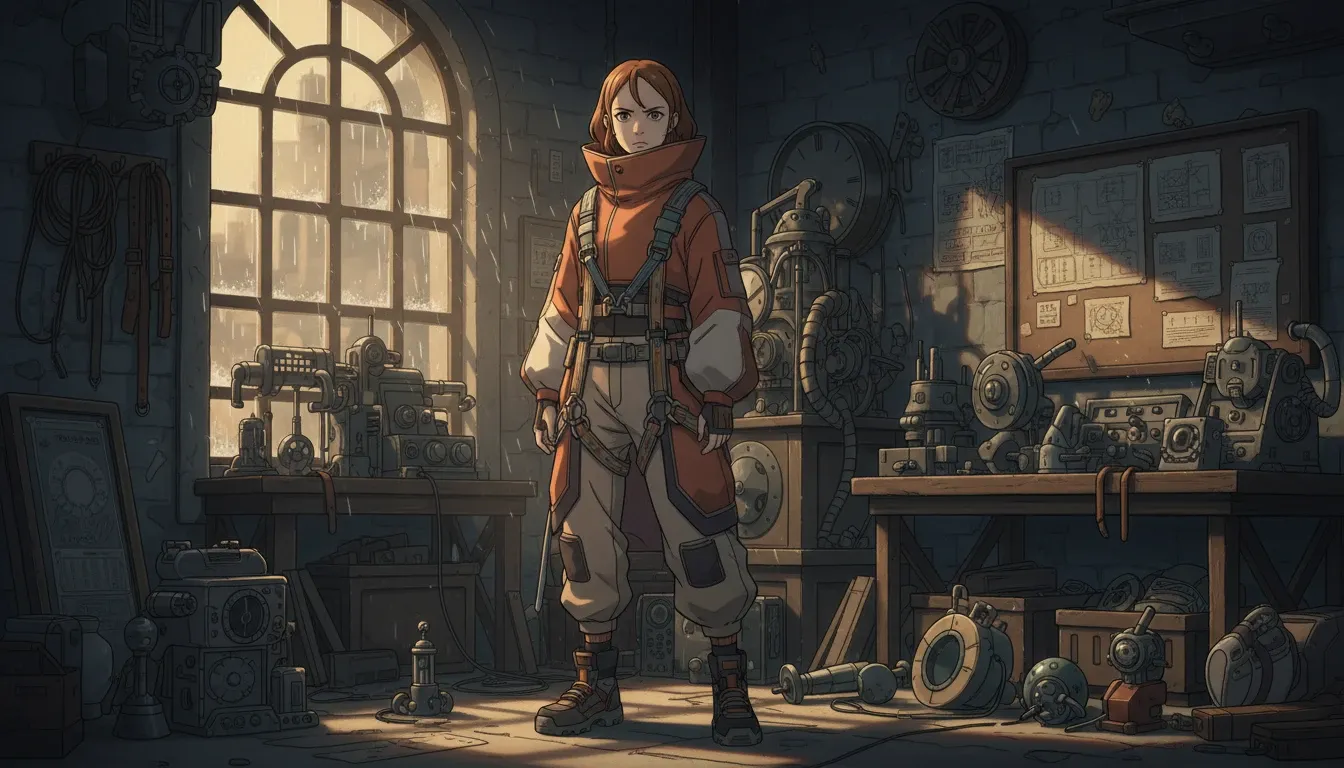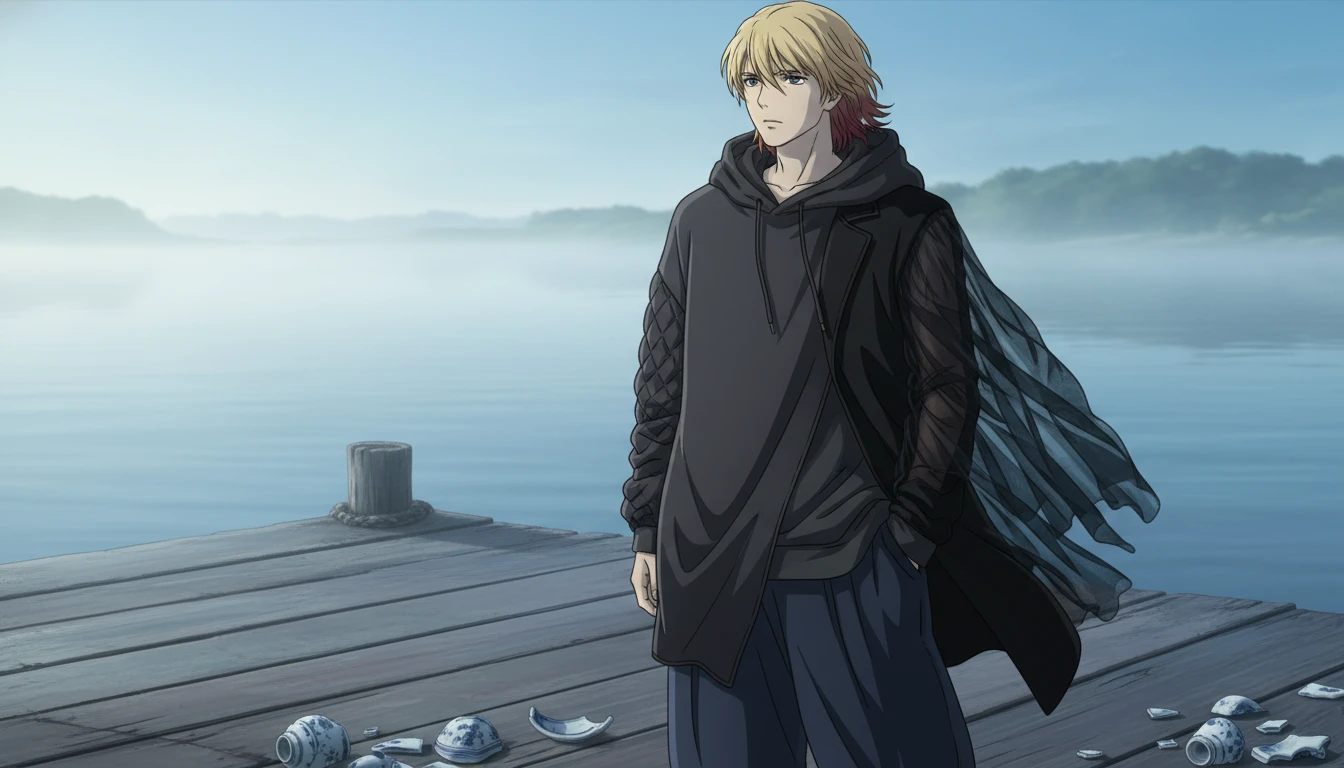
Howl from Howl's Moving Castle in a casual streetwear look, oversized charcoal hoodie draping asymmetrically, avant-garde black jacket with visible seams, quilted left sleeve, sheer organza right sleeve, low pleated trousers, set against a misty Yangtze River dock at dawn, porcelain shards scattered, soft blue light reflecting off the water, atmosphere of nostalgia and craftsmanship, anime style blended with realism, detailed textures of clothing and environment, capturing the essence of movement and longing
The dock never really sleeps. Even at dawn, when the Yangtze looks like poured pewter, the pilings keep creaking in a slow, arthritic rhythm and the tide drags silt against the hulls as if filing its nails. My workshop squats where the shipyard’s concrete ends and the river begins—one door to the cranes, one door to the smell of wet rope, diesel, and river mud that has been turning over the same secrets for centuries.
I mend porcelain that has been drowned.
Not the museum kind that sits obediently under white light, but cargo: bowls stacked like lungs, jars sealed with pine resin, plates whose rims still remember the pressure of straw and bamboo shavings. When I lift a shard from its tray, it is cold in the way river stones are cold—cold that carries time in its weight. The glaze, when it catches the slant of morning, has a shallow blue like a bruise healing. I run my thumb along the fracture and feel the edge bite back, a thin, clean cruelty. Every break is a sentence in a language the river wrote.
People think restoration is only surface: glue, fill, polish, pretend. I do the opposite. I listen for what a vessel was made to do. A thick foot ring with abrasion on one side tells me it lived on deck, dragged by salt-stiff hands, not coddled on a table. Soot under a shoulder tells me it sat near a brazier. A certain kind of micro-pitting in the glaze—tiny craters that look like pores when you wet them—usually means it traveled through a hold with fermenting grain; the gas eats at it slowly, like gossip. From these clues, I map routes the way sailors once mapped constellations: by guessing, by fear, by repeating what worked.
When the river wind pushes through the gaps in my doorframe, it brings in other worlds. Today it brings in a film I watched once on a battered player that still smells faintly of camphor—Howl’s Moving Castle, the characters walking like wind given manners, all of them stitched together by longing. The dockmen think it’s strange that I watch animated people while I repair real, broken things. But a ship that moves on legs, a castle made of scavenged iron and smoke—tell me that isn’t kin to a wreck hauled up from the Yangtze, ribs exposed, cargo turned to bone.
I begin laying out looks the way I lay out fragments: not as costumes, but as evidence.
Howl arrives first in my mind, flamboyant and exhausted, and I don’t dress him in fantasy—he has enough of that. I put him in casual streetwear that can survive smoke and sudden weather: an oversized hoodie in washed charcoal, the kind that holds warmth like a held breath, with a hem cut slightly longer on one side so it drapes like an unbalanced cloak. Over it, an avant-garde jacket constructed like a repaired vessel: panels of matte black technical fabric joined with visible, deliberate seams, each seam a confession. The jacket’s left sleeve is quilted, the right is sheer organza layered over mesh—because he is always half armor, half rumor. His trousers sit low, pleated, with one leg wider than the other, a silhouette that sways like a crane boom in wind. On his feet: scuffed leather sneakers dyed with iron mordant until they look like river stones, the toe boxes scratched on purpose, because perfection on a dock is suspicious.
I imagine Sophie watching him dress, fingers smelling of soap and old wood, the look in her eyes that says: I can see your magic and your mess. I put Sophie in a plain cotton tee the color of steamed rice, but the collar is asymmetrical, twisted slightly as if it was sewn in a hurry—because she has always been forced to grow faster than her stitches. Her streetwear isn’t loud; it’s honest. A denim skirt reworked into wide-leg pants, one side patched with sashiko-like handwork in uneven lines, the other left raw, fraying. She wears an avant-garde apron layered over it—waxed canvas, stiff, stained with imaginary tea and real glue—apron as armor, apron as proof she works. On her wrist: not jewelry, but a strap.
That strap is where my own life leaks into the fantasy, a piece no visitor ever recognizes. I cut it from old sheepskin and plant-tan it myself, rubbing it with river clay and oil until it smells like damp earth and smoke. I stitch it with linen thread that squeaks when pulled tight. Under the strap, hidden against the skin, I slide a thin sliver of porcelain—one I will never use in a public repair. It is from a bowl I found years ago inside the belly of a wreck, wedged into the timber like a tooth. The glaze on that shard has a faint swirl pattern only visible when you breathe on it and the condensation blooms. I keep it close because it reminds me: everything we think is lost can still press back against us.
Calcifer, of course, cannot wear clothes the way bodies do, but he can wear attitude. In my head, I design him as an accessory that refuses to be minor: a flame-shaped bag, glossy vinyl that catches light like oil on water, with a zipper that runs off-center in a grin. The strap is a chain that’s been heat-blued, shifting from purple to bronze. Inside, instead of pockets, there’s a lining printed with maps—river bends and tide marks—because he is the engine, the route, the hunger. When you open it, it should smell faintly of burnt sugar and metal, like a welding torch passed too close to candy.
Markl is the kid who would steal your heart and your lighter in the same breath. For him I choose streetwear with mischief built in: a puffer vest in acid green over a striped long-sleeve, but the stripes don’t match at the side seams—on purpose, like he dressed in the dark. His pants are convertible: zip-off, but only on one leg, leaving the other stubbornly long, swishing like a banner. His shoes have exaggerated tongues that flop out like dog ears. On his head: an avant-garde cap made from two caps fused together at an angle, brim pointing both forward and sideways, as if he’s always looking for an exit and a shortcut.
Then there’s Turnip Head, awkward and patient. I dress him like a walking found object, because that’s what he is: a mystery wrapped in friendliness. Oversized sweatshirt in muted beige, sleeves too long, cuffs covering his hands as if he’s shy. Over it, an avant-garde harness made of braided rope and leather—dock rope, not boutique rope—knotted in a pattern sailors use to keep cargo from shifting. The knots sit slightly off-center on his chest, pulling the fabric into strange drapes. His pants are wide, with a stiff crease that never quite holds, like someone trying to behave. A single flower pin—real dried petal encapsulated in resin—sits near his collar, fragile as a promise.
I keep designing, and the room fills with imaginary fabric rustles and the low click of my tools. The river light shifts; the glaze on my real fragments changes from blue to green, like mood. I dip a brush in adhesive that smells sharp and sweet, like almonds with a threat. I press two porcelain edges together until the seam becomes a whisper. My fingertips stick slightly; the skin remembers every vessel it has held.
There are things I never show anyone. In the back of the workshop, under a tarp that smells of mildew and engine grease, there is a wooden crate stamped with customs numbers rubbed almost blank. Inside are failures—my failures—repairs where the line didn’t disappear, where a fill turned the wrong shade under humid air, where the piece cracked again months later with a sound like a dry twig snapping. I keep them not as punishment, but as a private atlas. Each mistake teaches me something about pressure, about patience, about how the river continues its work even after you think you’ve finished yours. Sometimes, late at night, I open that crate and the smell that rises is not just glue and old clay; it’s embarrassment, and the weird relief of being human.
And then there’s the recording.
I have an old voice recorder—silver, scratched, heavy as a small fish—that never leaves the pocket of my apron. Outsiders assume I use it for inventory notes. I do, sometimes. But mostly I use it to capture sound: the moment a lifted shard taps another shard and rings a particular pitch, the way certain glazes respond with a faint glassy chime when you touch them with a bamboo pick. Years ago, divers brought up a cluster of bowls fused together by silt and pressure. When I separated them, one bowl had a hairline crack that ran in a shape like a river bend. When I tapped near the crack, it sang a tone that was not quite right, a little flat, like someone swallowing grief. I recorded it. I’ve never played it for anyone. I can’t explain why, except that it feels like the bowl is still speaking from inside the wreck, and I am not sure I deserve to translate it.
So when I write these outfits—Howl’s asymmetrical hoodie, Sophie’s patched trousers, Calcifer’s flaming bag—I am not playing dress-up. I am doing what I always do: trying to reconstruct a life from fragments. Streetwear and avant-garde fusion is just another kind of restoration. It takes what is practical—hoodies, sneakers, denim—and fractures it with intention: a sleeve that doesn’t match, a hem that refuses symmetry, a seam left visible like a scar you no longer hide. It’s the same philosophy as kintsugi without the gold: not “look how perfect,” but “look how true.”
On the dock, workers shout, metal bangs, gulls argue. The air tastes faintly of rust. I set a repaired bowl on the table and step back. The seam is there, but it doesn’t scream. It sits quietly, like a road you only notice when you travel it.
I imagine Howl leaning against my doorway, hair catching river light, watching barges pass like slow thoughts. I imagine Sophie touching the bowl with the care of someone who has been broken and remade. I imagine Calcifer laughing in the belly of the castle and the smell of his heat mixing with my adhesive and the river’s cold breath.
Each piece I restore, each look I assemble in my head, becomes an identity—a solidified shipping history you can hold in two hands, feel the weight of, hear the dull porcelain clack when it meets wood. The Yangtze keeps moving. The shipyard keeps pounding. And in this small room by the dock, where salt meets silt and fabric meets fracture, I keep stitching together the lives that once crossed water, refusing to let their routes dissolve entirely back into mud.