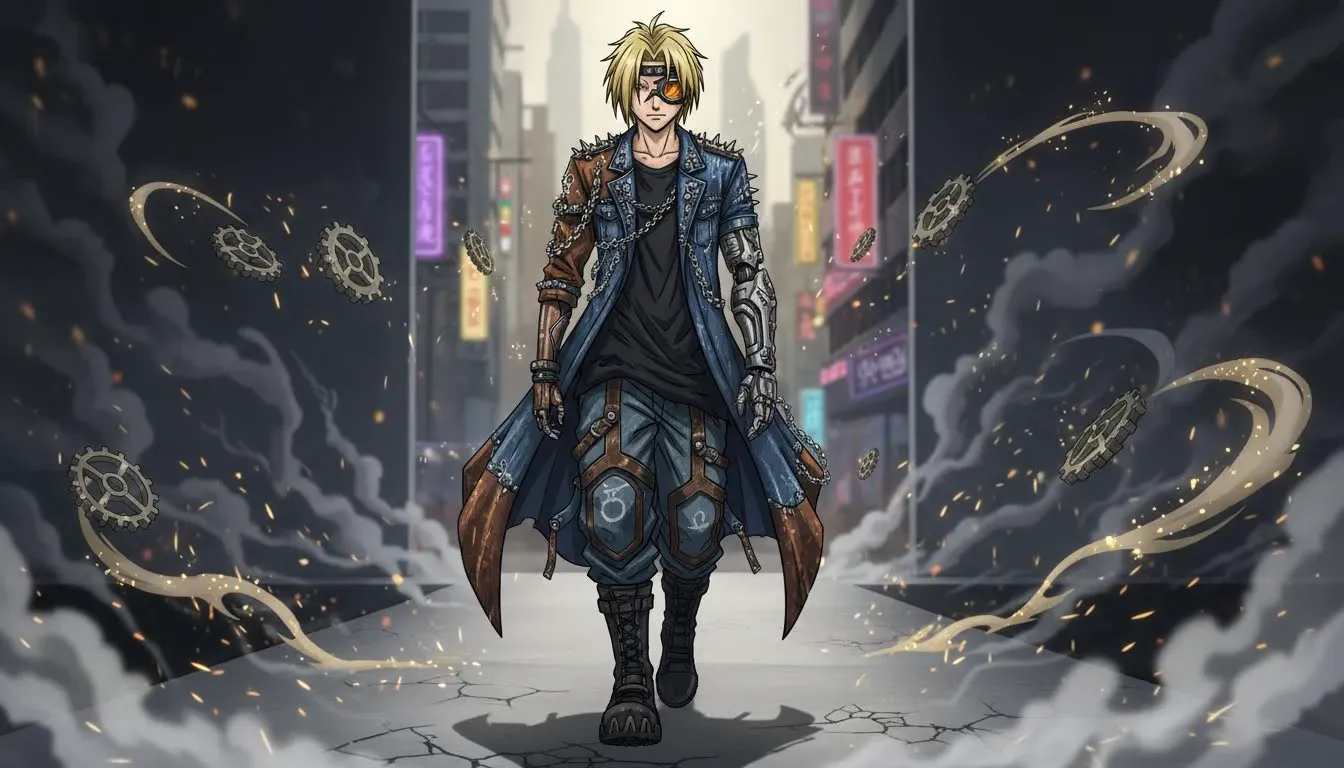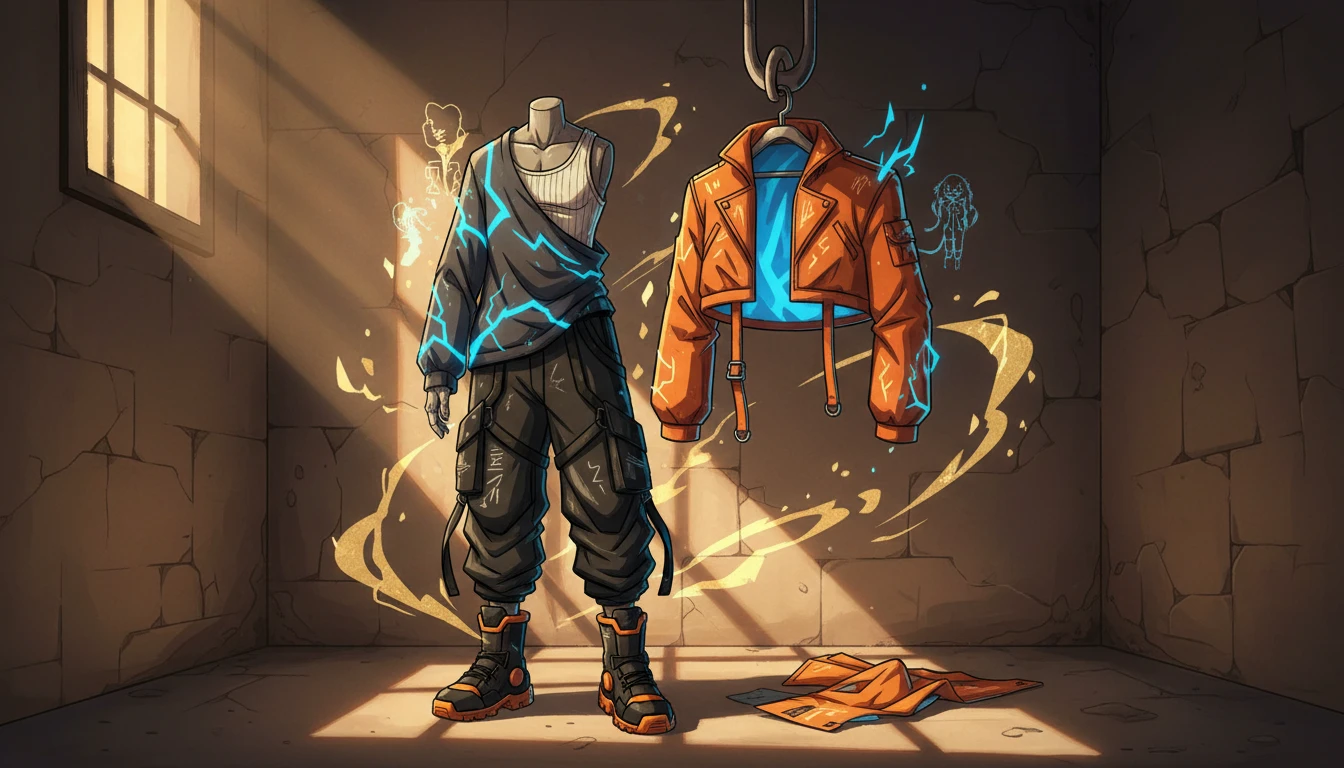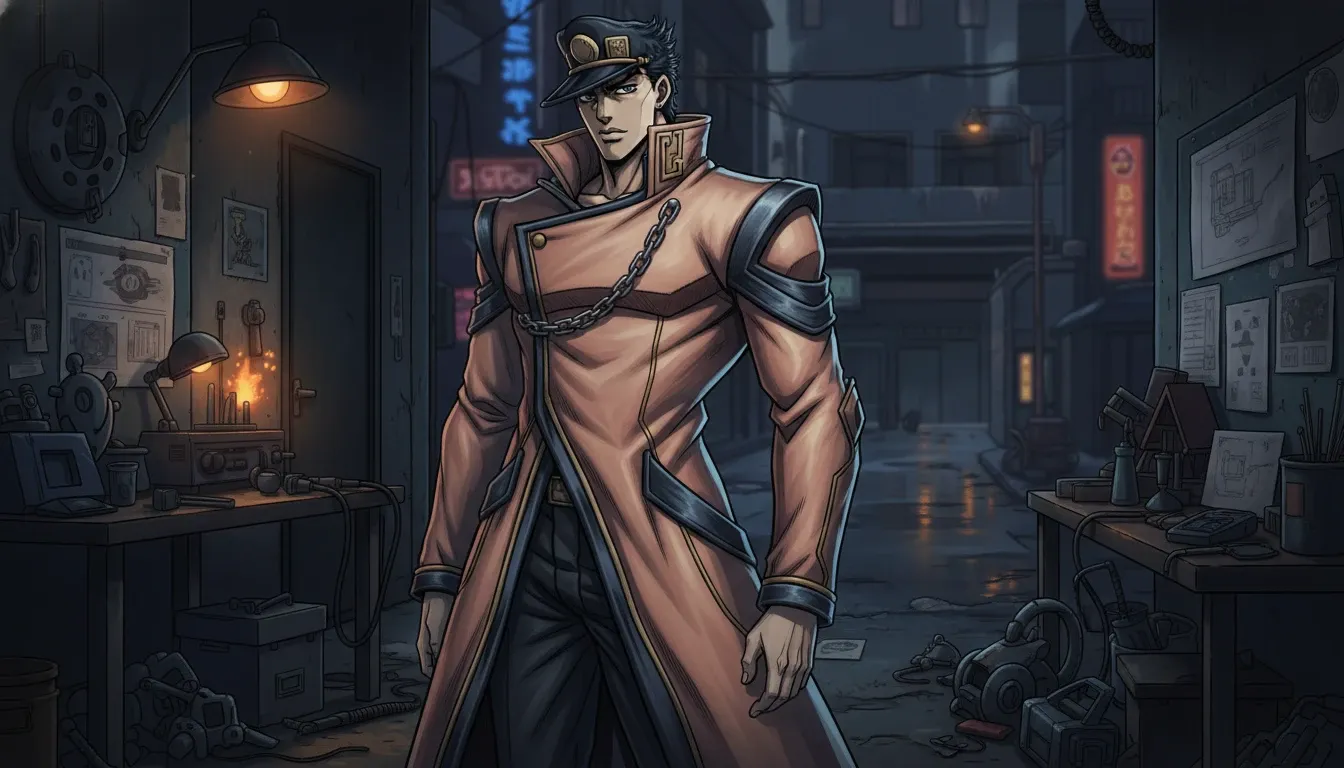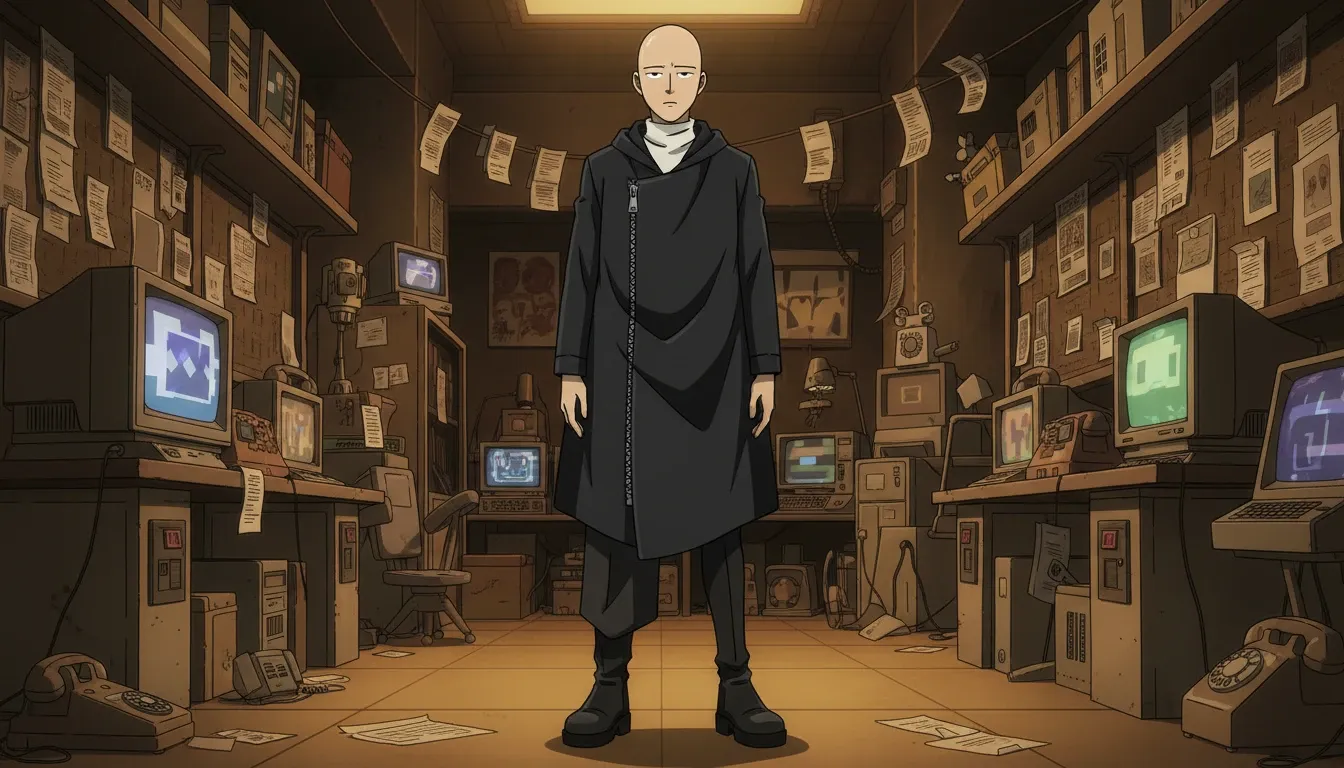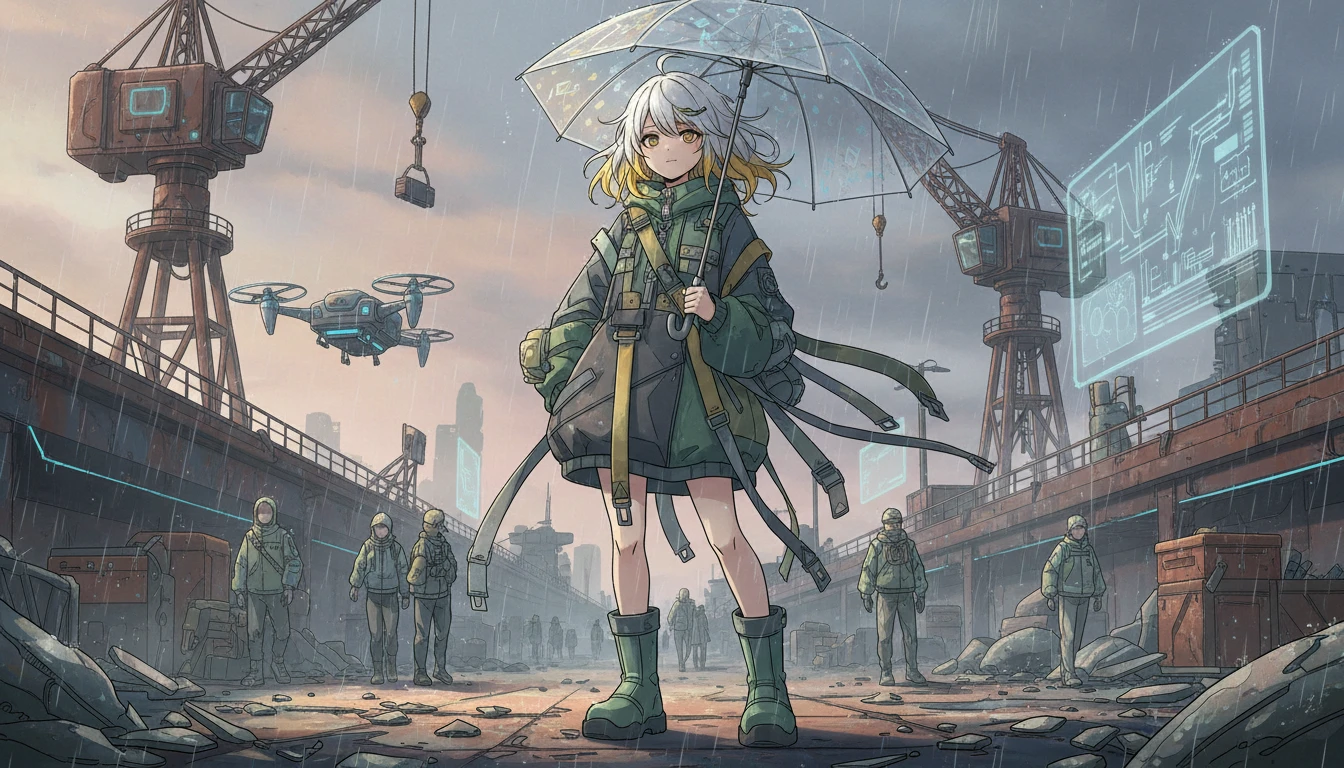
A blend of Hina Amano's aesthetic in a bustling dock environment, featuring oversized streetwear with asymmetric straps, waterproof textures contrasting soft fleece, and colors reflecting the weather: slate gray, algae green, cloud-white, and sunburst yellow. Incorporate realistic details of rusted cranes, silt-dusted studio, and a misty shipyard. Emphasize light interplay on ceramic shards, capturing the essence of rain-soaked intimacy, while a dynamic anime character embodies the futuristic avant-garde spirit
The dock never truly sleeps. Even at noon, it keeps a midnight smell—diesel breath trapped in wet timbers, iron sweating rust, river wind carrying a greenish bite that stings the soft tissue behind the nose. My studio squats beside the shipyard like a barnacle: one door facing the cranes, one window facing the Yangtze, both forever filmed with silt dust. When I open a crate of lifted shards, the air changes. Old porcelain has its own weather. Not rain, not sun—something quieter: the mineral aftertaste of kiln fire that refuses to die.
They call it “restoration,” as if I’m returning an object to what it was. That word is too clean. What I do is closer to docking a ghost. I take bowls and jars hauled up from a drowned hull and stitch them back into a body that can hold light again. But in the seams, in the hairline crazing, in the way river sediment has nested inside foot-rings like a second glaze, there is always a route. A purpose. A deckhand’s careless handprint sealed under the base like a confession.
And lately, as I grind and fill and re-glaze, I’ve been thinking about Hina Amano—sunlight in a rain-soaked city—and how her kind of weather feels like fashion when you stop treating clothing as fabric and start treating it as forecast.
In Weathering With You, the sky is not background; it’s a character that grabs your sleeve. Rain isn’t merely wetness—it’s pressure, consequence, a constant drumbeat on tin roofs that makes even a convenience-store umbrella feel heroic. Casual streetwear in that world is not “casual” at all; it’s survival gear with an emotional lining. A hoodie is a portable room. A cap brim is a small roof you carry for your face. The soft cotton that holds body heat becomes a private hearth when everything outside is water and neon.
I understand that intimacy. When I work, I dress for the kind of mess that clings. My cuffs stiffen with slip and resin. My apron keeps the chalky scent of ground ceramic, the way bread boards keep flour no matter how often you scrub them. The studio radio hisses, and beyond it the shipyard’s metal music—chains, pulleys, the thunk of a container landing like a heavy thought. Between those sounds, I can almost hear an old deck: lacquered planks slick with mist, a cook shouting over rain, ceramic bowls stacked in woven baskets, each bowl a small moon waiting to be broken.
Hina’s styling, if you translate it into streetwear, is the paradox of softness under storm. Think: oversized silhouettes that swallow you like a promise, but cinched somewhere unexpected—an asymmetric strap crossing the torso like a diagonal bolt of lightning. Waterproof textures paired with something tender: nylon against skin, matte tech fabric beside fleece that smells faintly of detergent and human warmth. Color that behaves like weather: slate gray, algae green, cloud-white, interrupted by sudden sunburst yellow—the way a repaired crack catches gold kintsugi when the angle is right.
Avant-garde futurism, in my hands, never looks like chrome for chrome’s sake. It looks like repair made visible. It looks like seams that refuse to pretend they’re not seams.
When I fill a loss in porcelain, I can choose to hide it—match the glaze, erase the wound. Or I can leave a deliberate interruption: a patch like a different material, an honest prosthetic. That’s where “futuristic” actually begins. Not in pretending we are beyond damage, but in designing with damage as a permanent citizen.
Streetwear already knows this. Streetwear is the democracy of scars: frayed hems, sun-faded caps, sneakers that carry the map of your day in their soles. It’s “casual” the way the river is “casual”—always there, always moving, always capable of swallowing a ship.
So I imagine Hina not as an anime icon but as a walking artifact—someone whose outfits are talismans against a sky that won’t make up its mind. She’d wear layered pieces that can be stripped or added like controlling humidity in a kiln. She’d favor pockets—deep, utilitarian, secretive—because in a flooded city you never know what you must save. The avant-garde twist would be in the wrongness that feels right: one sleeve longer than the other, a collar that folds like a paper boat, reflective tape placed where it mimics the run of rain down a window.
In my studio, I’ve learned that asymmetry is rarely an accident. It’s a record. A cup’s rim worn down more on one side means a habitual drinker—right-handed, perhaps, someone who lifted it in a hurry. A jar’s handle repaired with a different clay suggests a stopover port where the original material wasn’t available. The object tells you who touched it, and how often, and under what kind of sky.
There are details in this work most outsiders don’t see, because they don’t sit for hours with their fingertips reading a fracture the way you read Braille. Here is one: some of the shipwreck porcelain carries a faint, stubborn sweetness when warmed—not perfume, not mold, but something like dried longan or brown sugar that has seeped into microcracks and refused to leave for centuries. You only notice it if you run a low heat gun over the body to chase out moisture before bonding. For a few seconds, the studio smells like a market stall that no longer exists. That smell tells me the cargo was not just tableware; it was living commerce, food and appetite traveling with the bowls that would hold it.
Here is another detail, quieter: under certain glazes, river-weathered crazing aligns in patterns that echo rope lashings. It’s not mystical; it’s physics. A bundle stored tight, pressed and vibrated over long distances, creates stress lines that later become crackle maps. When I see those lines, I see the deck. I see wet hemp rope biting into ceramic through straw padding, and I know the vessel sailed with urgency—cargo strapped like someone feared sudden squalls or sudden inspectors.
And here is the detail that has recently made my days stranger: my most heated arguments about these ghosts are no longer with other restorers. They’re with a tech obsessive who has never loved a bowl for its curve, only for its data. He shows up in my studio with a tablet and a smile sharpened by efficiency. He wants to scan every shard in high-resolution photogrammetry, feed it to a reconstruction model, and have an algorithm “solve” the missing portions—fast, cheap, scalable. An investor backs him, a man who talks about throughput the way sailors talk about tide. They dream of an automated pipeline: wreck to museum in months, not years.
At first I despised them. The dock has taught me suspicion. The river has eaten too many promises.
But then the tech man did something I didn’t expect: he brought me a map of micro-sediment distribution across a batch of fragments, color-coded like a weather radar. He had run a mineral assay on the silt trapped in the foot-rings—minute differences in quartz and feldspar that correspond to specific stretches of the river. He wasn’t trying to replace my hands; he was trying to give them a second set of eyes. The assay suggested the ship had lingered near a bend upstream longer than the logs implied, perhaps sheltering from a storm, perhaps waiting for a bribe to clear a checkpoint. That pause—the shape of delay—changed my understanding of the cargo arrangement, which changed how I reassembled the fragments. A bowl that I thought belonged to one stack belonged to another. A crack that looked like impact looked like pressure over time.
We cooperated, reluctantly, like two people holding opposite ends of the same plank above floodwater. And still we fought. He wanted to render the missing areas in neutral resin, invisible, “clean.” I wanted to mark them like new skin, not fake old skin. He talked about museum lighting and visitor attention spans. I talked about the feel of a seam under a thumb, how truth lives in texture. In the end, we compromised in a way that felt oddly like Hina’s weather bargains: some losses filled with matte black ceramic resin—night sky against white glaze—others traced with thin metallic pigment like the first slice of sun through cloud.
That compromise is where “Hina Amano Weathering With You Meets Casual Streetwear And Avant Garde Futuristic Styling” becomes more than a mood board. It becomes a method.
Because the best streetwear isn’t just clothing; it’s a wearable repair strategy. It knows the body will sweat, bruise, ache, and keep moving anyway. The best avant-garde futurism isn’t sci-fi armor; it’s design that admits the world will keep breaking things and asks: how do we keep beauty without lying?
When I finish a restored piece, I don’t place it on a velvet pedestal in my mind. I imagine it back on deck, rain tapping it like impatient fingers, someone’s palm warming its side. I imagine the bowl under a tarp, half-hidden, next to a pair of sandals, next to a bundle of cloth, next to a letter sealed with wax. I imagine the sailor’s casual uniform: rolled sleeves, damp hem, rope burn on the wrist. I imagine the futuristic element not as technology but as resilience—human beings inventing style in the middle of bad weather because style is a kind of defiance.
Sometimes, when the dock fog comes in thick as cotton, my window turns into a blank screen. The studio light reflects back at me, and I see myself doubled: one figure with powdered hands, one with a shadowy, rain-soaked outline. On those nights, I think of Hina’s sunlight as a glaze that doesn’t belong to the clay but changes everything it touches. I think of streetwear as the practical poetry of layers. I think of avant-garde as the courage to show your seams.
Then I pick up a shard. Its edge is sharp enough to bite. Its surface is cool, like river stone. I press it to its matching half and feel, for a second, the click of history aligning—two broken things remembering they were once one.
Outside, cranes swing like slow metronomes. Inside, my repair line cures under heat, smelling faintly of that ancient sweetness again. Somewhere in the noise, the river keeps talking. And every time I listen closely, I hear not only the past’s rain, but the future’s weather—made wearable, made repairable, made honest.