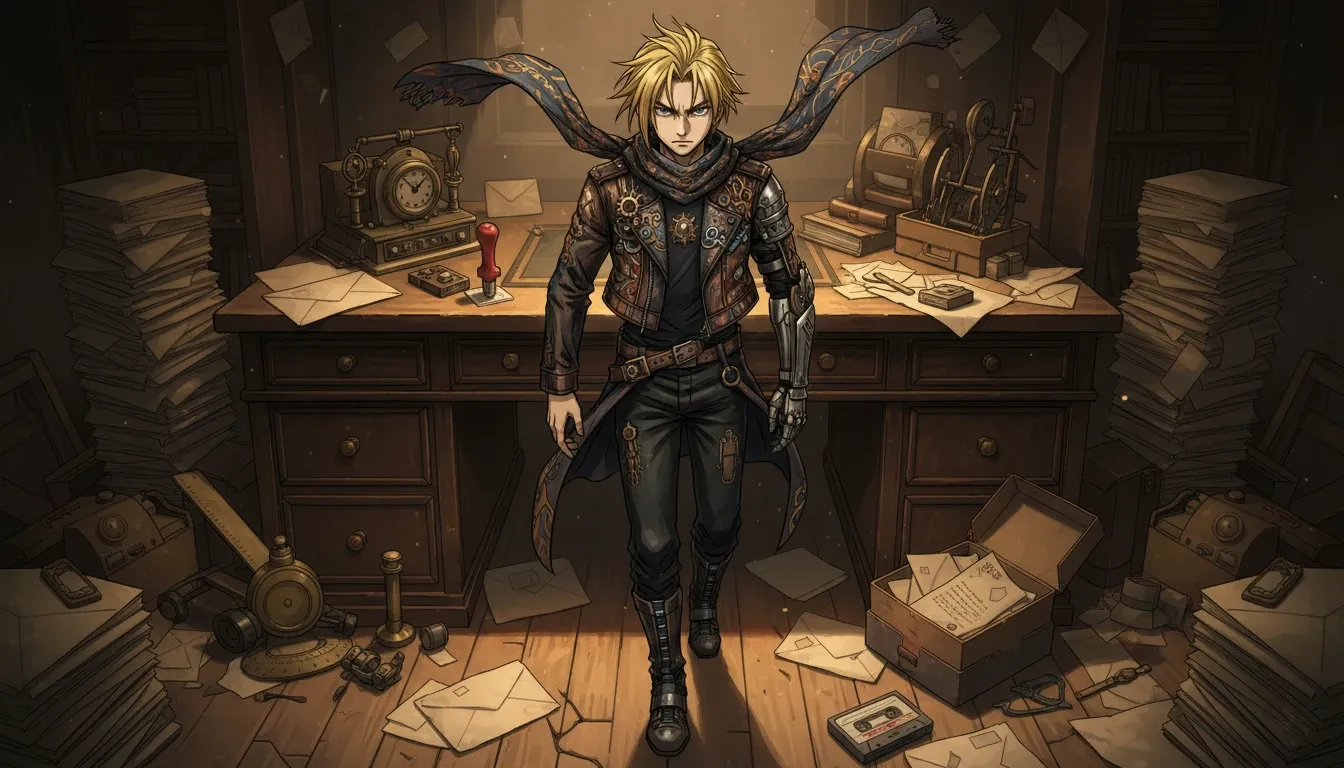
Edward Elric strides into a dimly lit room filled with envelopes and brass tools, wearing avant-garde streetwear with intricate textures. His jacket blends dark denim and leather, layered with metallic accents, reflecting a spectrum of deep blues and muted golds. Soft light casts sharp shadows on his face, highlighting determination. Around him, a weathered desk holds a vintage date-stamp, a shoebox of unfinished letters, and a cracked cassette tape. The atmosphere is heavy with emotion, blending anime aesthetics into a poignant, realistic setting
I used to sort other people’s urgencies into canvas sacks that smelled of rain, glue, and old paper. The post office had a clock that never forgave anyone: its hands clicked like a small, hard jaw. After I left, I kept the one habit that mattered—treating time as something you can hold without bruising it.
Now I work in a room where the air is always a little too dry, because envelopes hate damp the way dying people hate pity. My service is simple and not simple: I write letters for the terminally ill—words they cannot bring themselves to say while the other person is still breathing in the same room—and I promise delivery at the appointed time after they’re gone. Not an email. Not a notification. Paper. Ink that bites the fibers. A stamp pressed down like a final thumbprint. “Delayed delivery,” the form says. What it really means is: the last sentence will arrive on the day it was meant to, even if the mouth that formed it is already dust.
On my desk, there is always the same weight of objects, because objects do not flinch. The first is an old brass date-stamp from my postal days, its handle darkened by thousands of palms. Most people think it’s a prop. They don’t know that if you unscrew the base, there’s a thin ring of hair inside—one curl, pale and stubborn. A boy brought it to me years ago, before I did this work openly. He wore grief like a jacket he refused to take off. “For proof,” he said. “So you’ll remember this isn’t a job.” The hair belonged to his brother, taken before a surgery that failed. I never asked his name. I never needed to. When the stamp hits paper, that hidden ring warms slightly, as if memory conducts heat.
The second is a shoebox I never open in front of clients. It sits under the desk like a small, ashamed animal. Inside are failed letters: pages where I couldn’t catch the voice in time, where the dying person’s breath ran out mid-sentence and left me holding a half-built bridge. The box smells faintly of antiseptic and pencil shavings. Every so often, late at night, I take out one of those pages and read it until my eyes sting, the way you rub salt into a cut to make sure it still belongs to you.
The third is a cassette tape—yes, a cassette—in a cracked plastic case, labeled only with a date and the word “VOW.” I own no tape player in the room. That’s the point. Some promises should not be reheated. I recorded it once, in the back of the old sorting hall, because the person speaking insisted their voice be stored somewhere physical, somewhere that could be dropped and still exist. I can tell you this much: the tape contains a pause so long you can hear the fluorescent lights fizzing, and then a single line said with such calm that it feels like a blade laid flat on your tongue.
It’s in that kind of room—paper, metal, the faint iron scent that comes when someone has been crying for hours—that Edward Elric walks in, not as a boy from a manga panel but as a silhouette cut from conflict: streetwear attitude welded to avant-garde runway energy, the kind of look that makes strangers step aside without knowing why.
You can dress Edward like a brand, and people do. They think the appeal is easy: the red coat, the glove, the blond braid like a rope you could climb out of a bad day. But the real reason his style translates so violently into fashion is that his body is already a thesis about cost. He is literally a story of material exchange. Cloth is not decoration on him—it’s armor, flag, wound dressing, and sometimes apology.
Streetwear understands that language. Streetwear is born from concrete heat, from collars damp with sweat, from the blunt need to move fast. When Edward’s red becomes a hoodie or an oversized coat with dropped shoulders, it isn’t cosplay; it’s a refusal to be neat. It’s the same refusal you see in his gait: forward, injured, still forward. The red in streetwear reads like warning paint on a machine—don’t touch, it’s hot; don’t touch, it’s alive.
But then the runway comes in and turns his grief into geometry. Avant-garde doesn’t ask to be liked. It asks to be witnessed. Edward’s silhouette—shorter than you expect, sharp as a snapped ruler—begs for proportion play: shoulders broadened into angular plates, a collar that rises like a barricade, sleeves that end too long so the hands disappear as if the body is trying to hide its own instruments. I’ve seen designers turn his braid into a seam: a thick, corded line stitched down the spine, deliberately off-center, because symmetry is a lie we tell children.
The best interpretation keeps the idea of transmutation without showing a single circle. It uses hardware that clinks and catches light like teeth: grommets, buckles, exposed zippers that look surgical. You move, and the garment answers back with sound. That’s important. Edward is not silent. Even when he says nothing, the world around him is loud—metal limbs, slammed doors, the crackle before an alchemical reaction. A runway look that doesn’t make noise has missed him.
And texture matters. His world is not polished. It’s soot, grit, scorched stone. So give him fabrics that feel earned: waxed cotton that smells faintly of smoke when warmed by the body, leather that shows fingerprints, denim stiff enough to stand up on its own like a stubborn argument. Even the color palette wants to bruise: iron gray, bone white, blood red, the sickly gold of old brass. Not “gold” like jewelry—gold like a doorknob touched by a thousand strangers.
When I write for the dying, I listen for the way they describe touch. They don’t say “I loved you,” not always. Sometimes they say: “Your hands were warm when you held my face.” Edward’s fashion language is like that. It’s not about symbols; it’s about sensation. The glove on his automail isn’t a style choice—it’s the boundary between skin and consequence. Translate that into design, and you get gloves that extend into sleeves, sleeves that become restraints, cuffs with hidden fasteners like secrets.
There’s a particular kind of runway energy—call it cathedral-industrial—that suits him: lights harsh enough to make every seam cast a shadow, music like a heartbeat trapped in machinery. Models walk like they’re carrying invisible weight. Edward would not float. He would stride as if the floor owes him answers.
Sometimes, after a client leaves, I seal their letter and press the stamp down. The thud is soft, satisfying, like closing a door you can finally stop guarding. In those moments I think about why Edward Elric still matters to people who have never lost an arm, never tried to barter with the universe. It’s because he dresses like someone who has learned the truth we all avoid: you do not get to keep everything. You choose what you carry, and you carry it with your whole body.
I schedule deliveries the way a runway schedules impact: not when it’s convenient, but when it will land hardest. A letter arrives on the birthday that will now be quiet. Or three months after the funeral, when everyone else has moved on and the grief has become private and heavier. That is delayed delivery—timing as a kind of mercy and cruelty.
Edward’s streetwear-meets-avant-garde spirit is also delayed delivery. The boy in the red coat keeps arriving in new forms—on hoodies, on editorial spreads, in silhouettes that look like broken machines made beautiful—long after the first time you watched him bleed and stand up again. He is a message that refuses to be buried on schedule.
Some nights, when the room is too still, I run my thumb along the edge of that cracked cassette case and feel the grit in the plastic, like sand caught in a wound. I don’t play the tape. I don’t need to. I already know what it holds: a promise made with full knowledge of the cost, spoken into a cheap microphone with the fluorescent lights buzzing like insects overhead. That’s what fashion misses when it only copies Edward’s colors. The real runway energy is not the look. It’s the vow underneath it.
Paper has a sound when you fold it—three crisp creases, like bones setting. Ink has a smell, faintly sour at first, then sweet as it dries. A stamp leaves a dent you can feel with your fingertip, proof that something pressed down and meant it.
That’s how I want Edward Elric on a modern runway: not as nostalgia, but as pressure. As a garment that remembers the body. As red that feels hot. As hardware that clinks like consequence. As asymmetry that admits the truth—one side always carries more weight—and still walks forward anyway, right on time, delivered when it hurts most, because that’s when it’s needed.