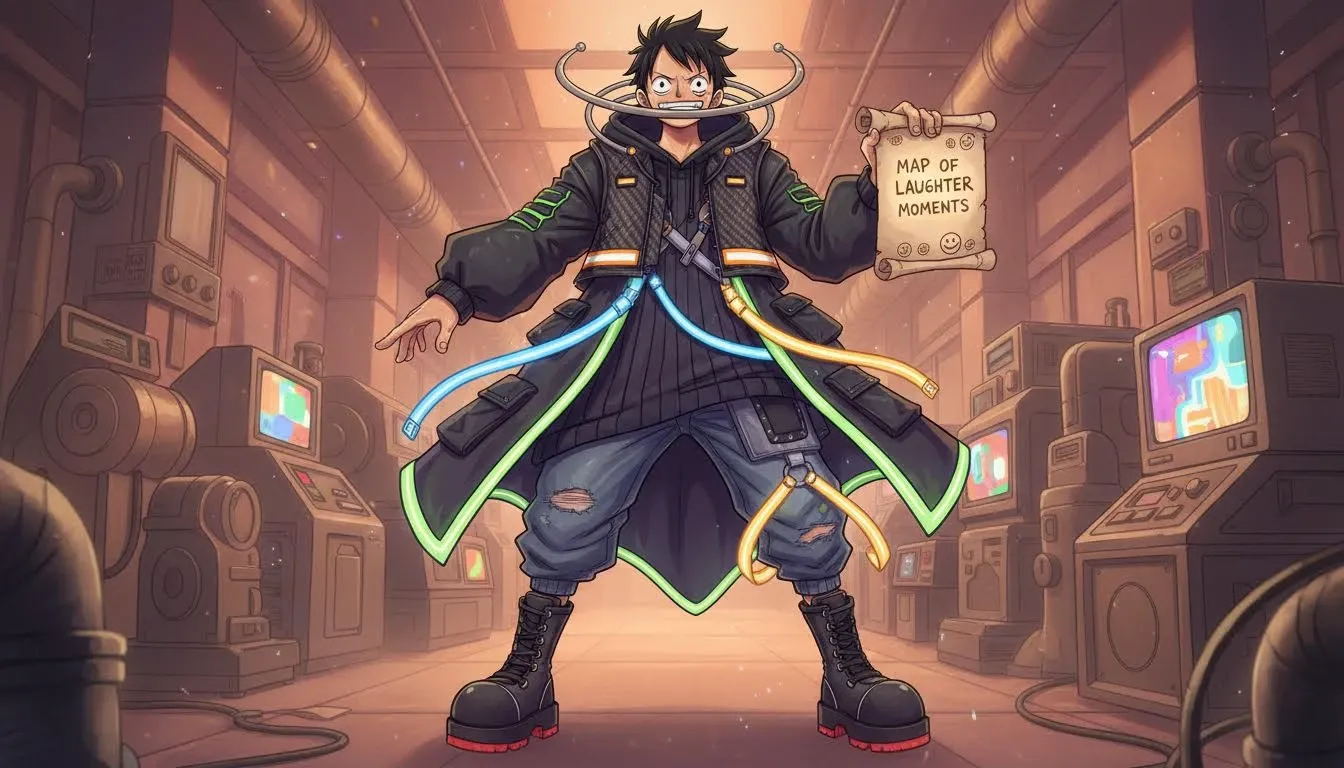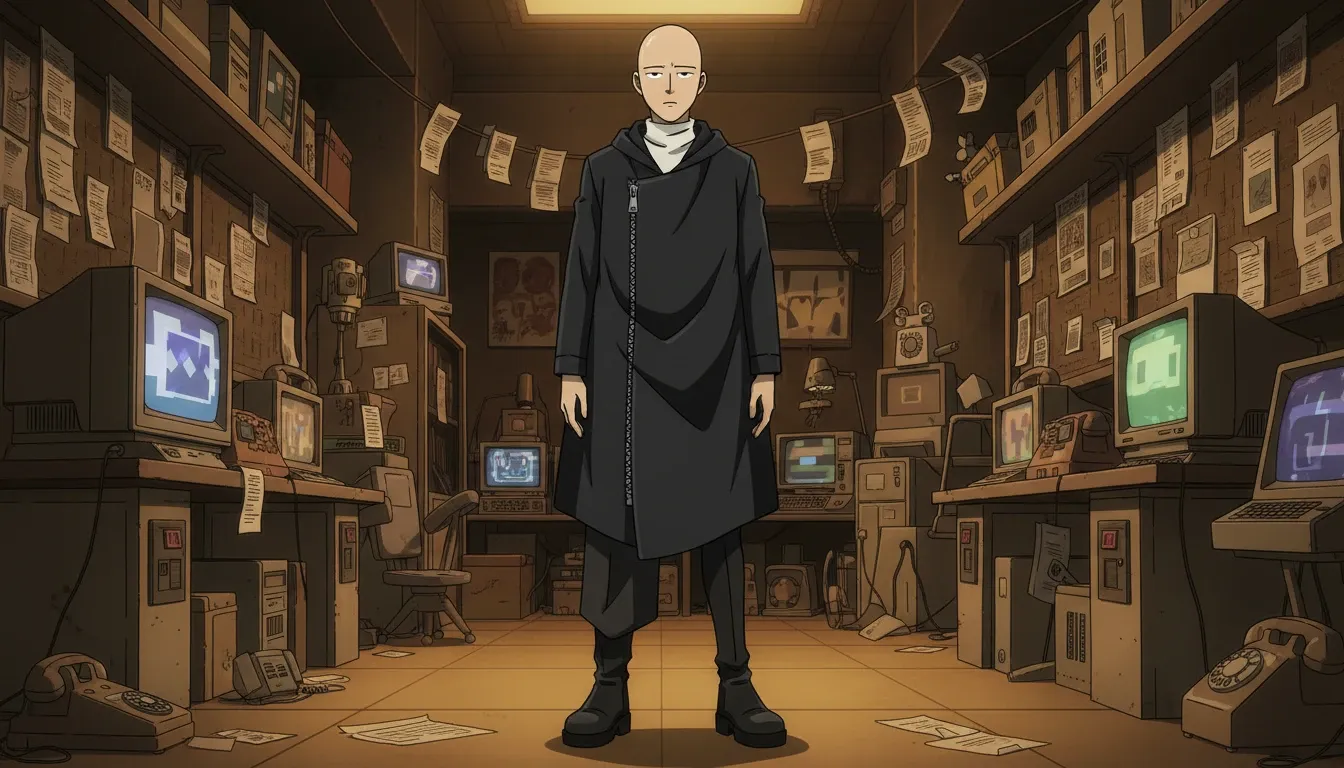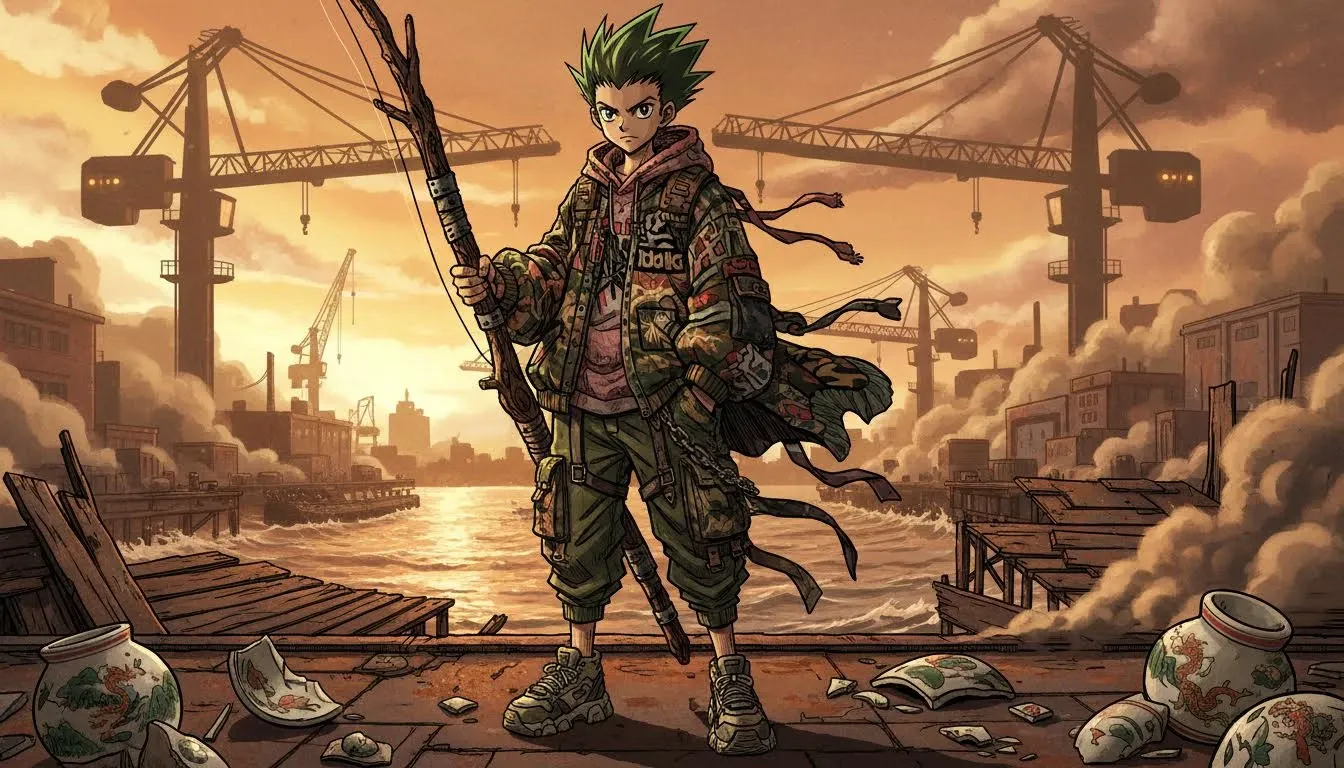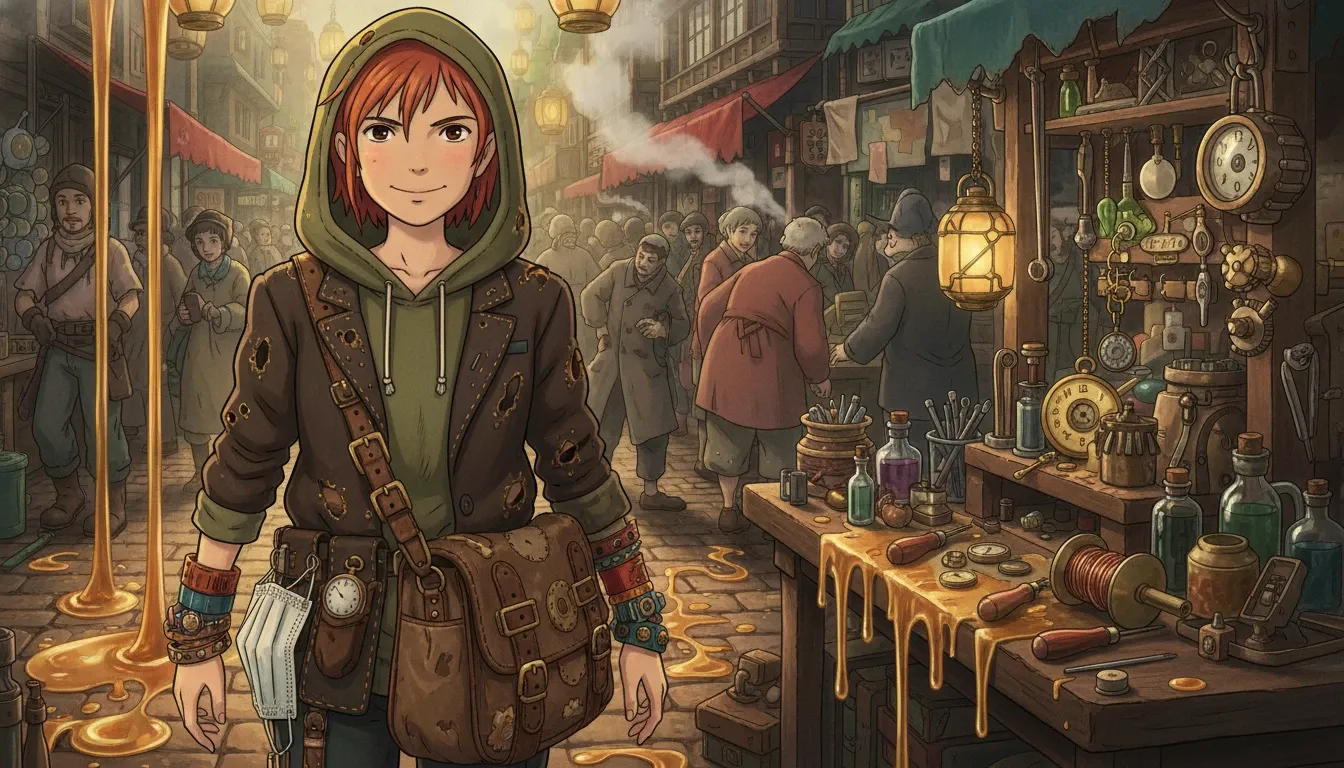
Natsu Dragneel in avant-garde streetwear, urban setting at dawn, asymmetrical cropped jacket: one sleeve heat-treated leather, the other ripstop nylon with crimson thread. Oversized gauzy scarf, scorched gradient pants, metal hardware off-center. Textures: fire, street, fantasy fusion. Layered textiles, soft light casting shadows, vibrant city life in the background, blending realism with anime style. Sound signatures: flame-snap, laughter, boots on wet stone. Atmospheric details: crushed ice and cilantro in the air, bustling market scene, dynamic energy
At 04:38 the city is a throat clearing itself.
I tell my travelers not to look up. Not at the cathedral crown, not at the postcard skyline, not even at the neon that keeps pretending the night is still on duty. I used to be a film foley artist—paid to make a world believable with shoes, celery, sand, and lies. Now I make routes for people who can stand to be unsure of what they’re “seeing.” We walk by ear. We let the street do wardrobe fittings on the mind.
Natsu Dragneel—if you drop him into this city dressed the way I imagine him today—doesn’t arrive as a character. He arrives as a sound signature: flame-snap under a cuff, a laugh that hits like a lighter wheel, the soft violence of boots meeting wet stone. Avant-garde streetwear for him isn’t a runway statement; it’s a portable weather system, fantasy fused to asphalt. Mix and match, yes, but not random: a deliberate clash the way two languages collide in one sentence and make a third meaning.
I build his look the way I build a soundscape: in layers you don’t notice until they’re gone.
We start where the wholesale market breathes. The air tastes like crushed ice and bruised cilantro. Pallets scrape concrete in a rhythm that could be sampled into a kick drum—thunk, pause, thunk-thunk—then a vendor barks a price so fast it becomes percussion. Here Natsu wears asymmetry like a dare: a cropped jacket with one sleeve built from heat-treated leather, the other from ripstop nylon stitched with crimson thread that catches the dawn like a match head. Under it, a scarf—not the tidy hero scarf, but an oversized, gauzy wrap dyed unevenly, ember to ash, edges frayed like a campfire’s last whisper.
He shouldn’t look “clean.” Fire is never clean. So I give him pants with a scorched gradient, charcoal to rust, tailored wide through the thigh like streetwear, then narrowing hard at the ankle as if the fabric remembered being a uniform and refused to fully forget. Metal hardware sits slightly off-center—buckles that don’t align, a zipper that stops where you expect it to continue—because fantasy, when it fuses with the street, shouldn’t become obedient.
You can hear this outfit before you see it: the faint clack of a carabiner on a belt loop, the hush of layered textiles brushing, the secret rasp of a seam reinforced too many times.
I know about seams. I used to keep an old foley tool in my pocket, always. It’s not impressive—just a dented brass awl with a handle darkened by sweat and time. Outsiders would assume it’s for emergencies, but that’s not why it never leaves me. The tip has a tiny notch filed into it, a mistake I made ten years ago on a set when the director wanted “a dragon’s wing folding” and I couldn’t find the right crackle. I carved that notch in panic, used it to score a strip of dried kelp, and the sound came out like ancient parchment catching fire. The film won awards. I never told anyone the wing was seaweed and fear. Now, when I design Natsu’s streetwear fantasy fusion, I keep that awl in my hand for the same reason: to remember that the right edge—literal or metaphorical—often comes from a flaw you refuse to polish away.
We move into an old neighborhood where dialects overlap like threads in a scarf. Two grandmothers argue in a cadence that sounds like stones knocking underwater. A delivery rider mutters to himself in a regional accent so rare it makes my spine straighten. This is where Natsu’s look gets more intimate: a layered tee with a collar that sits crooked on purpose, exposing the hollow where your throat pulses. A shoulder harness—half tactical, half ceremonial—crosses his chest, holding small pouches that look like spell components but carry street things: lip balm, a metro card, a lighter, a folded receipt from a noodle shop at midnight.
The harness straps are dyed with plant tannins, not chemicals, so they smell faintly of wet bark when rain hits them. I insist on that. It’s my superstition: if you’re going to wear fantasy in a city that wants to grind you down, at least let the materials have a living odor, something that reminds the body it’s not purely symbolic. The tannin scent rises when he moves—like a forest pressed into a subway.
He accessorizes with contradiction: one fingerless glove on his right hand, the left bare, rings mismatched—one cheap resin, one hammered metal that looks scavenged from a broken gate. A chain necklace sits under the scarf so it only flashes when he laughs. That laugh is important. In my routes, laughter is a landmark. It bounces off tile, gets swallowed by velvet curtains in old bars, turns brittle near office towers. Natsu’s laugh should never be swallowed. So his outfit includes tiny reflective fragments stitched near the collarbone, not for the camera, but for the ear’s imagination: you hear brightness and you believe it.
There’s a bridge we visit that tourists photograph and forget. We don’t photograph anything. We stand beneath it, where concrete ribs hold the city like a clenched jaw, and we listen.
Under this bridge, the echo has a flaw. One pillar was repaired with a different aggregate decades ago—denser, slightly rougher—and the sound returns to you with a faint double, as if the city is copying itself a half-beat late. I learned this by accident, waiting out a storm, recording footsteps for a project that never happened. You need time to find it: you have to clap once, then let your breath settle, then clap again closer to the third rib. The second clap comes back wearing a shadow.
This is where Natsu’s styling turns truly avant-garde. I imagine a long, sleeveless overcoat with an exaggerated collar that frames the scarf like a flame halo. The coat’s hem is uneven—one side longer, cut like a torn banner—so it flutters and slaps his legs when he walks. The fabric is treated to make a dry, papery whisper, like pages being flipped quickly. Under the bridge, that whisper becomes chorus. Streetwear becomes ritual. Fantasy becomes acoustics.
I have a box I never show clients, not even the ones who tip too much and try to buy my secrets. It’s a small metal crate, dented at one corner, full of failed recordings—footsteps that didn’t land, rain that sounded like static, a “heartbeat” effect that came out like a refrigerator cycling. I keep them because failure has texture. It has grain. When I dress Natsu in mix-and-match pieces that technically “don’t go together”—a sculptural sneaker with a high-fashion sole beside a boot with soot-stained laces—I’m using that crate as a mood board. The city itself is a crate of mismatched sounds. You don’t fix it. You learn to hear the rhyme.
We walk toward noon, when the street’s frequency range gets crowded: construction drills, bus brakes, café grinders, the sharp wet snap of someone opening an umbrella too early. My travelers start to sweat; their attention gets sticky. This is when styling must breathe. So Natsu’s look needs vents, cutouts, negative space: a mesh panel running along the ribs, a back yoke that lifts like a gill, an undershirt that wicks heat like it’s swallowing flame. His palette stays ember—burnt orange, soot black, ash gray—but the textures shift: matte against gloss, rough against slick, soft against armored.
And then there’s the one recording I’ve never played for anyone.
It’s not dramatic in the way people expect. No sirens. No confession. It’s a child’s voice, captured by mistake on a night I was trying to steal the sound of a door closing “like regret.” The kid was on the other side of an alley, singing a made-up song in a made-up language, the melody looping, stubborn, bright. In the background, a man says a name—quietly, like he’s afraid of breaking it—and the kid laughs, and the laugh hits the brick and comes back warmer, larger, as if the alley itself wanted to be kind.
I keep that file locked because it reminds me what fantasy is supposed to do on the street: not escape reality, but warm it from the inside.
So when I write Natsu into this city in avant-garde streetwear—fantasy fusion, mix and match—I’m not dressing him for a photograph. I’m dressing him for sound: for market rhythms that slap your shins, for dialects that roll like marbles in the mouth, for bridge echoes that duplicate your hands. His scarf is a moving microphone windscreen. His asymmetry is a syncopation. His hardware is a metronome. His colors are temperature.
Near the end of the walk we pass a laundromat, doors fogged, machines spinning like small moons. Someone inside shakes a wet jacket hard—one snap, two—and the water hits tile with the exact sound of sparks dying in snow. Natsu would turn his head at that. He would grin, because he recognizes a cousin of fire.
I don’t tell my travelers what to feel. I just keep us on the route where the city speaks in layers. When we stop, they always look surprised, like they’ve arrived somewhere without ever seeing it. That’s the point.
If you can map a city by its noises, you can dress a character by the same logic: not by silhouette alone, but by friction, resonance, and the way fabric and myth move through air.
And if you listen closely—if you stand under the bridge’s flawed echo, if you let the market’s rhythm rewrite your pulse—you might hear it: the fantasy doesn’t sit on top of the street. It stitches itself into it, imperfectly, the way my dented awl stitches through thick material. The city bleeds sound. Natsu wears it.