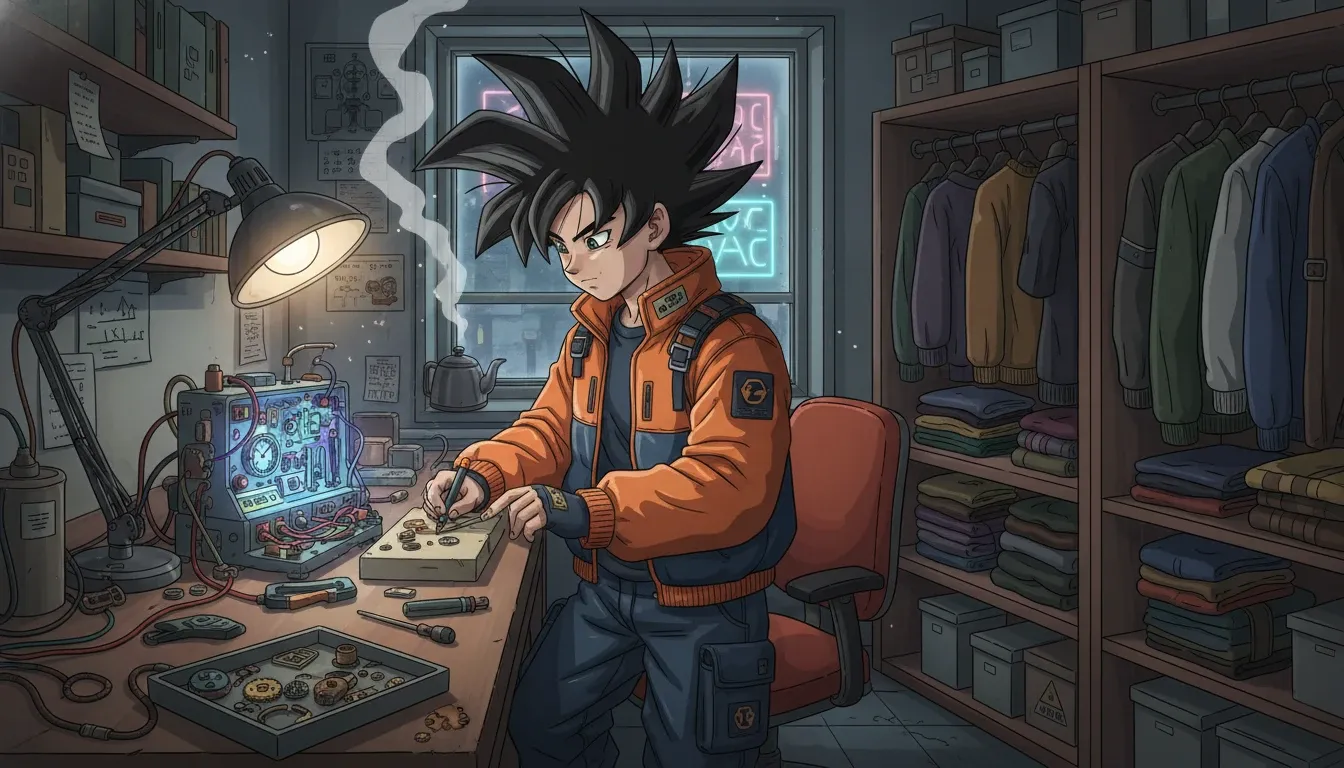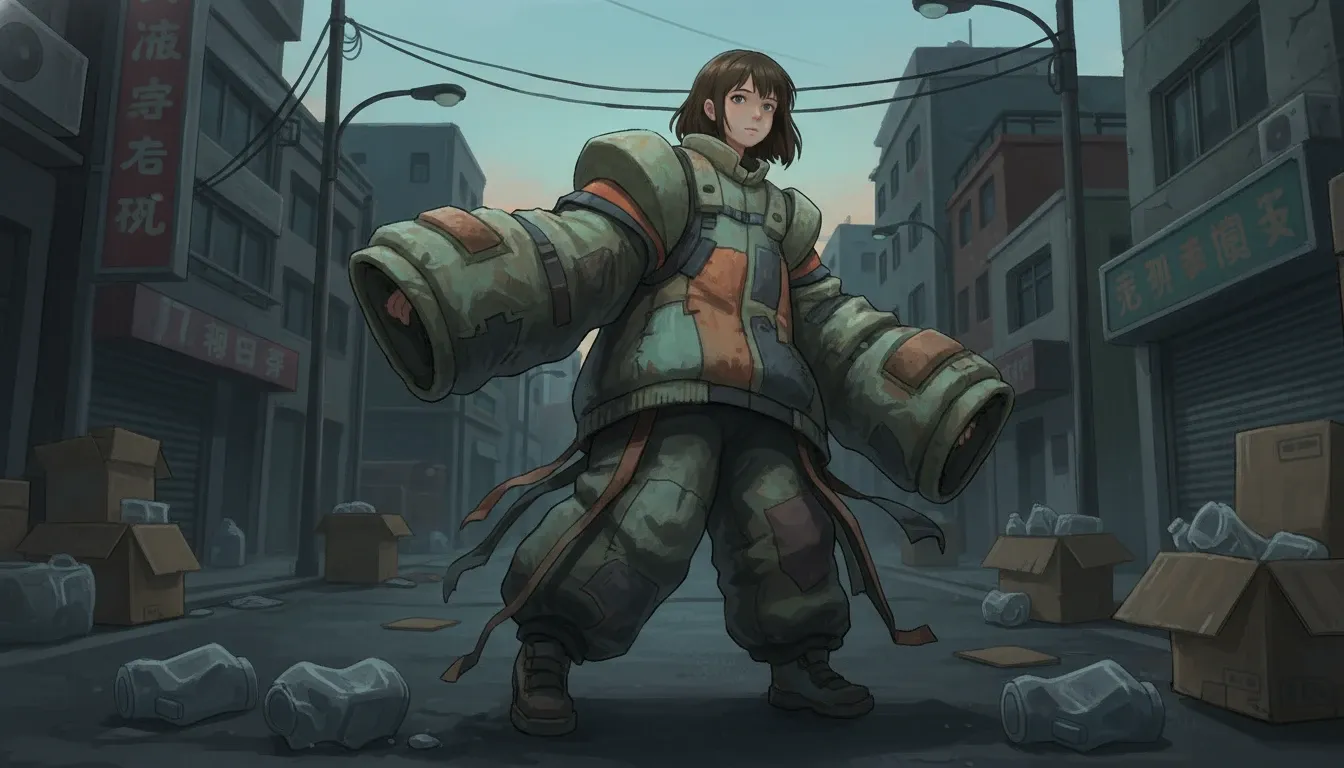
"Emma from The Promised Neverland in avant-garde streetwear, featuring bold silhouettes and layered chaos. A blend of oversized nylon pieces in vibrant red-orange and black, textured with warm cotton and a matte technical jacket. Set in a dimly lit urban studio, shadows dancing around abstract installations. The atmosphere carries hints of rain-soaked fabric, with intricate details like scuffed linoleum and a cracked cassette recorder nearby, evoking nostalgia and hope."
My studio is a catalog you cannot browse with fingers.
You enter and the first thing that greets you is not a welcome, but a temperature: the faint chill of stainless steel drawers, the warm animal breath of cork stoppers, the dust-sweet rasp of blotter paper stacked like thin bones. I do not make perfumes for crowds. I make odor specimens—sealed vials that hold a year, a room, a specific hour. 1998 internet café: microwaved cup noodles, heated plastic, nicotine varnish on keyboards. Grandmother’s barn in plum-rain season: damp straw, rusted nails, fermented rice husk, the slow-green of moss thinking.
Today I am asked for a different specimen: Emma from The Promised Neverland—not as nostalgia, not as fandom—but as an outfit you can hear and smell: avant-garde streetwear, layered chaos, bold silhouettes. Emma, who runs with her mouth open and her eyes wider than the future. Emma, whose hope is not a soft candle but a snapped glowstick—bruised, chemical, stubborn.
I begin the way I always do: by letting the air choose the first note.
A swish of nylon like a flag cut into strips. The smell of rain caught in synthetic fibers—clean, almost sterile, until it warms on skin and turns faintly sour, like the inside of a backpack after sprinting. Oversized sleeves clap against ribs. Fabric becomes percussion. In my head she is already in motion: a red-orange pulse under a black shell, an asymmetrical hem flashing like a warning light at a crosswalk.
Layered chaos is not mess; it is weather. You stand still and the outfit moves around you, a small climate. I smell the interior layers first: cotton loopback warmed by body heat, the ghost of starch, a salted sweetness from dried sweat that never fully leaves a hoodie no matter how many washes. Then the outer layer: technical jacket, matte and stubborn, smelling of factory—hot rubber conveyor belts, cold machine oil, the faint bitterness of flame retardant. Not ugly. Just honest.
Bold silhouettes have their own odor: volume traps air. Air holds memory.
I pull open Drawer 19, where I keep my “places that do not exist but insist anyway.” There is a vial labeled Orphanage Corridor, 04:13—not from any museum, not from any official archive. I do not tell visitors how I got it. The truth is embarrassing and tender: years ago I bought a cracked cassette recorder from a junk stall in a seaside town where the wind tastes like iron. It came with a tape inside, unmarked. When I played it, I heard children’s shoes scuffing linoleum, a distant door latch, breathing that tried to be quiet and failed. The sound carried smell in my mind, as sound sometimes does when your nose never forgets. I recorded the air that day as faithfully as others record birdsong.
That recorder is still here, always within reach, wrapped in a faded microfiber cloth so the plastic doesn’t shed its own story onto my samples. Its play button is loose; you have to press it with a fingernail at an angle. I like it that way. It refuses casual use. It demands intention.
Emma’s look is intention disguised as improvisation.
Avant-garde streetwear is an argument with uniformity. Emma was born under rules—measured, numbered, scheduled—so I imagine her clothes as a refusal to be measured. A jacket that doesn’t close where it “should.” A strap that hangs like an unfinished sentence. Pants with pleats that balloon, not for trend, but for running: air pockets like stolen seconds. Each layer is a small act of misdirection, a way to hide tools, maps, contraband hope.
In the back of my studio, behind the curtain that looks like ordinary canvas, there is a wooden crate I never show. The label reads “FAILURES / DO NOT OPEN IN HUMIDITY.” Inside are dozens of sealed attempts that did not behave. They turned sharp overnight. They rotted into sweetness. They separated like bad friendships. One of them is my first try at “Escape”—a specimen I made after listening to that unmarked tape until the magnetic hiss felt like sand between teeth. I chased the smell of fear and ended up with something theatrical: too much metal, too much aldehyde, panic rendered glossy. I hid it away because it was dishonest.
But failure has a scent too: the sour milk tang of pride curdling, the dry-paper smell of notes crossed out, the sting behind the nose when you realize you were trying to impress instead of to preserve. That crate is my private discipline. It teaches me the difference between drama and truth.
So I return to Emma.
Her silhouette is loud, but her core is clean. Not clean as in sterile—clean as in direct. A bright citrus hit, but not perfume citrus; more like peeling a tangerine with cold hands, the oil snapping into the air and landing on your lips. The bitterness of white pith. Under that, something green and raw: crushed stems, the smell you get when you break a leaf and the plant “bleeds” clear water. It says: I am alive, I am not finished.
Then comes the streetwear density: tar-warm asphalt after rain, the mineral dust of concrete, the faint ozonic edge of a subway arriving. A metallic thread runs through it—like the zipper you yank too hard, like a safety pin held between teeth, like the taste of blood when you bite your lip while thinking. She is not delicate hope. She is hope that has bitten down and refused to let go.
I stitch the chaos with asymmetry: one side of the accord leans into smoke—charred paper, the quiet sweetness of burnt sugar crust—while the other side stays airy, translucent, almost soap-like. Not because she is “soft,” but because she makes space for others. A leader who smells like opening a window in a crowded room.
There is a detail I learned the slow way, the way you learn a smell: by living near it until it stops performing. In my notebook—red cover, edges darkened by thumb oil—I once wrote about a boy who taught himself to tie knots in the dark by touch alone. That line is from a voice memo I made at 2:07 a.m. after dreaming of rope fibers and small hands moving fast. I never told anyone because it sounded like obsession. But it matters here: Emma’s layers are not fashion; they are survival techniques translated into cloth.
Streetwear, in her case, is not irony. It is equipment that also happens to be beautiful.
When I finish blending, I do not bottle it as “Emma.” Names invite ownership, and Emma belongs to no one. I label it the way I label all true specimens: with coordinates of feeling.
RUNNING / LAUGHING / TEETH GRIT / ORANGE LIGHT ON BLACK FABRIC
The first spray is a slap of citrus oil and wet nylon. The second breath brings warm cotton, salt, and asphalt. After a minute, the green note rises again, stubborn as a sprout in cracked pavement. Hours later, what remains is a clean skin musk with a faint metallic edge—like the memory of a key in your palm, proof that a door can be opened.
In my archive, eras and rooms sleep in glass. But this one does not sleep. It keeps its shoes on. It keeps a hand on the strap of a bag. It waits at the edge of the shelf like someone who cannot sit still, because sitting still feels like surrender.
If you stand in my studio long enough, you will notice something: the air near that vial is always a little warmer.
As if hope, when layered correctly, has weight.