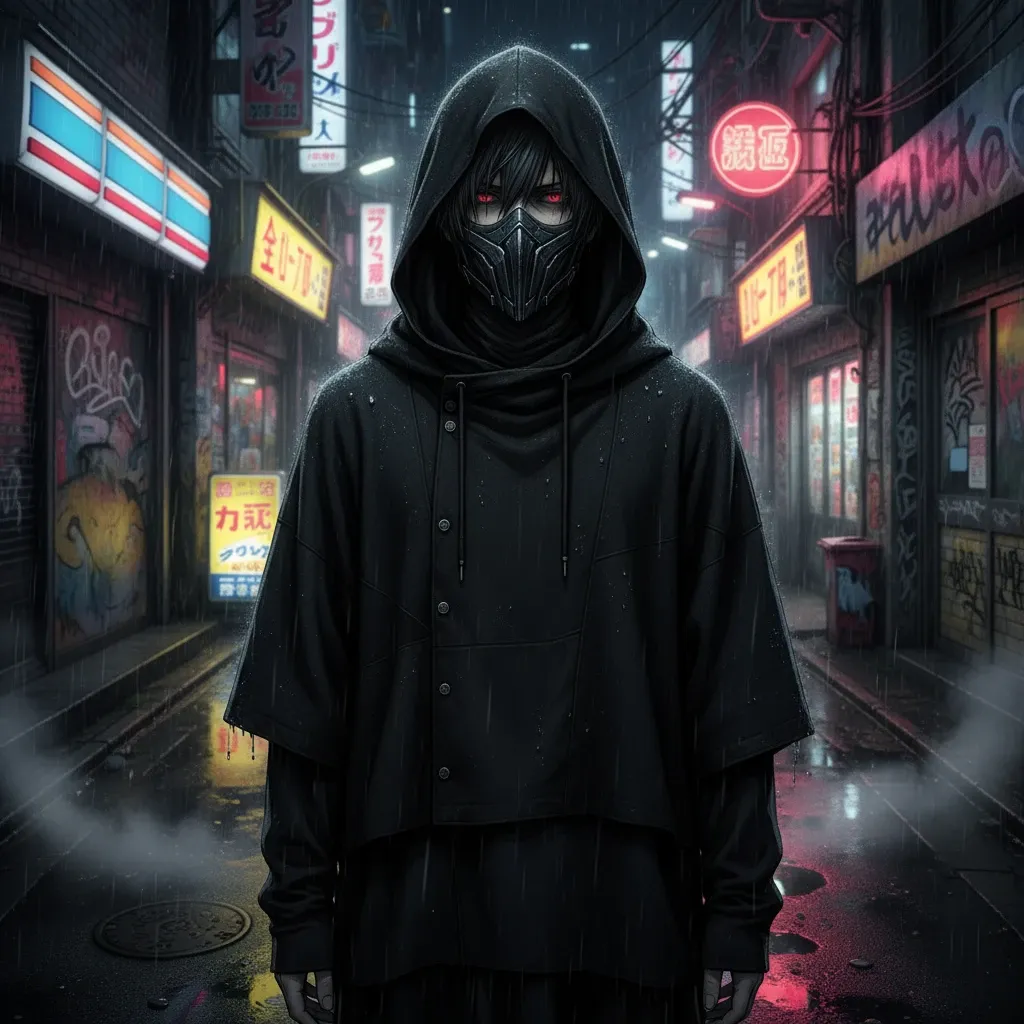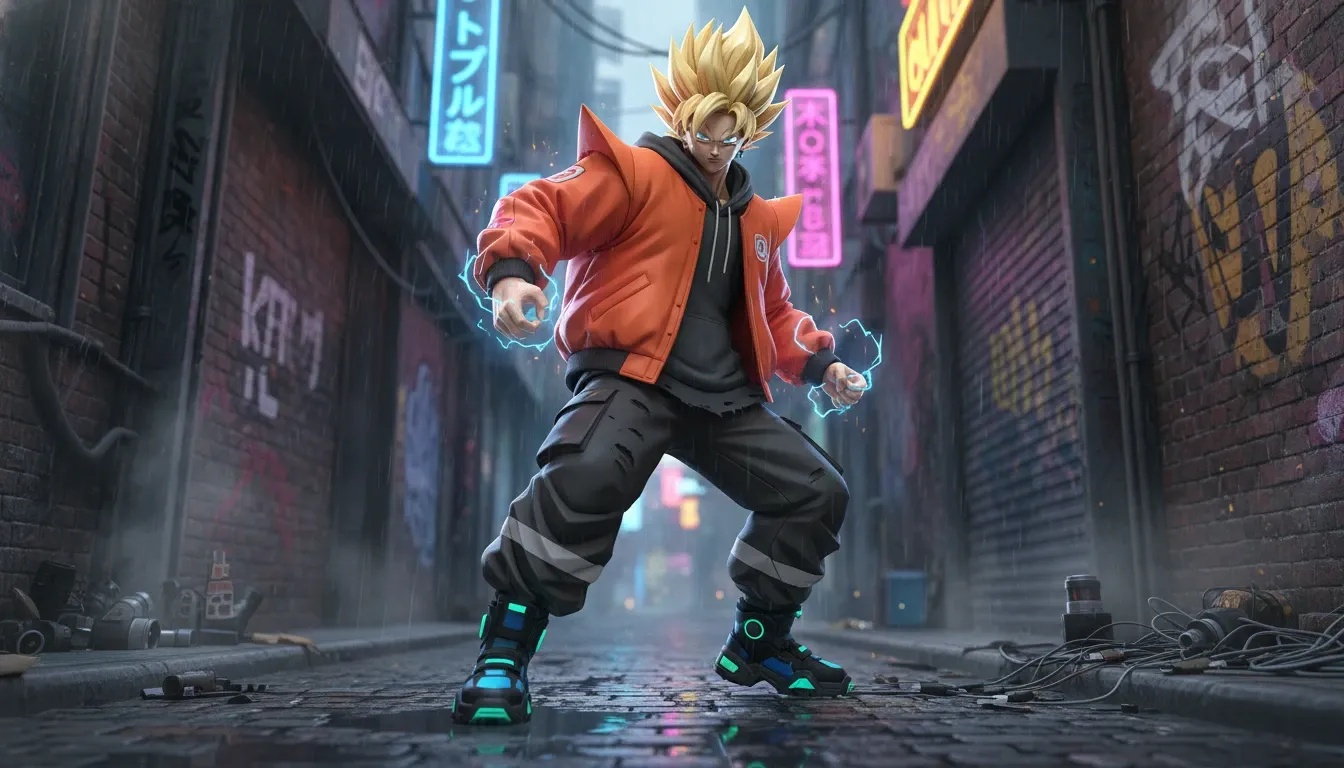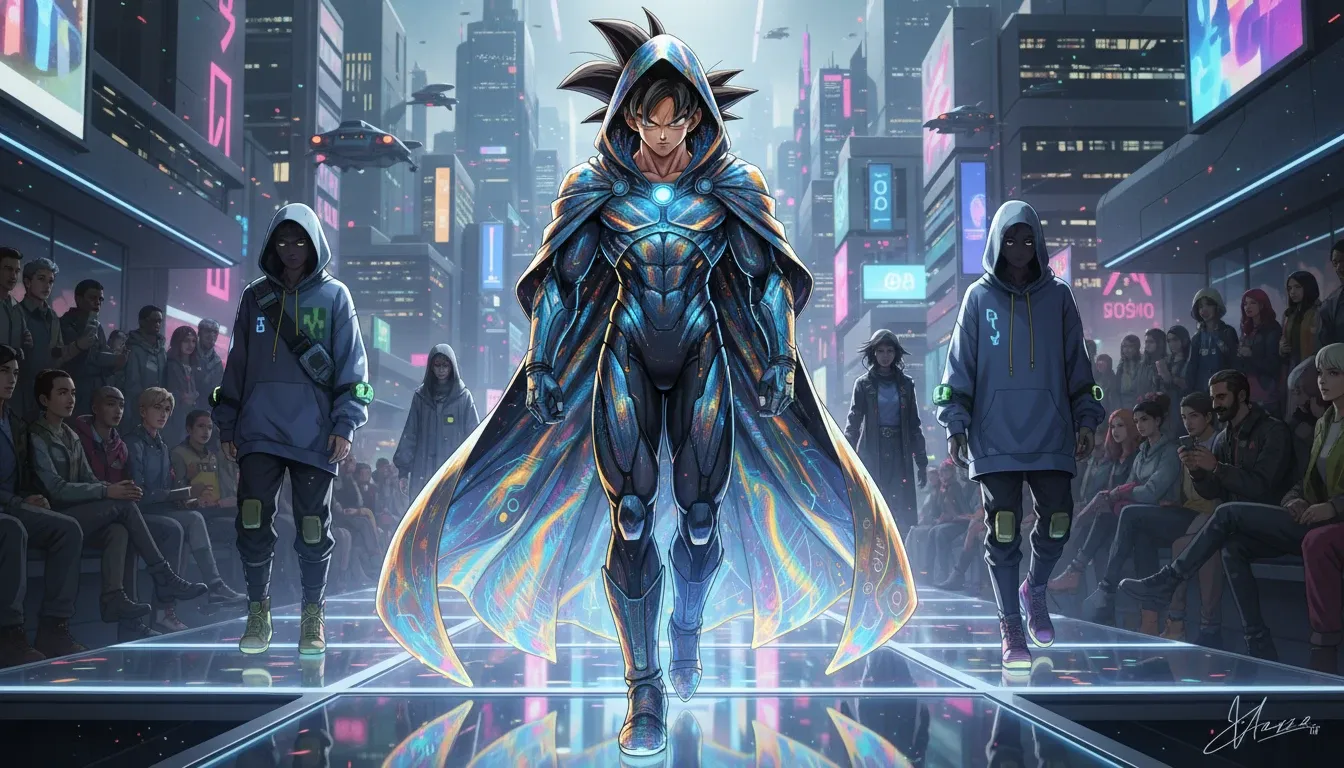
A futuristic Saiyan runway, featuring Goku in sleek, textured armor that flows like energy; light reflects off the fabric, creating a dynamic interplay of shadows and colors. The backdrop includes a modern urban landscape, blending anime aesthetics with realistic details. Streetwear elements like oversized hoodies and innovative materials are present, while the atmosphere feels charged and vibrant. Captivating visual storytelling through fabric textures, showcasing the tactile sensations of the garments, with a hint of chaos from the fast fashion world subtly integrated
Capsule tees made me quit
I left fast fashion on a Tuesday that smelled like hot toner and stale vending‑machine coffee. The kind of day when the ceiling lights hum just loud enough to make your molars feel itchy. I remember my badge lanyard rubbing my neck, slightly damp, as I stood over a table of “drops” that weren’t drops at all—just the same Goku screaming on another blank, another “limited” tee scheduled to hit the site at 11:59 PM so we could brag about selling out by 12:03.
People call it a Dragon Ball streetwear renaissance, but I lived the capsule tee chaos from the inside, and chaos is the right word. Not creative chaos. Spreadsheet chaos. Chaos with Pantone callouts and “distress effect” filters that never actually distressed anything, because distressed printing costs more and the margins were already thin enough to cut you.
I was the designer who had to pretend the third variation of a Kamehameha burst was a concept. My hand would hover over the Wacom pen, and I’d feel this weird dryness in my eyes—like my body knew I was lying before my brain admitted it.
And yes, I still love Goku. That’s the problem. I love him in a way that makes the cheap stuff feel insulting, like printing a prayer on a disposable napkin.
And—this is embarrassing to admit—part of why I quit wasn’t ideology. It was this tiny moment: I caught myself zooming a face to 300% just to make the “rage” read better at thumbnail size, and I thought, wait… when did my job become designing anger for phones? I sat back and my neck cracked. I can still hear it.
I keep thinking the real renaissance begins when you stop printing
The older I get, the more I believe the next wave of anime streetwear won’t be a graphic era. It’ll be a material era. I’m biased because I’m building my second career in sustainable textiles, but I’m also biased because I’ve watched “hype” rot from the inside: you can only shout so many times on cotton before the shout becomes noise.
When I say “futuristic Saiyan runway armor,” I don’t mean cosplay, and I don’t mean plastic shoulder pads sprayed matte white. I mean clothing that behaves like energy—lightweight but structured, quiet but charged, a garment you can feel through your fingertips the way you feel a subwoofer through your ribs.
In the fast fashion office, we talked about storytelling while touching nothing but screens. Now I spend my days rubbing swatches between thumb and forefinger like a nervous habit. Some fabrics squeak. Some fabrics whisper. Some have a cool, mineral chill like river stones. That’s where the renaissance lives: not in another screaming face, but in the sensation of power built into the weave.
There are moments where I want to over-explain this—prove it, quantify it, make it “make sense.” But the truth is simpler and harder to defend: I trust my hands more than I trust a moodboard… and that still feels like a slightly reckless thing to say out loud.
A detail most people never see: the prototype that died in a drawer
One of the last internal “innovation” attempts at my old job was a jacquard knit inspired by Goku’s gi—no prints, just texture, a subtle grid that echoed the chest emblem without actually reproducing it. We called it “Nimbus Knit” as a joke. The sample arrived rolled in brown paper, smelling faintly of machine oil and wet wool. I remember the surface: tiny raised ribs that caught the light like muscle.
It was killed in one meeting because the CFO ran a fingernail over it and said, “Consumers won’t notice.” That sentence lodged in me like a seed. Consumers won’t notice. Translation: if it can’t be seen from six feet away on a phone screen, it doesn’t exist.
I think about that dead prototype whenever someone says anime streetwear is “just merch.” It’s only merch if you keep insisting the body is a billboard instead of a battlefield.
Also—small audit, because I don’t want to sell mythology here: jacquard knits do tend to cost more than basic jersey, not because they’re “fancy,” but because the structure itself is the design. More setup, more constraints, more chances to get it wrong. The CFO wasn’t wrong about risk. That’s what makes the decision sting.
The tee era taught me something ugly about Goku’s face
Here’s my unromantic take: the capsule tee craze wasn’t really about Goku. It was about distribution. We used his image as a battering ram to break into new customer lists, new algorithms, new “communities” that were mostly just checkout funnels with memes.
I still remember the internal debate—small, petty, but revealing—about which Goku expression sold best. Not which scene mattered. Not which arc carried emotional weight. Just: eyes wide or narrow? Teeth visible or not? The winning option was always the one that looked angriest in a 2‑inch thumbnail.
That’s when I started to feel the gap between what Dragon Ball means and what we were selling. Goku’s power isn’t just volume. It’s discipline. It’s repetition. It’s sweat. It’s the quiet choice to get better even when nobody is watching.
Fast fashion is the opposite: it’s screaming for attention, terrified of silence.
And—wait, this is going to sound unrelated, but it isn’t—I keep thinking about gyms at 6 a.m. The fluorescent lights, the rubber smell, that one person moving slowly and seriously in the corner, not filming. That energy is closer to Goku than any “limited drop” countdown timer. I didn’t understand that until I was out.
Side note, because I can’t help myself
I used to stash rejected sample tees in my car trunk. Not to resell. Not even to wear. I kept them like evidence. In summer, the trunk would heat them until the plastisol ink got that soft, rubbery smell—like beach toys left in the sun. I’d open the trunk and think: this is what our “culture” smells like.
Anyway.
My new studio smells like wet fiber, not ambition
Now my days start with a kettle and a bucket. I’m not being poetic; I’m literally soaking yarns. I work with blends that behave like a compromise between apology and insistence: recycled nylon with bio-based elastane, cellulose fibers that drape like a tired flag, algae dyes that never land on the exact shade you asked for. Perfection is rare. Honesty is common.
I’m chasing a specific vision: what would it mean to wear Saiyan strength without wearing a Saiyan illustration?
For me, it means:
- Compression zones that feel like a supportive grip around the torso, like bracing before a sprint.
- Lightweight paneling that moves with you but doesn’t collapse, like armor that learned flexibility.
- Surface irregularities that catch light in a way printing never can—like ki, but quiet.
I want garments that look almost plain until you move. Then the structure shows up. Then the glow happens.
And if I’m being really honest: some mornings I don’t feel “visionary.” I feel tired. My hands smell like wet fiber. My shoulders get stiff from hunching over samples. I still do it, though. That’s… kind of the point, isn’t it?
Another detail outsiders miss: the tiny industry fight over “recycled” nylon
In the sustainable textile world, there’s a low-grade argument that never makes it to marketing decks: some mills push “recycled nylon” that’s basically recycled industrial scrap from their own production line—clean, consistent, and yes, better than virgin, but not the heroic ocean-salvage story people imagine. Designers whisper about it the way chefs whisper about frozen stock.
I’m not saying it’s useless. I’m saying the romance is often a costume. And if we’re talking about Dragon Ball, costumes are exactly what I’m trying to avoid.
Quick accuracy check, since “recycled” gets treated like a magic spell: what I’m describing is commonly called pre-consumer recycled content (factory offcuts, production waste). The other bucket people picture is post-consumer (used fishing nets, old carpets, etc.). Both can be real. Both can be audited. Both can be exaggerated. And the paperwork can be cleaner than the truth—
…which is why I’ve started asking annoying questions and accepting awkward silences as part of the job.
“Runway armor” is not about looking expensive, it’s about refusing disposability
I have a memory of a runway show I visited after quitting. The room was cold, the kind of cold that makes your skin tighten on your arms. A model walked out in something that wasn’t explicitly anime at all—no logos, no references—but the silhouette hit me like Vegeta’s pride: sharp shoulders, a cinched waist, movement that looked engineered.
That was my pivot. I realized the most futuristic anime fashion is the kind that doesn’t need to announce itself.
The tee culture trained us to think references must be explicit. But Dragon Ball is already inside a generation’s posture: the wide stance, the forward lean, the hands that itch to do something dramatic. The clothes can meet the body halfway without plastering a face on it.
Say it out loud: the best Goku-inspired garment might have no Goku on it
This is where my personal bias gets obnoxious, so let me be blunt: I think the next renaissance will be led by designers who are willing to disappoint the comment section.
Because the comment section wants instant recognition. It wants “I get it!” in half a second. But the body doesn’t live in half a second. The body lives in sweat, friction, heat, cold air sneaking under hems, the waistband digging in after lunch, the relief of taking a jacket off.
A futuristic Saiyan piece should earn love over time. It should soften where you touch it most. It should keep its shape where you need it. It should survive.
Fast fashion taught us to treat clothes like snacks. Sustainable design forces you to treat clothes like companions.
And—this is me leaving a little space on purpose—because there’s a part of me that still fears I’m just swapping one kind of purity performance for another. I don’t have a clean answer for that yet.
The renaissance I want is quieter, and that scares the merch machine
I can already hear the objections: “But tees are accessible.” “But runway is elitist.” “But anime is for everyone.” Sure. I’m not trying to gatekeep fandom. I’m trying to rescue it from landfill destiny.
I’m also not pretending my path is pure. I still sell. I still price things. I still have days when I stare at my inventory and feel my stomach tighten like a drawstring. Sustainability doesn’t turn you into a saint. It just makes your compromises louder.
But when I hold a finished sample—matte, structured, surprisingly light—I feel something I never felt approving another capsule graphic: I feel respect. Not for a brand. For the person who will wear it.
And yes, for Goku too. Because the core of him is effort. Not spectacle. Effort you can feel in your shoulders after training, in the way your breath changes when you push.
If the streetwear renaissance stays trapped in tee chaos, it’ll burn bright and vanish like a flash sale banner. If it steps into futuristic Saiyan runway armor—real material innovation, real construction, real longevity—it might finally match the thing we’re borrowing from: a story about growth that doesn’t end when the drop sells out.
One last side note, because my brain always does this
Sometimes I imagine Goku in my studio, not as a model, but as a nuisance. He’d touch everything. He’d stretch the knits. He’d spill dye. He’d ask if he could train in it. And that’s the test I’ve started using.
If a garment can survive that kind of curiosity—messy, physical, alive—then it deserves the name renaissance.
And if it can’t? If it pills instantly, or twists, or gives up the first time life gets rough—then maybe it was never “future” at all. Maybe it was just another loud, temporary costume.
I keep the question hanging there, like fabric on a rack that hasn’t decided what it wants to become yet.