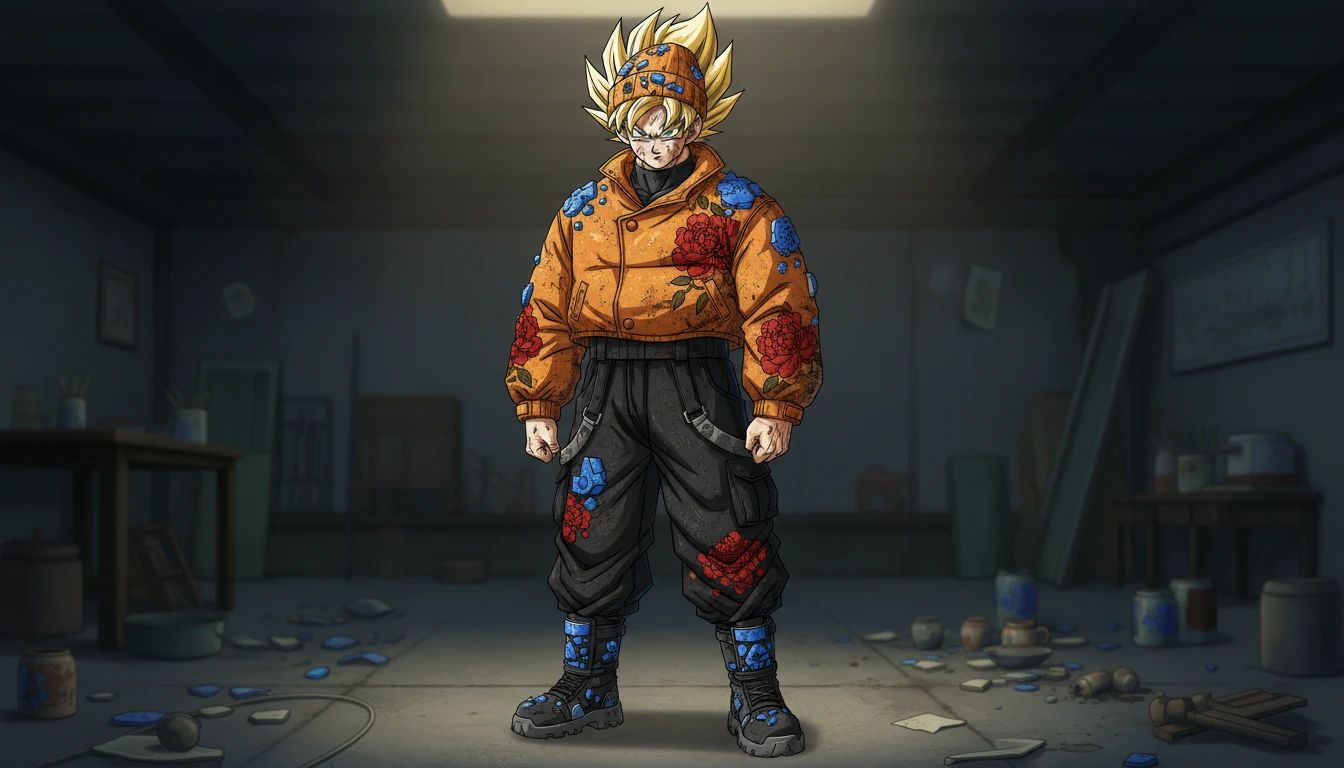
A fusion of Dragon Ball Goku in streetwear, featuring avant-garde layers and bold experimental styling. Visualize a boxy cropped outer layer in a deep river lantern orange, textured like weathered fabric. Accents of cobalt from porcelain shards, layered with rough black kiln grit, and vibrant red enamel peonies. Set in a dimly lit dock studio, shadows dancing over scattered ceramic fragments, evoking a sense of history. The character embodies strength and resilience, wearing an outfit that tells a story, merging fantasy with gritty realism, all under a soft glow that highlights the intricate details
The dock never truly sleeps. Even at three in the morning the river keeps worrying the pilings, a low animal sound, and the wind brings in that mixed breath of diesel, wet rope, and the cold mineral taste of silt. My studio sits where the shipwrights used to stack planks—now it’s my tables, my lamps, my trays of sherds, and a little kettle that stains the air with bitter tea whenever the glue pot starts to cool.
I mend porcelain pulled from the Yangtze’s belly. Not museum-clean things in glass boxes—workaday bowls that once knocked against other bowls, jars that sweated rice wine, plates that felt knives. When the salvage crew hands me a crate, the shards come coated in river mud like bruised skin. I rinse them gently and the water turns the color of old coins. Sometimes the glaze, once it’s clean, catches my lamp and throws a sharp blue-white reflection that feels like a stare. I always pause at that moment. That stare is a timestamp.
Tonight, on the cutting mat beside my scalpel and bamboo brushes, there’s a curve of cobalt underglaze: a half-loop of a dragon’s whisker, the end of a cloud. My hands know the weight of it before my eyes do. Porcelain remembers fingers. It remembers heat. It remembers being set down too hard on a damp deck and vibrating for a second like a bell.
People come to me for restoration, yes, but also for a kind of divination. From a rim thickness, I can tell if it was meant for hot soup or cold tea. From the way soot freckles the foot ring, I can picture where it sat: close to a brazier, away from the captain’s lacquered chest. From a hairline crack that spreads like a river delta, I can guess it was pressed into service beyond its design—maybe someone used a teacup to measure lamp oil when the ship’s gourd ladle split.
That’s how I think about style, too: as use, as pressure, as route. And when you ask me for “Dragon Ball Goku Streetwear Fusion With Avant Garde Layers And Bold Experimental Styling,” you’re asking for a vessel that can survive impact without losing its myth. You’re asking for a body that moves through weather.
Goku is a sun you carry on your back. Streetwear is how you keep warm while you carry it. Avant-garde layering is what you do when the old map tears and the river refuses to be what it used to be. There’s a reason the best looks feel like they’ve been patched in motion: because they have.
In my studio, the fashion begins the moment I start sorting fragments. I lay them in rows like swatches. A broken celadon shoulder, pale as winter cabbage. A red enamel peony that still looks wet. A chunk of blackened kiln grit fused to glaze, rough as sharkskin. My fingertips read them. And I imagine the outfit the same way—by touch first, then silhouette.
Start with the orange: not a costume-orange, not a clean cartoon orange, but the orange of river lanterns seen through fog, the orange of a life jacket that’s been baked by sun and salted by sweat. A cropped outer layer in that tone—boxy, street—like a modern gi translated into a bomber’s language. Under it, a long, off-white base with a hem that drifts unevenly, as if it’s been tugged by wind. The asymmetry matters: on a deck, symmetry is a promise the river never keeps.
Then the blue, but not only in the obvious places. Let it show as binding on a seam that crosses the torso too low, as if the garment is sliding toward the hip. Let it appear in an inner sleeve that peeks out when the arm lifts—like the flash of a blue-and-white shard under mud when you wash it. Make the blues slightly mismatched, deliberately, the way porcelain repairs never perfectly disappear. That tension—between “should match” and “doesn’t”—is the whole story of bold experimental styling.
I’ve learned that the best layers behave like history: they don’t stack neatly, they interrupt. A deconstructed vest that buckles on only one side. A collar that folds wrong on purpose. A skirt-panel over pants that swings like a sail scrap, catching air with every step. Hardware that looks improvised: mismatched rings, toggles that could have come from a net. You want the outfit to sound faintly when it moves—tiny clicks of metal against metal—like my tweezers tapping a shard.
There’s a detail I’ve never heard anyone else talk about, because you only learn it after nights of cursing at broken things: certain river-recovered porcelains, after you dry them, will “weep” again hours later. The moisture doesn’t show at first. It rises slowly from the body clay, finds the old crack network, and beads along the fracture lines like sweat along a scar. If you glue too early, your adhesive turns cloudy, your seam goes brittle. So I wait. I always wait. I set the sherds under the lamp and watch for the smallest shine.
That’s what I want from an avant-garde Goku fusion: patience engineered into the look. Fabrics that breathe, panels that can flex, closures that can be opened mid-journey. A jacket that looks aggressive but has a hidden gusset so the shoulder can throw a punch without tearing. A hood that can be tucked away when you enter a temple-like interior. Streetwear as survival, not as slogan.
Another thing outsiders don’t know: I keep a jar of river water from a specific bend upstream, where silt is finer and the current turns lazy. When a piece is too clean—when it starts to look like it never suffered—I rub a trace of that silt into the repaired seam before sealing. Not to fake age, but to keep the object honest. Under daylight, the seam reads as a line of weather, not a mistake.
In clothing, honesty is in the abrasion points. The cuffs that darken first. The pocket edge that frays under the thumb. The knee that remembers kneeling. Bold styling isn’t neon for its own sake; it’s controlled damage. It’s letting a raw edge exist where it wants to exist, then reinforcing it so it doesn’t die.
Sometimes, standing over my bench, I think of the ship as a wardrobe trunk that sank. Not everything was meant to be precious. Some things were meant to be replaced. But when I restore them, I’m not only saving an object; I’m saving a choice: someone chose to carry that bowl on that route, at that time, through that weather.
And here is the asymmetry you asked for—the kind that isn’t visible on the surface unless you live inside it.
There was a year when the last small kiln-supply shop in our district closed. Not a big factory, just a narrow room that smelled of clay dust and burnt cardboard, where the old man kept mica, bone ash, tiny packets of pigment, the odd screws and brass tubes I use to repair tools. When he locked the shutters for the final time, it felt like a rib pulled out of the city. I stood there with my hands in my pockets, listening to the padlock click, realizing some repairs would become impossible not because I lacked skill, but because the system that fed the skill had starved.
That night I went back to the studio and looked at my shelves: half-finished restorations waiting for one last powdered ingredient, one last specific brush. For a few hours I considered quitting the way people quit quietly—finishing what I had, then letting the work fade. But the river doesn’t negotiate with your fatigue. The salvage keeps coming. The shards don’t care about your mood. So I made a choice that still makes my jaw ache when I think about it: I began cannibalizing my own tools. I ground down old tungsten tips to make micro-spatulas. I cut and re-soldered brass, breathing in the metallic sting. I used a jeweler’s saw on a broken compass housing just to get a ring small enough to clamp a crack.
That’s avant-garde layering in its truest form: not adding, but adapting. Taking what should be “finished” and making it work again, differently.
Another time, a collector came in and asked why I don’t “erase” the repairs, why I leave a line, why I let the seam speak. He said, bluntly, that my insistence on visible mending made the pieces “less valuable.” He was questioning the meaning I’ve built my life around, the way a storm questions a boat.
I didn’t argue. I just poured him tea. The cup was one I had repaired myself—white glaze, a thin gold seam, warm under the palm. He drank, paused, and his eyes flicked to the line. He had noticed. He couldn’t help noticing. Because the seam is where the body goes first. It’s where your mouth meets history.
When the old system collapses—when the last parts shop closes, when the market sneers at your ethics—you either chase invisibility or you deepen your signature. I chose to deepen.
So the styling I imagine isn’t a clean cosplay; it’s an identity that survived water. Goku’s iconography as a repaired myth: an orange shell that’s been re-cut and re-stitched, an inner architecture of straps that looks like martial wraps but functions like rigging. Bold experimental elements that aren’t decorative, but structural: a diagonal harness that distributes weight, a pocket system that sits where your hands naturally reach in panic, a layered skirt-panel that hides a utilitarian loop. Avant-garde not as “weird,” but as “necessary.”
If you stood on that old deck, you’d hear the river slap and the ceramics clink as the ship rolls. You’d smell tar and rice steam. You’d feel damp boards under your soles. The people would be ordinary—tired, hungry, laughing too loudly to scare the darkness away. Someone would tug their jacket tighter and look toward the shore lights like they were looking toward a future that might not hold.
That’s the feeling I want the outfit to carry: the weight of a story without the stiffness of a museum.
When I finish a restoration, I don’t polish it into silence. I set it on the bench and tap it lightly with my fingernail. A good piece gives a clear, bright note. A repaired piece gives a slightly different one—still clear, but with a second tone hiding underneath, like a harmony you only hear if you listen for it.
Streetwear fused with Goku and layered with avant-garde should sound like that when you walk: confidence with an undertone of survived impact. A body moving forward with the river’s cold on its skin, but not owned by it.
Outside, the dock crane groans in its sleep. Inside, my lamp makes a small sun over the shards. I touch the cobalt dragon whisker again, and for a second I can see it: not just the bowl, not just the ship, but a whole route, a whole life on planks, condensed into a curve of glaze.
Every piece I mend is a frozen shipping history with a name. Every outfit worth wearing should be the same: a route you can feel, a story you can sweat through, a seam that doesn’t apologize for existing.