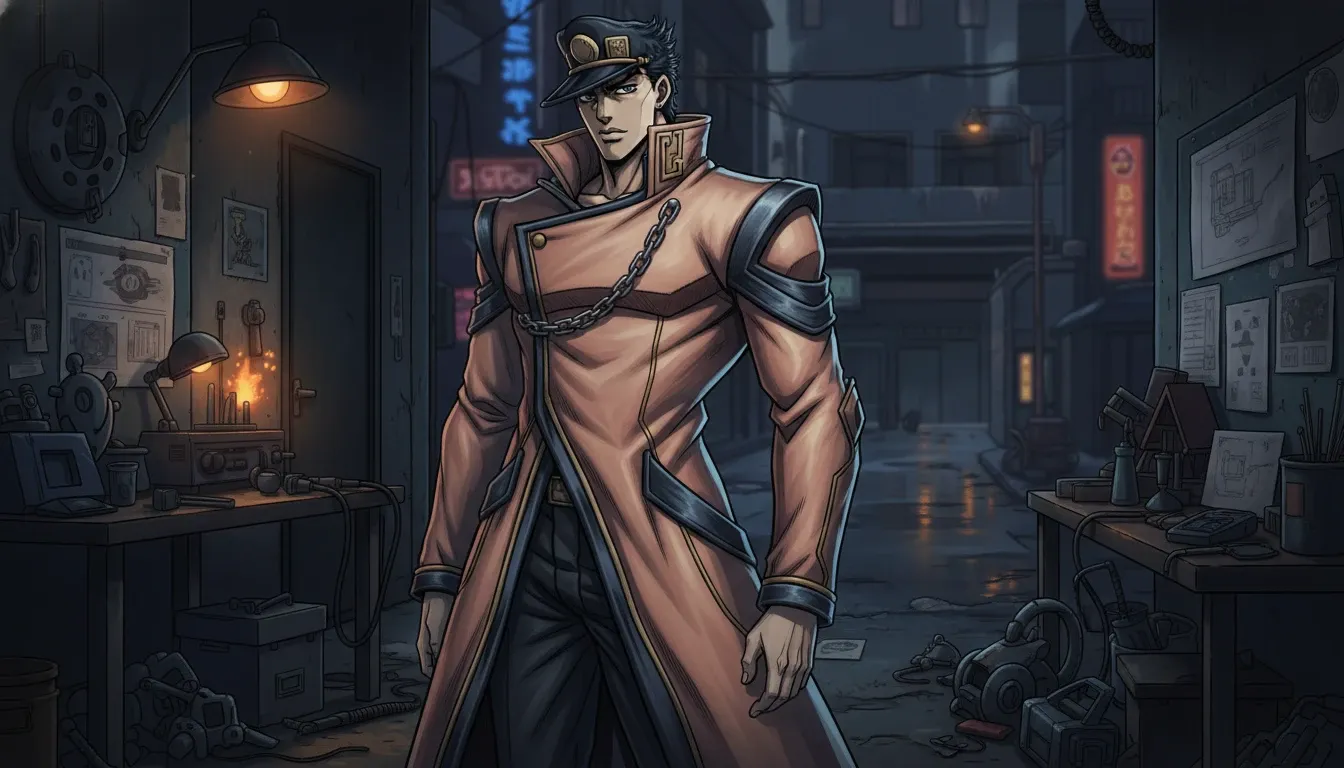
A dimly lit urban alley, blending streetwear and avant-garde fashion. Shinichi Kudo in a sharp, asymmetric jacket made of technical nylon and matte wool. The jacket features a detachable half-lapel with hidden magnets, a lining printed with Tokyo's alley grid. Plywood runway under LED lights, textured with chalk lines. Moody shadows and warm highlights create a dramatic atmosphere. The setting reflects the tension between concealment and revelation, embodying the essence of a detective
I make my living resurrecting inventions that were never meant to survive daylight.
In the alley where my studio hides, the air always tastes faintly of scorched lacquer and wet cotton, as if a thunderstorm once got trapped in a drawer and keeps breathing. My neighbors think I build props. They’re not wrong. But the props I love most were born in patent offices: portable cloud-making machines, cat pianos, self-stirring teacups that never learned rhythm. Designs that look like jokes until you hold their weight and realize somebody once believed hard enough to file paperwork.
Tonight, my workbench is a runway.
Not a clean, white, antiseptic runway—the kind that smells like expensive perfume and fear—but the version I can afford: plywood slicked with resin, chalk lines, a strip of LED tape that buzzes like a mosquito. On it, I’m staging a fusion that shouldn’t make sense: Detective Conan’s Shinichi Kudo as streetwear, but cut with avant-garde runway logic—silhouettes that interrupt themselves, hems that behave like alibis, a collar that lies, beautifully, until you tug the right seam.
I keep the reference on the wall: a boy’s certainty in a blue blazer, the clean geometry of a tie, the neatness of a mind that wants the world to confess. But I’m not chasing cosplay. I’m chasing what I can’t unsee: the tension between “I look ordinary” and “I know too much.”
Streetwear understands concealment. You can hide in a hoodie the way a witness hides in a crowd. Avant-garde understands revelation—how to slice fabric so the body becomes evidence. Shinichi sits exactly between those instincts: sharp enough to cut, practiced enough to pass.
So I build him the way I build my “failed” inventions: by translating paper fantasies into objects that bruise my fingertips.
A jacket comes first. Not the blazer, not literally. I draft something with the clean, confident shoulder line of his silhouette, then sabotage it. One side sits higher, like a raised eyebrow; the other drapes heavier, like the moment after a clue lands and your stomach goes cold. I use technical nylon that whispers when it moves, and a strip of matte wool that drinks light. If you run your palm along the seam, you feel the change in temperature—slick synthetic to warm fiber—like switching from a public face to a private thought.
The lining is my favorite lie. I print it with a map of Tokyo’s alley grids in a tone so close to the base color it reads as blank unless you stand under the right angle of light. It’s the kind of detail that rewards patience. The kind of detail I’m addicted to, because patience is what separates a prank from a proof.
On the runway side of the fusion, I let the jacket do a trick: a detachable half-lapel that clips and unclips with magnets disguised as buttons. When it’s on, the piece looks disciplined, almost academic. When it’s off, the neckline collapses into an off-kilter cowl, like someone’s life got rearranged in a second. Streetwear loves modularity. Runway loves transformation. Shinichi loves the moment the scene changes.
The pants follow—cargo, yes, but with a surgical pleat that runs diagonally, refusing symmetry the way a case refuses closure. I stash pockets where people don’t expect them: one behind the knee, one inside the waistband, one hidden in a fold that looks purely decorative until you slide two fingers in and find space. The fabric smells faintly of metal from the dye bath. It stains my nails a smoky gray. I like that. I like proof that something happened.
I build accessories the way other designers build mythology.
A tie, but cut from webbing and edged with reflective piping so it flashes like a camera bulb when a passing car hits it. A sneaker with an exaggerated tongue that folds over like a sealed envelope, with laces that thread through asymmetric loops—an intentional inconvenience, because obsession is inconvenient. Gloves that stop at the knuckles, leaving fingertips bare for prints, for texture, for the truth.
And then there’s the object that never leaves my pocket: an old, dented brass micrometer, the kind machinists used before cheap digital calipers flooded the world. Outsiders assume it’s a talisman. It is, but it’s also a weapon against sloppy thinking. The micrometer’s wheel is worn smooth where my thumb has worried it for years; the metal carries a faint smell of skin and oil. I found it in a closed factory auction, wrapped in a rag that still held grit like pepper. The seller didn’t know why it mattered. I did.
That micrometer once belonged to a patent model-maker named Hasegawa, a name you won’t find in fashion magazines and barely in archives unless you sit for hours with old municipal records and ask the right retired clerks the right questions. He specialized in building demonstration prototypes—objects that only needed to live long enough to convince an examiner. His last logged project, according to a brittle invoice I had to photograph in a room that smelled of mold and ink, was a “portable weather simulation device” from 1978. A cloud machine, yes, but one designed to be carried like a briefcase. It never went into production. It never needed to. It only needed to look possible.
When I twist that micrometer, I remember that. Possibility has a sound: a faint, dry tick as the spindle closes.
The Shinichi fusion outfit gets its “impossible” from the same place.
On the runway, “avant-garde” is often shorthand for alienation. But I want intimacy. I want garments that feel like being watched and understood at the same time. I want the audience—real or imagined—to feel the pressure of a gaze on the back of their neck, and also the comfort of a well-placed pocket.
I test the pieces the way I test my reconstructed patent absurdities: by wearing them while I build something else. My studio is a forest of half-finished miracles. A cat piano that purrs when a paw lands on a key (it took me three weeks to get the sensor sensitivity right). A collapsible “pocket greenhouse” that fogs up like a cheap confession. A hat-mounted umbrella that actually works, but makes you look like a moving punchline.
There is, under the steel table, a crate I never show visitors. Not because it’s embarrassing—failure isn’t embarrassing to me—but because the failures are… loud in their own way. The crate is labeled with a misprinted shipping sticker: “CERAMIC FASTENERS,” a lie that has saved me from casual curiosity. Inside are prototypes that came too close to working. Too close is worse than not at all. A cloud-briefcase that once made a room smell like wet stone for days. A “silent” self-winding metronome that learned to throb audibly at night. A glove with embedded graphite that left fingerprints where there should’ve been none. I keep them sealed like evidence you can’t submit, because submitting it would change the case.
Some nights, when the alley is quiet enough that I can hear my own joints pop as I bend, I play a recording I’ve never told anyone exists.
It’s stored on a microcassette—ancient, stubborn, like a secret that refuses modern formats. I had to hunt down a working player from a collector who wouldn’t meet in daylight. The tape holds three minutes of a man’s voice, rough with age, talking about “clarity” and “misdirection” as if he’s describing fabric, not machinery. He doesn’t say his name. But he mentions a micrometer—“my brass one, the one with the nick at zero”—and laughs once, softly, like he’s surprised he can still laugh.
How did I get it? That’s the part that cost time. It came tucked inside the false bottom of a wooden toolbox I bought because the hinges were beautiful. The toolbox smelled of camphor and cigarette ash. The false bottom was held in place by a screw so old the slot had almost rounded. When I lifted it, the tape sat there like a tooth.
I listened in the dark, sitting on the studio floor, knees pulled up, the player warm against my thigh. The voice said: “A convincing illusion is a kind of kindness. It lets people approach what frightens them.” Then the tape clicked and ended.
That line is stitched into the inside of the jacket, in thread the color of dried blood. Not readable unless you’re looking for it. Not readable unless you’re close enough to touch.
That’s my Shinichi: kindness disguised as precision. The urge to solve, not to humiliate. The clean lines hiding a mind that never stops replaying evidence.
When I finally place the full look on my mannequin, it feels like the moment before a reveal. The studio lights hit the reflective piping and the hidden map glints like a secret sidewalk. The nylon crackles softly when I adjust the shoulder. The wool panel holds onto warmth. The magnets click—small, decisive, like a lock turning.
I stand back and try to see it the way an outsider would.
Streetwear people will notice the utility first: the pockets, the adjustable straps, the modular lapel, the sense that the outfit can survive a city. Runway people will notice the silhouette: the imbalance, the deliberate interruption, the refusal to be neat. Detective Conan people—if they’re truly paying attention—will feel something else: the way the look carries a double life without announcing it.
Because that’s what I’m always making, whether it’s a cat piano or a cloud in a suitcase or a Shinichi Kudo streetwear fusion with avant-garde runway spine.
I’m making evidence you can wear.
And I know, in my bones, how it feels to be a “failed” design on paper—how it feels to be dismissed as absurd before anyone bothers to build you properly.
In the alley, a scooter passes and its exhaust drifts in through the cracked window, bitter and sweet. I taste it and think of rain. I think of ink. I think of a boy detective whose life is an asymmetry forced onto him, and who still insists on tailoring meaning from chaos.
I switch off the LED strip. The mannequin becomes a silhouette, a suspect in the dark.
Under the table, the crate stays closed. In my pocket, the micrometer presses a small circle into my palm. Somewhere in the fibers of a jacket, a sentence waits like a hidden recording: a convincing illusion is a kind of kindness.
Tomorrow, if someone asks what I do in here, I’ll tell them I make clothes.
If they’re patient enough to look closer, they’ll realize I’m doing what I’ve always done—dragging beautiful, ridiculous blueprints into the world, until they have weight, and texture, and a heartbeat you can hear if you put your ear to the seam.