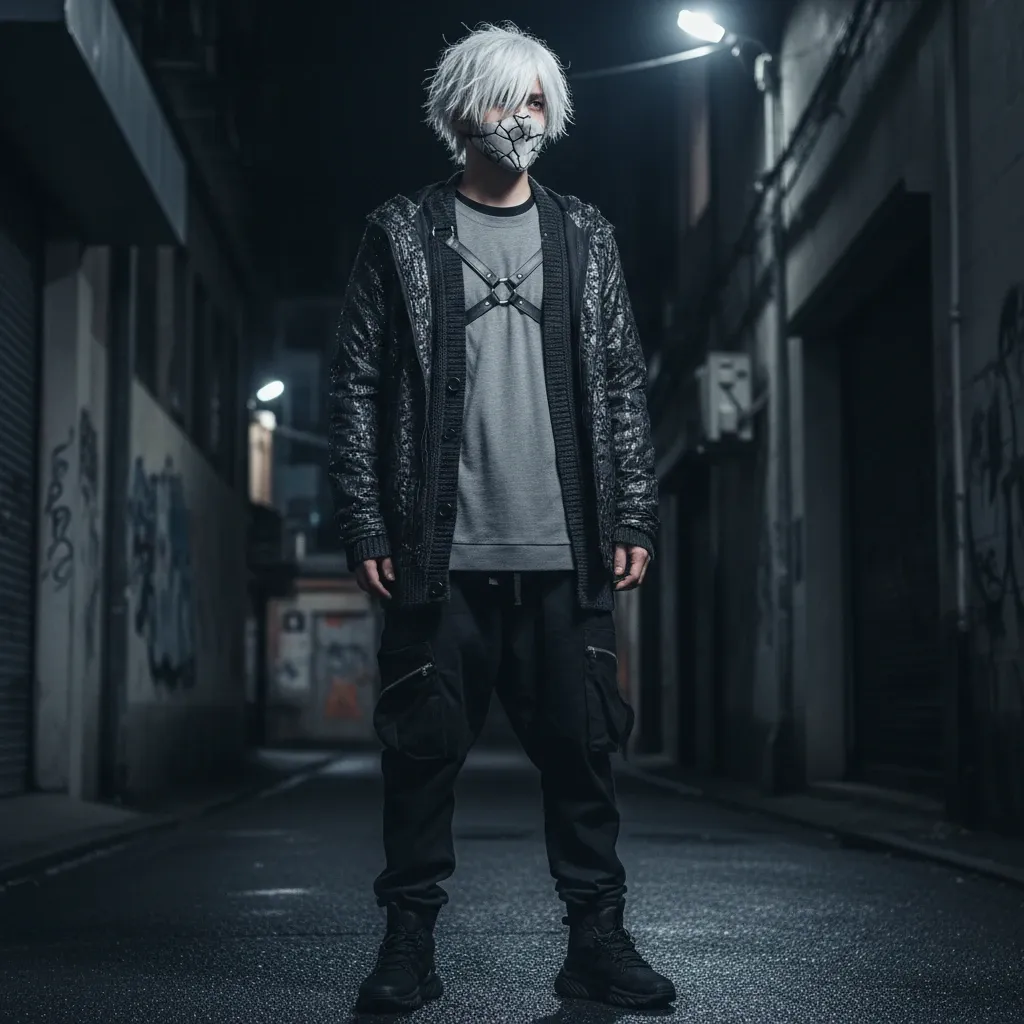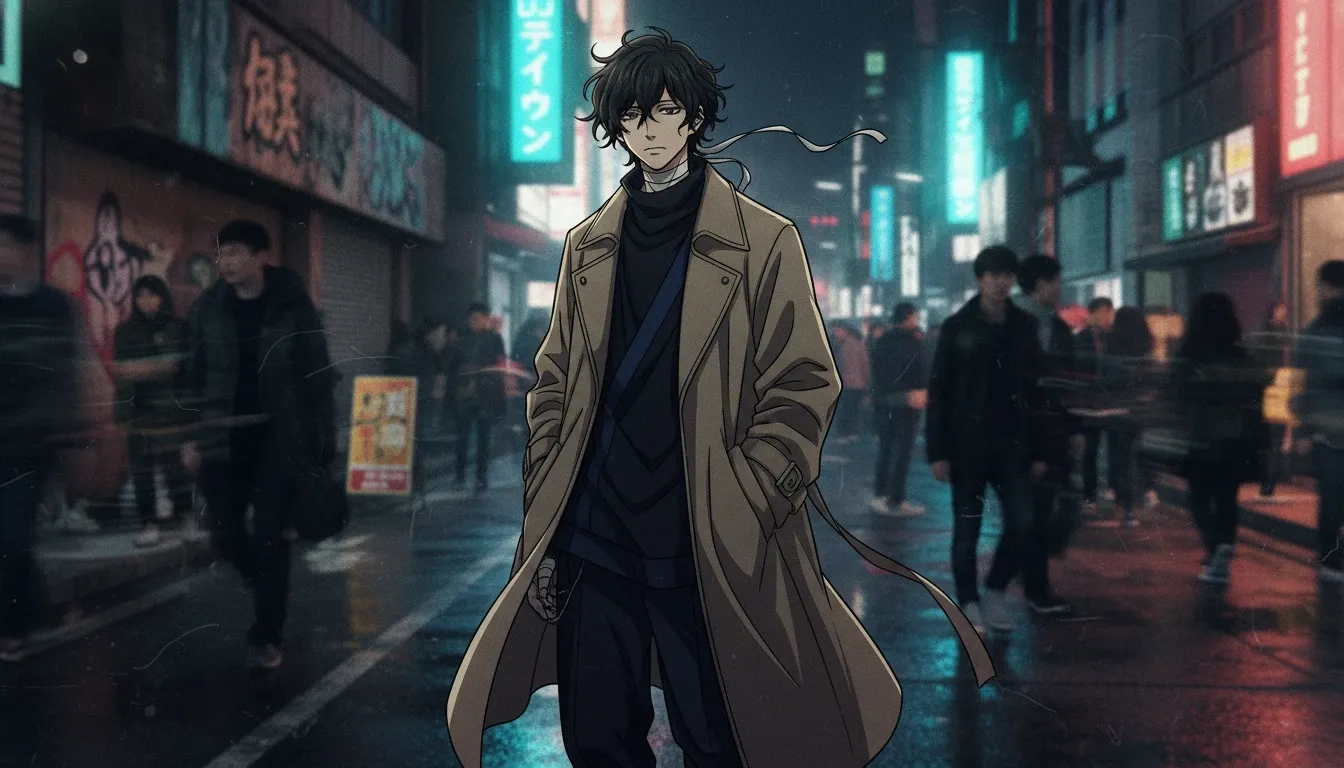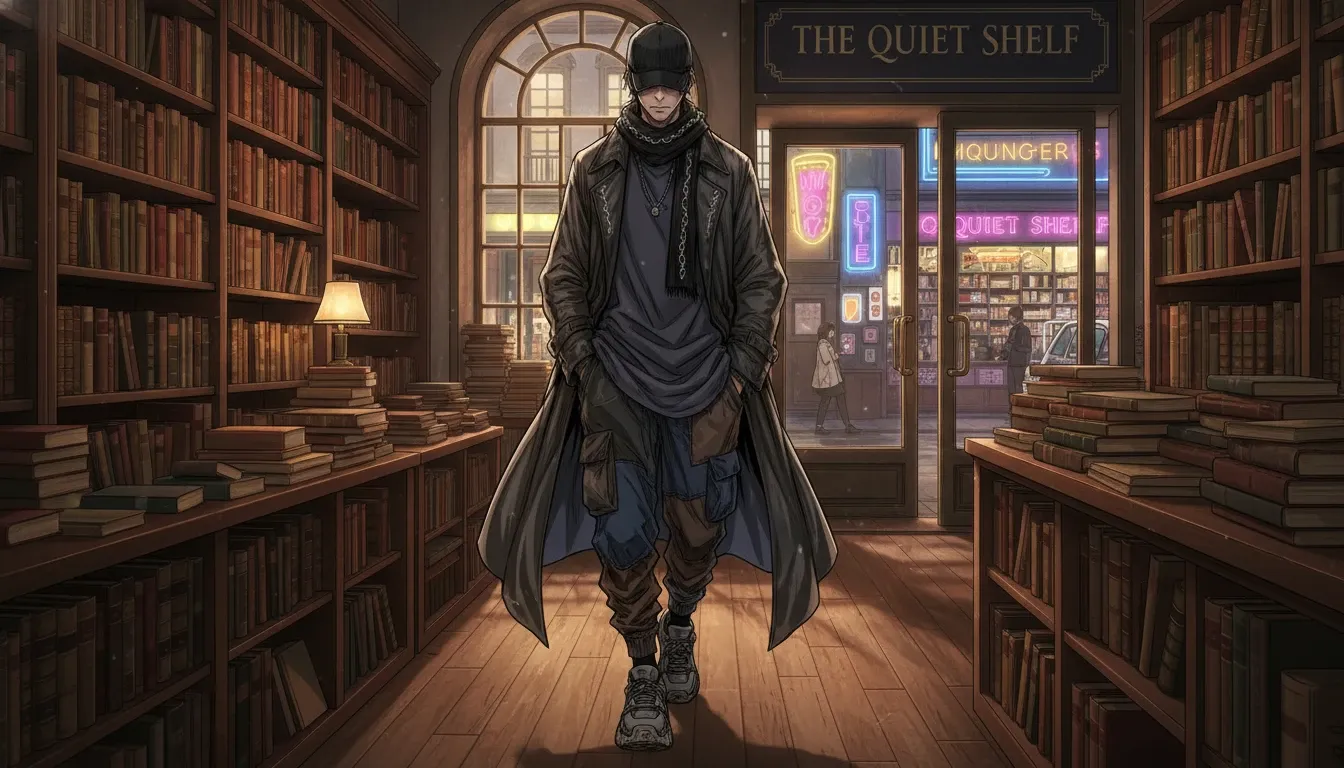
A stylish Dazai Osamu in urban streetwear, layered with avant-garde textures, strolls through a dimly lit, nostalgic bookstore. The scene captures a blend of anime and realism, with warm light casting shadows on vintage book spines. His oversized tee drapes loosely, sneakers show signs of wear, and a cap obscures his eyes. Surrounding him, the shop's rustic charm contrasts with the trendy influencer bookstore next door, where bright colors and curated coffee vibes clash with Dazai's casual, introspective demeanor
The Glass Next Door Never Sleeps, But My Shelves Do
Ten years is long enough for paper to change its smell. On damp mornings my shop breathes out a mix of yellowed glue, peppery dust, and that faint vanilla note you only get from cheap mid‑century pulp. My wrists already feel a little tacky from wiping the counter—funny how “old books” is supposedly romantic, but a lot of it is just residue.
Next door, the influencer bookstore—let me call it that without pretending I’m neutral—pumps out espresso steam and curated playlists like a machine that’s learned how to flirt. Last week I heard a barista say, “No, stand here, the light makes your tote look richer.” I don’t know why that line stuck to me, but it did. It landed like a coin in a tip jar: casual, practiced, worth something.
I’ve watched their line form the way pigeons gather around a dropped croissant. People pose with tote bags that look pre-wrinkled. They take photos of spines they’ll never crack. And I, behind my narrow counter, keep wiping fingerprints off the same glass case where I store the fragile stuff: oddball poetry, outlawed prints, manga volumes with sun-faded covers that used to travel in backpacks.
Some days I resent them. Other days I’m grateful they keep the street bright and loud so my dim little cave can feel like a choice.
Tonight, I’m thinking about Bungo Stray Dogs—specifically Dazai Osamu—because someone left a copy open on my windowsill this afternoon like an offering. The page corners were curled from being carried barehanded, no sleeve, no protection. That’s the kind of carelessness I secretly respect.
Or maybe “respect” is too clean a word. Maybe it’s envy. I don’t know—let’s leave that there.
Dazai Walks Like He’s Borrowing the City
I know the character. Everyone does, if they’ve been online for more than five minutes. But I don’t meet him in the anime glow or the edits with glittering captions. I meet him the way my shop meets anyone: through the residue they leave behind.
Dazai, as he exists in my head, doesn’t “enter a scene.” He slips into it like a draft under a door. His charm is always a little late, like a cigarette lit after you’ve already promised yourself you quit. He wears jokes like bandages—thin, practiced, and not actually stopping the bleeding.
And streetwear—real streetwear, not the “clean boy” showroom version—has the same habit. Oversized tees that hang like tired curtains. Sneakers scuffed on the toe because the city keeps asking you to stop short. Caps pulled low, not for style, but because you don’t want eye contact today.
When I imagine Dazai Osamu meets casual streetwear, I don’t see a perfect fit pic. I see a man using fabric as misdirection.
The Layers Are Not Fashion, They Are Evasion
Avant garde layering is usually sold as bravery: asymmetry, unexpected drape, cloth that refuses to behave. But I’ve handled enough old garments from estate cleanouts—coats that still carry the sour-sweet smell of mothballs and cologne—to know layering has another purpose: hiding.
People layer when they don’t want their outline to be readable.
Dazai would understand that instinct immediately. He’s a character built from the refusal to be pinned down. Put him in a long black coat and he becomes a silhouette. Put him in a soft hoodie under an angular, deconstructed vest and he becomes a question mark.
And I’m going to be blunt—maybe unfairly blunt: most people who imitate avant garde layers are chasing the aura of complexity without paying the cost. The cost is discomfort. The cost is carrying the weight of extra fabric when the subway is already a furnace, when rain turns hems into wet ropes. The cost is being stared at, not admired, but evaluated.
Dazai wouldn’t dress like that to be admired. He’d dress like that to stay unreadable.
…and that’s the part that makes me pause, actually. Because “unreadable” sounds stylish until you remember it can also mean “untouched.” And “untouched” is just loneliness with better lighting.
A Detail I Learned the Hard Way, Not From Any Trend Report
Here’s one of those small industry truths you only learn if you’ve spent years on the street, watching what actually sells and what only photographs well: a lot of “layering pieces” were designed for studio lighting, not daylight.
There’s a particular class of matte black dyes and finishes (often used because it looks deep on camera) that can shift under harsh sun toward a slightly greenish cast. I’ve watched people walk out next door looking like a sleek shadow, then cross into my doorway and suddenly their outfit blooms into swamp tones.
Is it always the dye? Sometimes it’s the fabric blend, sometimes it’s cheap finishing, sometimes it’s just brutal noon light telling the truth. But the effect is real.
I don’t say anything. I let them discover it. Cities teach with embarrassment.
Urban Dreamwalk Is Not Escapism, It’s Rehearsal
People talk about “dreamy” city vibes like it’s an aesthetic filter: neon reflections, late-night convenience stores, rain on asphalt. But when I hear urban dreamwalk, I think of how it feels at 2:17 a.m. when you lock up and the street is still awake—only now it’s awake in fragments.
A bus sighs at an empty stop.
A delivery bike rattles over a metal grate.
The air smells like fryer oil and wet concrete.
Somewhere a club door opens and bass spills out like hot breath.
That’s a dreamwalk. Not because it’s pretty, but because it’s slightly unreal—like the city is practicing being itself for tomorrow.
Dazai belongs in that rehearsal space. He’s not a daylight hero. He’s a night figure: ironic, slippery, and too aware of the performance everyone else thinks they’re naturally born into.
If you dress him in casual streetwear and avant garde layers, he doesn’t become “cool.” He becomes accurate.
An Unpopular Opinion From Behind My Counter
I think the influencer bookstore next door misunderstands what makes characters like Dazai stick. They sell the look of melancholy: black coffee, gray hoodies, a quote printed on a postcard. But melancholy isn’t a poster. It’s a habit of attention.
Dazai’s attention is predatory in a quiet way. He notices what people try to hide. He notices how they present themselves and where the presentation cracks. That’s why layering suits him: layers create seams, and seams are where truth leaks out.
…And yeah, writing that sentence makes my neck tighten a little, like I’m accusing people of something. Maybe I am. Maybe I’m accusing myself, too.
Off Topic: I Keep a Failed Display Mockup Under My Counter
Say something off topic—I will, because my brain does that when it gets tired.
Under my counter there’s a warped piece of foam board from a display idea I tried in year three. I wanted to compete with the bookstore next door when they started doing “aesthetic tables.” I made a theme: night city literature. I stacked noir paperbacks, taped a cheap LED strip under the shelf, even sprayed the board with a “rainy street” gloss.
It looked terrible. Not charming-terrible. Just sad. The LED strip overheated and left a melted scar, like a burn mark on plastic skin. Customers didn’t browse; they winced.
I keep it because it reminds me: I cannot out-curate them. I can only out-last them.
And Dazai—whatever else he is—has that same stubborn talent for lasting through the wrong kinds of attention.
The Cold Little Controversy No One Mentions at Photo Time
There’s a minor argument that pops up among the few collectors who still care about objects more than posts: whether modern reprints of certain manga volumes use paper that’s too smooth, too white, too “clean,” stripping away the grit that matched the story’s mood.
This part is real, but it’s also messy. It’s not a single conspiracy, it’s a pile of boring reasons: different mills, different coatings, cost, availability, environmental standards, print schedules. Still—when publishers move to smoother, brighter stocks, you can feel the personality shift in your fingertips.
Old volumes have tooth. Your thumb catches slightly on the fibers when you turn a page. New volumes can feel like brochures—slick, efficient, forgettable.
Why am I bringing this up? Because streetwear and avant garde fashion have the same split. There’s clothing with texture that carries time—stitching that raises a ridge, fabric that pills at stress points, denim that creaks faintly when you move. And there’s clothing that’s engineered to be photographed: smooth, sterile, never resisting the hand.
Dazai in sterile fabric would be a lie. He needs something that shows wear, even if the wear is curated. The city, at minimum, should be allowed to leave fingerprints.
The Dreamwalk Happens Between Two Kinds of Light
I’m always watching light. My shop depends on it. The front window gets a gray wash in winter afternoons; the dust motes look like slow snow. Next door, their warm bulbs make everyone’s skin look like it’s permanently on vacation.
When I picture Dazai stepping out into an urban dreamwalk, I picture him moving between those two lights—my honest gray and their flattering amber. Casual streetwear gives him the ability to vanish into crowds. Avant garde layers give him the ability to look like he meant to vanish.
And here is my personal, biased thesis, the one I’m not even sure I’m mature enough to defend: Dazai is not a style icon; he is a walking excuse. People dress him up—literally and imaginatively—because they want permission to be messy without being dismissed. They want to wear darkness without having to explain it. They want the city to feel like a dream so they don’t have to call it loneliness.
I get it. I sell books. I sell other people’s words as ladders out of their own heads.
…Sometimes I wonder if I’m selling ladders, or just nicer wallpaper for the same room. That thought usually arrives right when I’m counting the day’s cash, which feels like the universe having a sense of humor.
Another Off Topic: The One Customer Who Never Took Photos
There was a regular—mid-thirties, always smelled faintly of machine oil—who came in once a month and bought whatever looked “sad but clever.” He never took photos. He never asked for recommendations with that hungry influencer tone. He just ran his finger along the spines like he was checking for a pulse.
One night he bought a battered literary magazine and, tucked inside, I found a receipt from the influencer bookstore next door. He’d been there too. He just didn’t want to be seen wanting.
That’s urban dreamwalk. That’s Dazai energy. That’s layering, in the end: hiding desire under structure.
I Close the Door, But the Street Keeps Editing Itself
When I pull down the shutter, the metal slats rattle like old teeth. The influencer bookstore is still open, still glowing, still selling an idea of the city that comes pre-framed. I don’t hate them. I hate what they make easy.
In my shop, nothing is easy. Books are heavy. Dust is real. The silence has a weight you can feel in your jaw.
So when I hear “Dazai Osamu meets casual streetwear and avant garde layers in urban dreamwalk,” I don’t hear a merch tagline. I hear a man stepping out of a story and into the part of the city that doesn’t care if you’re trending. I see him in a hoodie softened by too many washes, a long draped outer layer that catches wind like a slow flag, trousers with pockets deep enough to hide a hand, a secret, a plan.
And I see him walking past my window without looking in—because he already knows what’s inside: the unglamorous record of people trying to survive themselves.
I turn off the lights. The paper smell thickens in the dark. Outside, the city keeps moving, half dream, half rehearsal.
If Dazai is anywhere, he’s there—between the glow and the grit—wearing layers not to show off, but to keep the world from touching the soft parts.
Or maybe that’s just what I tell myself, because it’s easier than admitting I do the same thing with dust and silence and “taste.”
The street keeps going. Tomorrow the line next door will form again. And my shelves—stubborn, sleeping, patient—will wait to be chosen.